What It Really Means When an Outlet Is Installed “Upside Down” (Ground-Up vs. Ground-Down)
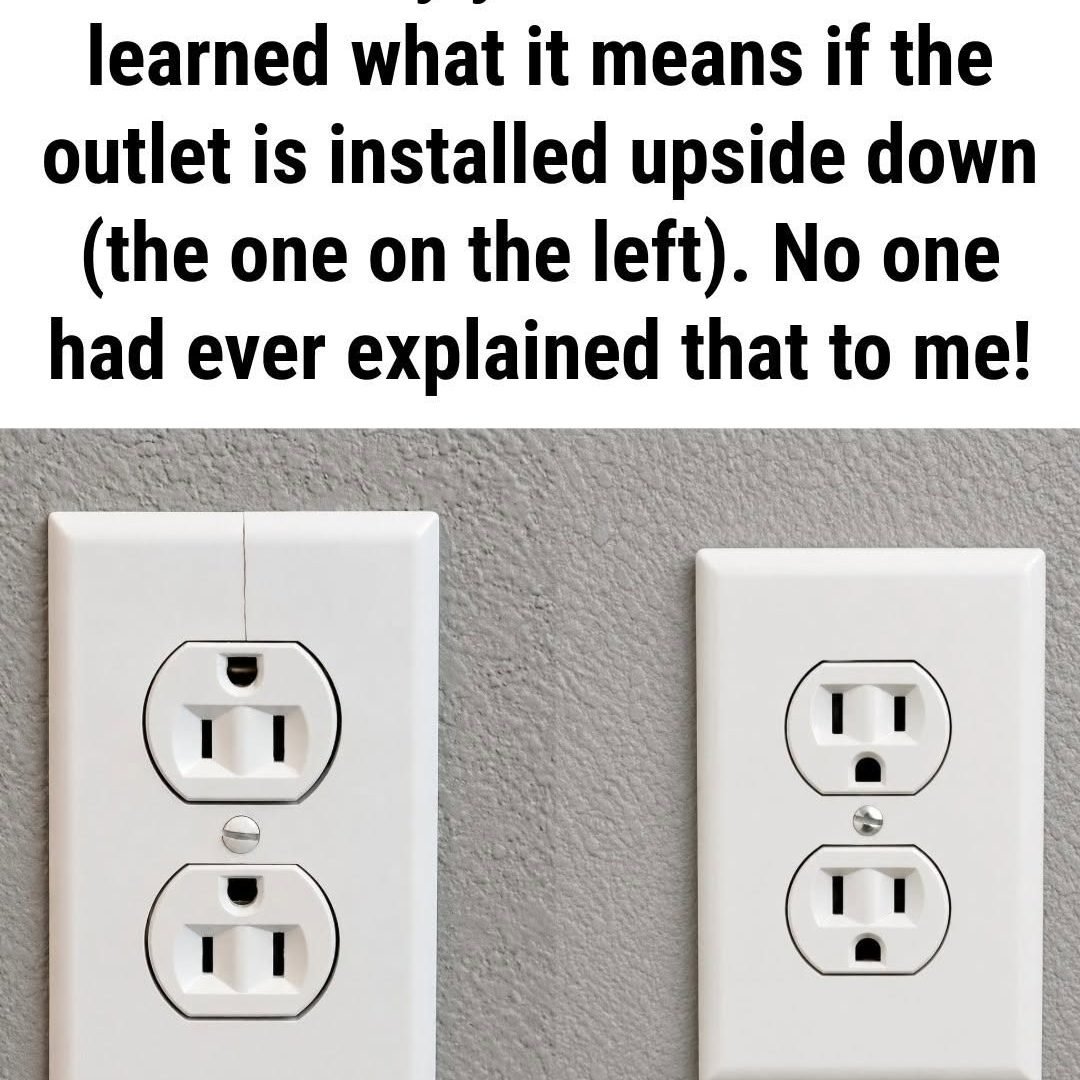
receptacle rotated 180 degrees. The round grounding hole is at the top. The two flat slots are below. That is the entire visible difference.
In North American electrical terminology, the round hole is the equipment grounding conductor. The shorter flat slot is hot. The longer flat slot is neutral. The grounding pin on a plug is longer than the hot and neutral blades. That length is intentional. When you insert a plug, the ground connection is designed to make contact first. When you remove a plug, the ground connection is designed to break last. This is a safety feature built into the plug and receptacle, independent of whether the outlet is mounted ground-up or ground-down.
The orientation of the outlet does not change which wire is hot, which is neutral, or which is ground. It only changes the physical position of the openings. A receptacle tester will show the same results whether the outlet is ground-up or ground-down, provided the wiring behind it is correct.
What You Are Looking At: The Anatomy of a Duplex Receptacle
A North American duplex receptacle has two outlets in one yoke. Each outlet has three openings:
A short flat slot for the hot wire.
A longer flat slot for the neutral wire.
A round or U-shaped hole for the equipment grounding conductor.
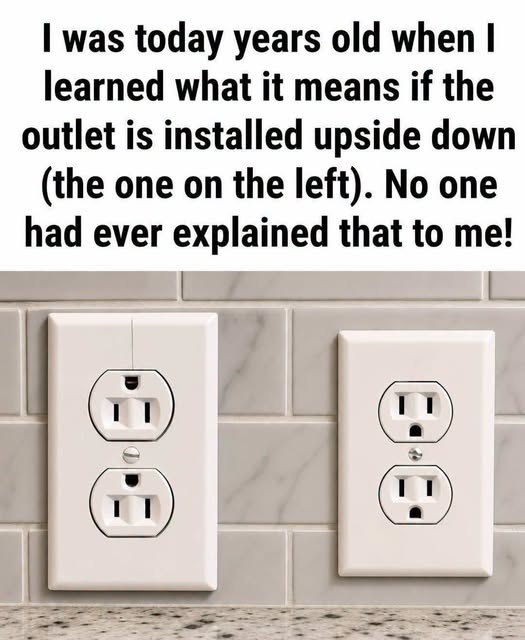
In the image, the left outlet has the round grounding hole at the top. The right outlet has it at the bottom. That is the entire difference visible to the eye.
The device is designed to be mounted in a box. The yoke can be oriented either way as long as the wires are connected correctly. In most homes, electricians install receptacles with the ground hole down because that is the common convention and because many plug cords hang more naturally that way. But “common” is not the same as “required.”
Ground-Up vs. Ground-Down: What the Terms Mean
“Ground-up” means the round grounding hole is at the top of the outlet. “Ground-down” means the round hole is at the bottom. Both are used in North America. Ground-down is more common in many residential settings. Ground-up is common in some commercial and institutional settings, and it is often preferred by electricians who follow the “safety first” convention.
The term “upside down” is informal. It is not a technical classification. An inspector will not usually write “upside down” on a report. They will look at polarity, grounding, bonding, box fill, tamper resistance, GFCI protection, AFCI protection, and installation instructions. Orientation may be part of a project specification, but it is not the same as correct wiring.
Why Some Electricians Install Outlets Ground-Up
The main argument for ground-up installation is a safety scenario involving a partially inserted plug and a falling metal object.
Imagine a plug is not fully inserted into the outlet. The hot and neutral blades are exposed. If a metal object—a spoon, a piece of wire, a metal cover plate, a tool—falls between the plug and the outlet, it could contact the hot blade and create a short circuit, a shock hazard, or a spark.
If the outlet is installed ground-up, the grounding pin is at the top. The ground pin is longer and is connected to the grounding system. In theory, a falling metal object would contact the grounded pin first, or would be more likely to contact the grounded pin and the hot blade in a way that trips the breaker rather than energizing the object. The ground pin acts as a barrier above the hot and neutral blades.
If the outlet is installed ground-down, the hot and neutral blades are at the top. A falling metal object could contact the hot blade more directly. The grounding pin is at the bottom, where it is less likely to intercept the object.
This is the “metal object” or “falling object” argument. It is a plausible safety rationale, and it is why many electricians, especially those working in commercial, industrial, and institutional settings, install receptacles ground-up. It is also why some hospitals and laboratories adopt ground-up as a standard.
However, the argument is not universally accepted as a proven, measurable safety improvement in ordinary homes. Real-world data comparing injury rates by outlet orientation is scarce. The scenario requires a specific combination of a partially inserted plug, a conductive object, and bad luck. The ground-up convention is best understood as a reasonable precaution, not a guarantee.