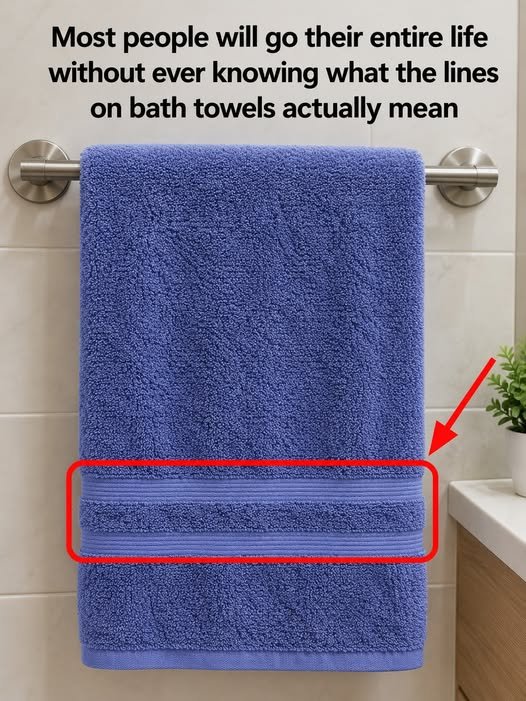
The Secret Meaning Behind the Lines on Bath Towels: It’s Not Just Decoration
Myth 3: The Lines are a Hotel Housekeeping Signal
There is a rumor that in hotels, the band indicates which part of the towel should be used for the face versus the body, or that a specific number of lines indicates the grade of the hotel. This is entirely false. The number of lines is simply a stylistic choice made by the manufacturer.
How to Use the Dobby Border to Judge Towel Quality
Now that you know what the band is, you can use it as a practical tool for shopping. When you are buying a new towel, inspect the dobby border closely. Here is what to look for:
Width: A wider dobby border usually indicates a higher-quality towel. It provides more structural support and is less likely to fray.
Density: Run your fingers over the band. It should feel tight, flat, and substantial. If it feels flimsy, loose, or scratchy, the towel is likely of lower quality.
Stitching: The hem at the end of the band should be neatly stitched with no loose threads. A poorly stitched hem is a sign of a towel that will fall apart quickly.
Consistency: The band should be perfectly straight and symmetrical. If it is crooked, the towel was poorly manufactured.
The History of the Terry Cloth Towel
To fully appreciate the design of the modern towel, it helps to look at its history.
From Linen to Terry Cloth
For centuries, people dried themselves with plain linen cloths or rough cotton fabrics that had very little absorbency. They were scratchy and had to be replaced frequently. In the mid-19th century, a British manufacturer named Samuel Holt patented a new type of fabric called terry cloth. It featured loops of thread on both sides, which increased its absorbency significantly.
By the early 20th century, terry cloth towels had become the standard in Western households. As manufacturing technology improved, the dobby loom allowed weavers to create patterns within the towel itself, leading to the decorative borders we see today.
The Evolution of Design
Over the decades, the dobby border evolved from a purely functional necessity into a major design element. In the mid-20th century, towel sets often featured elaborate floral or geometric bands in bold colors. Today, the trend is often toward minimalism, with simple, elegant bands in complementary colors.
Caring for Your Towel Bands: Maintenance Tips
To ensure your towels last for years, you need to care for the dobby bands properly.
Wash Separately: Wash new towels separately from other clothing for the first few washes, as they shed a lot of lint and dye.
Avoid Fabric Softener: Fabric softener coats the terry loops and the dobby band with a waxy layer, reducing absorbency over time.
Tumble Dry Low: High heat can damage the cotton fibers in the band, causing it to shrink or fray. Tumble dry on low or medium heat.
Don’t Overload the Machine: Towels need room to agitate in the wash to get clean. Overloading the machine can cause the dobby bands to snag and tear.
Conclusion: A Small Band with a Big Job
The horizontal lines on your bath towel are far more than just a decorative detail. They are the structural backbone of the towel, the anchor that prevents it from unraveling into a mess of threads. They provide a stable base for the hem, help the towel hang neatly on the rack, and serve as a canvas for elegant design and hotel branding.
The next time you reach for a towel, take a moment to look at the dobby border. It is a testament to the ingenuity of textile engineering—a small, flat band that silently does its job, ensuring that your towel remains fluffy, absorbent, and durable for years to come.
Frequently Asked Questions
What are the horizontal lines on a bath towel called?
They are called dobby borders or dobby bands. The name comes from the Dobby Loom, a type of weaving machine used to create small, intricate patterns in fabric.
Why do towels have those bands?
The bands serve three main purposes: they structurally reinforce the ends of the towel to prevent unraveling, they anchor the hem, and they provide a visually appealing design element. They also help the towel hang straight on a rack.
Do the lines mean the towel is higher quality?
Yes, generally. A wide, tightly woven, and neatly stitched dobby border is a strong indicator of a high-quality towel. It shows that the manufacturer took care to secure the edges, meaning the towel will last longer without fraying.
Is the banded end supposed to be for your feet?
No, this is a common myth. The banded end is simply the structural finish of the towel. It does not indicate which part of the towel should be used for your face or your feet.
Are the lines more absorbent than the rest of the towel?
No. The fluffy terry loops are far more absorbent than the flat dobby band, because the loops have a much larger surface area to soak up water.
How can I tell if a towel is good quality by looking at the band?
Look for a wide, dense band that feels smooth and substantial. The stitching on the hem should be tight and neat. Avoid towels with narrow, flimsy bands or loose threads, as these are likely to fray quickly.
What is a Dobby Loom?
A Dobby Loom is a weaving machine that uses a mechanical or computerized system to lift individual warp threads, allowing the weaver to create small geometric patterns, like the bands on towels, without the complexity of a full Jacquard loom.
Do all towels have a dobby border?
Most high-quality terry cloth towels do. However, some very cheap or novelty towels may have a simple hemmed edge without a dobby band. These towels are much more prone to fraying and unraveling over time.