The Secret Meaning Behind the Lines on Bath Towels: It’s Not Just Decoration
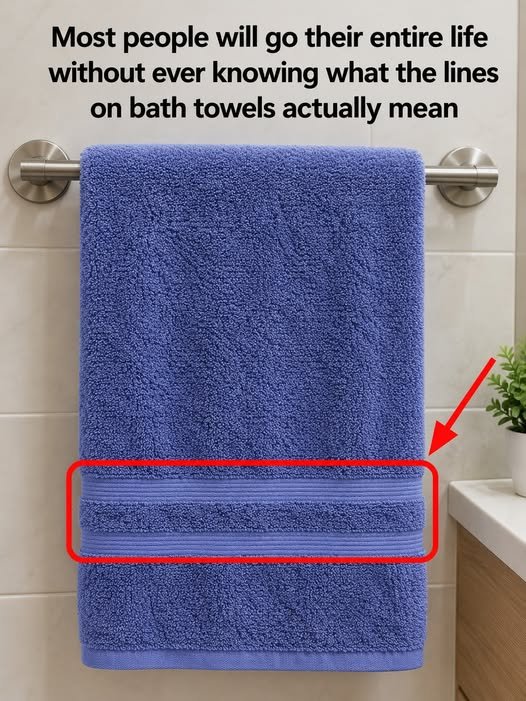
A viral social media post recently highlighted this mystery. It featured an image of a plush blue towel hanging over a rack, with a red arrow pointing directly to the horizontal, woven bands located near the bottom edge. The text read: “Most people will go their entire life without ever knowing what the lines on bath towels actually mean.”
The post sparked thousands of comments, with speculations ranging from the mundane to the bizarre. Some argued that the bands indicate the “foot end” of the towel, meant to keep your face clean. Others believed they are a hidden signal for hotel housekeeping, or simply a decorative flourish to break up the solid color.
The truth, as is often the case with well-engineered everyday objects, is far more practical. Those horizontal bands are called dobby borders, and they serve a crucial combination of structural, functional, and aesthetic purposes. They are not just decorative lines; they are a hallmark of textile engineering that ensures your towel remains durable, hangs properly, and looks good doing it.
This comprehensive guide will unravel the mystery of the towel band. We will explore the fascinating history of the terry cloth towel, explain the mechanical process of how these bands are woven, break down their primary functions, debunk the most common myths, and explain why this small design detail is actually a major indicator of quality.
The Anatomy of a Bath Towel
To understand why the horizontal bands exist, it is first necessary to understand how a towel is constructed. A towel is not just a flat piece of fabric; it is a complex textile composed of several distinct elements woven together.
The Ground Warp and Weft
Every woven fabric consists of two sets of threads. The warp threads run vertically (lengthwise) and are held under tension on a loom. The weft threads run horizontally (widthwise) and are woven over and under the warp threads. In a towel, these threads form the base fabric, known as the ground cloth.
The Terry Pile
What makes a towel different from a bedsheet is the terry pile. During the weaving process, extra warp threads are woven in small loops on both sides of the fabric. These loops are the fluffy, absorbent part of the towel. They increase the surface area of the fabric, allowing it to soak up massive amounts of water. The length and density of these loops (often measured in grams per square meter, or GSM) determine how plush and absorbent the towel will be.
The Hem
The top and bottom edges of a towel are folded over and stitched to prevent the fabric from unraveling. This is called the hem.
The Dobby Border (The Lines)
The dobby border is the specific area near the hem where the terry loops are interrupted. Instead of the fluffy, textured loops, the weaver switches to a flat, tightly woven pattern. This flat section usually consists of several distinct bands or stripes.
The name “dobby” comes from a specific type of weaving machine called a Dobby Loom. Unlike a plain loom that weaves simple, repeating patterns, a dobby loom uses a mechanical chain or a computer to lift specific warp threads in sequence, allowing the weaver to create small, intricate geometric patterns—like the horizontal bands seen on towels.
The Primary Purpose: Structural Reinforcement
The most important reason for the dobby border is structural. It is the architectural anchor of the towel.
Preventing Unraveling
Towels are woven in long, continuous bolts, often hundreds of feet long. When the towel is cut to its finished size, the raw edges are exposed. If a towel were made entirely of terry loops, cutting it would be a disaster. The loops would immediately begin to pull out, and the entire towel would unravel into a pile of loose threads in the washing machine.