The Hidden Purpose of the Decorative Band on Bath Towels: What That Woven Strip Actually Means
Introduction: The Everyday Object We Never Truly See
We interact with them every single day. We wrap ourselves in them after a hot shower, use them to dry our hands, and toss them into the washing machine without a second thought. Bath towels are one of the most ubiquitous and essential items in our homes, yet they are also one of the most overlooked. We choose them based on color, softness, and size, but how often do we truly examine the intricate details of their construction? A viral social media image has recently turned a spotlight on one of the most common—and most misunderstood—features of the modern bath towel.
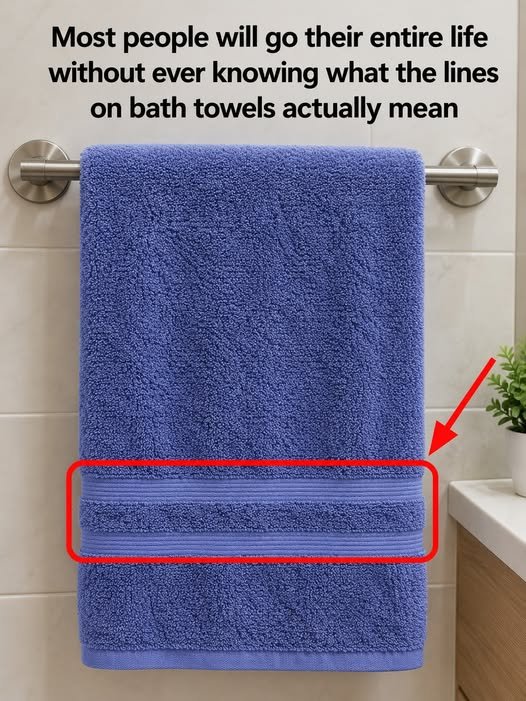
The image displays a stack of neatly folded beige towels, with a bright red box highlighting a textured, woven band running horizontally across the fabric. The overlaid text reads, “Most people will go their entire life without ever knowing what the decorative bands on bath towels actually mean.” For millions of viewers, this simple graphic triggered a moment of profound realization. We see this band every day. We dry our faces with it, we wrap our hair in it, but we have almost certainly never stopped to ask: What is that strip actually for?
Is it purely decorative? Is it a brand marker? Does it serve a hidden structural purpose? The truth is far more fascinating than a simple aesthetic choice. That woven band—known in the textile industry as a Dobby border or Dobby strip—is a marvel of engineering, history, and practical design. It is a feature that dates back centuries, born out of the mechanical ingenuity of the Industrial Revolution, and it continues to serve a critical function in the lifespan and utility of your favorite towel. This comprehensive two-part guide will unravel the mystery of the Dobby border. We will explore its historical origins, its structural and functional purposes, and why it remains a hallmark of quality in the modern textile industry.
The Mystery Revealed: It’s Called a “Dobby Border”
If you were to ask a textile manufacturer about the textured band on your bath towel, they would immediately identify it as a “Dobby border.” The name itself is a fascinating piece of industrial history. It does not refer to a person, but rather to a specific type of loom and the mechanism that operates it. Understanding what a Dobby border is requires a brief journey into the mechanics of weaving.
What is a Dobby Loom?
In traditional weaving, a loom holds a set of vertical threads (the warp) taut while a set of horizontal threads (the weft) is woven through them. The simplest looms create a basic over-and-under pattern. However, to create more complex patterns—like the tight, textured, and often geometric designs found on the Dobby band—a more sophisticated machine is required.
Enter the Dobby loom. Invented in the early 19th century, the Dobby loom features a special mechanism that controls the individual heddles (the wires that hold the warp threads). This allows the weaver to raise and lower specific threads independently, creating small, intricate geometric patterns, textures, or raised bumps directly in the fabric. The term “Dobby” is derived from the old English word “dobbie,” meaning a small, clever fellow or a mechanical contrivance.
When you see that woven band on a towel, you are looking at the output of this clever mechanical process. The Dobby border is woven directly into the towel, using a different pattern or tighter weave than the main body of terry cloth. It is not sewn on afterward; it is an integral part of the fabric’s construction.
The Historical Origins: A Mark of the Industrial Revolution
The presence of the Dobby band on modern towels is a direct link to the Industrial Revolution. Before the invention of the Dobby loom, creating patterned or textured borders on textiles was a slow, labor-intensive process, often done by hand or using a complex drawloom. These items were expensive and reserved for the wealthy.
From Luxury to Everyday Necessity
When the Dobby mechanism was introduced, it democratized intricate textile patterns. Factories could now mass-produce fabrics with decorative borders that were previously too costly for the average person. The Dobby border became a way for manufacturers to showcase their machinery’s capabilities. It was a visual flex—a way of saying, “Look at the complex pattern we can weave into this everyday object.”
Over the decades, as towels became a standard household item, the Dobby border transitioned from a symbol of luxury to a standard feature. It served as a way to break up the monotony of a large expanse of solid-colored fabric, adding a touch of elegance and visual interest to the bathroom. It was a small piece of art woven directly into a utilitarian object.
Structural Integrity: Why Towels Need a Dobby Band
While the Dobby border is undeniably attractive, its purpose is not solely aesthetic. It serves a critical structural function that significantly extends the lifespan of the towel. To understand this, we must look at how a towel is constructed.
Anchoring the Terry Loops
The main body of a standard bath towel is made of terry cloth, a fabric characterized by uncut loops of thread on both sides. These loops are what give the towel its absorbency and plushness. However, these loops are delicate. If they are not secured at the edges, they can easily snag, pull, and unravel, eventually ruining the towel.
The Dobby border acts as a structural anchor. Because it is woven tightly and flatly, without the protruding terry loops, it creates a secure, reinforced edge. The Dobby band essentially seals the ends of the towel, preventing the terry loops from unspooling. It is the equivalent of a seam on a piece of clothing, holding the entire structure together. Without the Dobby border, your towel would quickly fray and fall apart after a few washes.
Preventing Fraying and Unraveling
The tight weave of the Dobby band also prevents the edges of the towel from fraying. When a towel is cut from a larger bolt of fabric, the raw edges are highly susceptible to unraveling. The Dobby border provides a finished, durable edge that can withstand the friction and agitation of the washing machine and dryer. It is a built-in defense mechanism against the wear and tear of daily life.
The “Head” of the Towel: A Built-In Hanging Guide
Beyond its structural integrity, the Dobby border has a highly practical, everyday function that many people overlook. It serves as a visual indicator for the “head” and “foot” of the towel, providing a guide for how it should be hung on a towel bar.
How to Hang Your Towel Correctly
Have you ever noticed that when you hang a towel without a Dobby band, it can look a bit sloppy or uneven? The Dobby band solves this problem. The side of the towel with the Dobby border is intended to be the bottom of the towel when it is hanging on the bar. The plain, looped side is intended to be the top, where it folds over the bar.
Why does this matter? First, it ensures that the towel hangs straight and looks neat. The heavier, denser Dobby band helps to weigh down the bottom edge, preventing the towel from bunching up. Second, it aids in the drying process. Because the Dobby band has a tighter weave, it is less absorbent and takes longer to dry than the rest of the towel. By hanging it at the bottom, gravity helps the water drain away from it, allowing the towel to dry more efficiently and preventing the musty, mildew smell that can develop when towels remain damp.