I Was Today Years Old When I Learned What It Means If the Outlet Is Installed Upside Down (The One on the Left). No One Had Ever Explained That to Me!
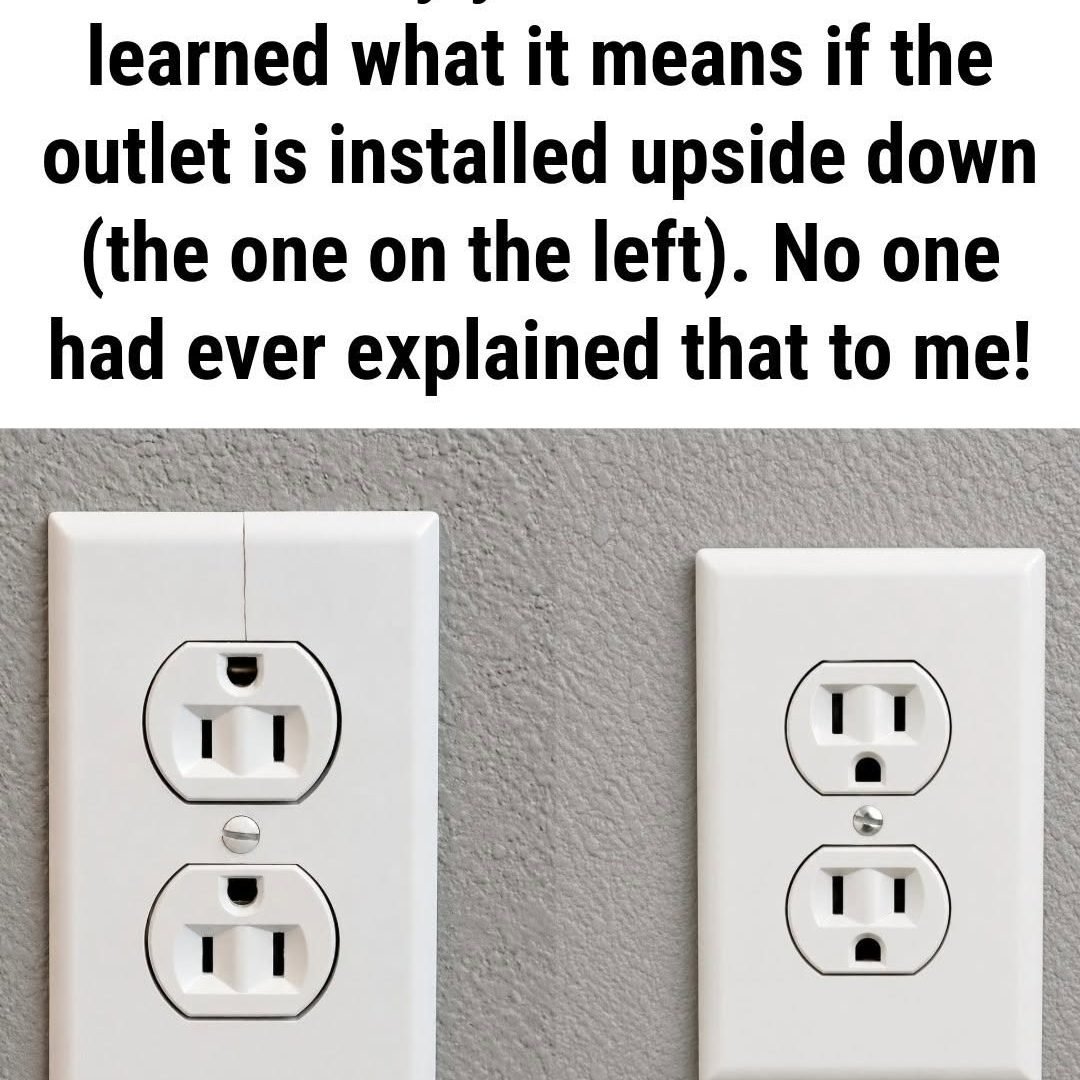
The image shows two ordinary North American duplex electrical outlets side by side. On the right, the familiar configuration: the round grounding hole is at the bottom, and the two flat slots sit above it. On the left, the same outlet is rotated 180 degrees—the round grounding hole is at the top, and the flat slots are below. Many people glance at the left outlet and assume something is wrong, that it was installed “upside down,” or that it signals a special type of wiring, a code violation, or a hidden safety feature. In reality, the answer is more interesting—and more nuanced—than a simple “right” or “wrong.”
The left outlet is usually described as being installed ground up or ground pin up. The right outlet is described as ground down or ground pin down. Both are standard 120-volt, 15-amp or 20-amp receptacles used in homes across the United States and Canada. The electrical function is the same. The difference is orientation, and orientation is largely a matter of convention, local practice, installer preference, and—in some settings—a deliberate safety policy.
This article explains what the “upside down” outlet really means, where the convention came from, why some electricians and hospitals prefer ground-up, what the electrical code actually requires, which myths are false, and when orientation genuinely matters for safety. It also explains how to inspect an outlet properly, when to call an electrician, and why “ground up” is not a universal sign of a problem.
What You Are Looking At: A Standard Duplex Receptacle
A North American duplex receptacle has two outlets in one yoke. Each outlet has three openings:
A short flat slot for the hot wire.
A longer flat slot for the neutral wire.
A round or U-shaped hole for the equipment grounding conductor.
In the image, the left outlet has the round grounding hole at the top. The right outlet has it at the bottom. That is the entire difference visible to the eye. The left outlet is not a special “hospital outlet,” not a 240-volt outlet, not a switched outlet, and not necessarily a sign of amateur wiring. It is a normal receptacle rotated 180 degrees.
The confusion comes from the phrase “upside down.” An outlet does not have a true top or bottom in the same way a picture frame does. The device is designed to be mounted in a box, and the yoke can be oriented either way as long as the wires are connected correctly. In most homes, electricians install receptacles with the ground hole down because that is the common convention and because many plug cords hang more naturally that way. But “common” is not the same as “required.”
The Three Wires: Hot, Neutral, and Ground
To understand why orientation is debated, you need to know what the three openings do.
The hot wire carries voltage from the electrical panel to the device. In a standard 120-volt circuit, it is usually black or red. The neutral wire carries current back to the panel and is usually white. The ground wire is a safety conductor, usually bare copper or green, that provides a low-resistance path back to the panel if a fault occurs.
The grounding pin is longer than the hot and neutral blades on a plug. That length is intentional. When you insert a plug, the ground connection is supposed to make contact first. When you remove a plug, the ground connection is supposed to break last. This is a safety feature designed into the plug and receptacle, independent of whether the outlet is mounted ground-up or ground-down.
The orientation of the outlet does not change which wire is hot, which is neutral, or which is ground. It only changes the physical position of the openings. A receptacle tester will show the same results whether the outlet is ground-up or ground-down, provided the wiring behind it is correct.
Ground Up vs. Ground Down: What the Terms Mean
“Ground up” means the round grounding hole is at the top of the outlet. “Ground down” means the round hole is at the bottom. Both are used in North America. Ground-down is more common in many residential settings. Ground-up is common in some commercial and institutional settings, and it is often preferred by electricians who follow the “safety first” convention.
The term “upside down” is subjective. If you grew up seeing ground-down outlets, ground-up looks upside down. If you grew up in a building where ground-up was standard, the ground-down outlet might look odd. Neither orientation is inherently more “normal” than the other.
Why Some Electricians Install Outlets Ground Up
The main argument for ground-up installation is a safety scenario involving a partially inserted plug and a falling metal object.
Imagine a plug is not fully inserted into the outlet. The hot and neutral blades are exposed. If a metal object—a spoon, a piece of wire, a metal cover plate, a tool—falls between the plug and the outlet, it could contact the hot blade and create a short circuit, a shock hazard, or a spark.
If the outlet is installed ground-up, the grounding pin is at the top. The ground pin is longer and is connected to the grounding system. In theory, a falling metal object would contact the grounded pin first, or would be more likely to contact the grounded pin and the hot blade in a way that trips the breaker rather than energizing the object. The ground pin acts as a barrier above the hot and neutral blades.
If the outlet is installed ground-down, the hot and neutral blades are at the top. A falling metal object could contact the hot blade more directly. The grounding pin is at the bottom, where it is less likely to intercept the object.
This is the “metal object” or “falling object” argument. It is a plausible safety rationale, and it is why many electricians, especially those working in commercial, industrial, and institutional settings, install receptacles ground-up. It is also why some hospitals and laboratories adopt ground-up as a standard.
However, the argument is not universally accepted as a proven, measurable safety improvement in ordinary homes. Real-world data comparing injury rates by outlet orientation is scarce. The scenario requires a specific combination of a partially inserted plug, a conductive object, and bad luck. The ground-up convention is best understood as a reasonable precaution, not a guarantee.
The Hospital and Commercial Connection
If you have ever looked at an outlet in a hospital, laboratory, or commercial kitchen and noticed that the ground pin is at the top, you are not imagining it. Many healthcare facilities and commercial buildings specify ground-up receptacles as part of their electrical standards.
This is often called a “hospital-grade” installation, but the term is misleading. “Hospital-grade” is a rating for the receptacle itself—it refers to higher durability, better contact retention, and stricter manufacturing standards. It does not mean the outlet must be installed ground-up. The orientation is a separate design choice.
Hospitals and laboratories often choose ground-up because of the metal-object rationale, because of infection-control and cleaning practices, and because standardized orientation makes inspections easier. In some facilities, ground-up is simply the house style. It is not a universal code requirement for hospitals, but it is a common institutional standard.
What the Electrical Code Actually Says
In the United States, the National Electrical Code (NEC) does not generally mandate whether a standard duplex receptacle must be installed ground-up or ground-down in a dwelling. The NEC focuses on proper wiring, grounding, bonding, box fill, tamper resistance, GFCI protection, AFCI protection, and installation instructions. Orientation is usually a matter of local amendments, project specifications, manufacturer instructions, or the authority having jurisdiction.
Some local jurisdictions, builders, or facility standards may require ground-up in certain applications. Some may require ground-down. Many do not specify. The key point is that “ground-up” is not automatically a code violation, and “ground-down” is not automatically the only legal orientation. The wiring behind the outlet matters far more than the rotation of the device.
If you are installing a new receptacle, follow the manufacturer’s instructions, local code, and the requirements of your inspection authority. If you are simply observing an existing outlet, do not assume it is wrong just because it is rotated.
Does Orientation Affect Electrical Function?
No. A correctly wired receptacle will deliver power the same way whether the ground pin is at the top or the bottom. The hot slot remains hot, the neutral slot remains neutral, and the ground hole remains ground. The plug will fit either way. The device will work either way.
Orientation can affect practical matters, however. Some right-angle plugs, furniture, baseboards, and cord shapes are designed to hang downward from a ground-down outlet. If the outlet is ground-up, the cord may point upward or sideways, which can strain the cord or block adjacent outlets. Some plug-in devices, such as certain timers, adapters, or wall chargers, may fit more easily in one orientation than the other.
Orientation can also affect how easy it is to read labels or operate a switch on the plug. But these are convenience issues, not electrical ones.
The Metal-Object Scenario in Plain Language
The ground-up safety argument is easier to understand with a simple image. Picture a plug that is halfway out of the outlet. The two flat blades are exposed. If a metal object falls from above, it will hit whatever is at the top of the outlet first.
If the ground pin is at the top, the object hits the ground pin first. The ground pin is connected to the grounding system, which is designed to carry fault current safely back to the panel. If the object then contacts the hot blade, the resulting short circuit should trip the breaker. The object may spark or trip the circuit, but the grounding path is involved.
If the ground pin is at the bottom, the object hits the hot blade first. The object can become energized before it contacts the ground pin. If a person touches the energized object, they can receive a shock. The grounding pin may not be contacted at all.
This is why ground-up is often described as “safer” in the specific case of a falling metal object. It is not a perfect protection. It does not prevent all shocks. It does not replace tamper-resistant outlets, GFCI protection, or safe plug handling. It is one small layer of defense.
Why Ground-Down Is Still Common
Ground-down installation remains common for several reasons. It is the traditional residential convention in many areas. It matches the way many plug cords hang. It is what many homeowners and builders expect. Some electricians prefer it because it looks familiar and because right-angle cords are often designed for it.
Ground-down is not inherently unsafe. The safety difference between the two orientations is debated, and the metal-object scenario is only one of many electrical hazards. A correctly wired, grounded, tamper-resistant, GFCI-protected outlet is safe regardless of orientation. A poorly wired outlet is unsafe regardless of orientation.
Myths and Misconceptions About “Upside Down” Outlets
Several myths circulate about ground-up outlets. Here are the most common.
Myth: An upside-down outlet means it was wired backward. False. Orientation and wiring are separate. A ground-up outlet can be wired correctly, and a ground-down outlet can be wired incorrectly. Only a tester or an electrician can confirm polarity and grounding.
Myth: Ground-up outlets are required by code everywhere. False. The NEC does not generally mandate ground-up in dwellings. Local codes and project specifications vary.
Myth: Ground-up means the outlet is “hospital-grade.” False. Hospital-grade is a durability rating, not an orientation. A hospital-grade receptacle can be installed either way.
Myth: Ground-up prevents all shocks. False. It may reduce one specific risk involving falling metal objects, but it does not prevent shocks from damaged cords, faulty appliances, missing grounds, or other hazards.
Myth: Ground-up means the outlet is switched. False. A switched outlet is controlled by a wall switch. Orientation does not indicate switching.
Myth: Ground-up means it is a 20-amp outlet. False. A 20-amp outlet has a T-shaped neutral slot. Orientation does not indicate amperage.
Myth: Ground-up is a sign of amateur work. Not necessarily. Many professional electricians install ground-up deliberately, especially in commercial and institutional settings.
Myth: Ground-down is always the “right” way. False. There is no universal right way in the NEC for ordinary dwellings. Local practice and specification govern.
When Orientation Might Matter More
There are situations where orientation is more than a cosmetic preference.
In healthcare facilities, laboratories, and industrial settings, ground-up may be specified for safety and standardization. In schools, public buildings, and commercial kitchens, house standards may require it. In homes with young children, tamper-resistant receptacles and outlet covers matter far more than orientation. In older homes with ungrounded outlets, the presence or absence of a ground path is far more important than whether the ground hole is up or down.
If a plug or cord is being strained because the outlet is oriented the “wrong” way for that device, a short extension cord or a right-angle adapter can solve the problem. Do not force a plug or modify the outlet.
Tamper-Resistant Outlets and Child Safety
Modern electrical code in many jurisdictions requires tamper-resistant (TR) receptacles in homes. These have internal shutters that block foreign objects from entering the slots unless a proper two-prong plug is inserted. TR outlets are a far more effective child-safety measure than orientation.
If you have young children, do not rely on “ground-up” as a safety strategy. Use TR receptacles, outlet covers, cord management, and GFCI protection in bathrooms, kitchens, laundry areas, and outdoors. Teach children not to play with outlets or plugs.
How to Inspect an Outlet Safely
If you are curious about an outlet’s wiring, do not remove the cover or poke inside. Use a plug-in receptacle tester, which is inexpensive and available at hardware stores. A tester can indicate open ground, open neutral, open hot, reversed polarity, and other common faults.
You can also press the TEST and RESET buttons on a GFCI outlet to confirm it trips. If it does not trip, the GFCI may be faulty or wired incorrectly. Call an electrician.
Do not use a multimeter unless you are trained and comfortable working with live electricity. Do not insert anything other than a proper plug into an outlet. Do not rely on visual orientation to judge safety.
Should You Flip an “Upside Down” Outlet?
If the outlet is working, properly wired, and not required by local code or a specific standard to be ground-up or ground-down, there is usually no urgent reason to flip it. Changing orientation is a cosmetic or preference-based task, not a safety emergency. If you do want it changed, turn off the circuit breaker, verify power is off, and have a qualified electrician or experienced DIYer do the work. Never work on a live circuit.
If the outlet is loose, cracked, discolored, buzzing, hot to the touch, or has a missing cover plate, do not ignore it. Those are signs of a potential hazard. Call an electrician.
Warning Signs That Matter More Than Orientation
An outlet’s rotation is less important than these warning signs:
The outlet is warm or hot to the touch.
There are burn marks, scorch marks, or discoloration.
The plug fits loosely or falls out.
The outlet buzzes, crackles, or sparks.
The cover plate is cracked or missing.
The outlet is ungrounded and you need grounding for safety.
A GFCI fails to trip when tested.
The outlet is in a wet location without GFCI protection.
The circuit breaker trips repeatedly.
There is a burning smell near the outlet.
These are reasons to stop using the outlet and call a qualified electrician.
Conclusion: A Rotated Outlet, Not a Secret Code
The “upside down” outlet on the left is not a hidden message, a code violation, or a sign of dangerous wiring. It is a standard receptacle installed ground-up. The ground-up convention is a deliberate safety choice in some settings, based on the idea that a falling metal object is more likely to contact the grounded pin first. It is common in hospitals, laboratories, commercial buildings, and some residential installations. The ground-down convention is also common and equally valid in most homes.
The electrical code generally does not mandate one orientation over the other in ordinary dwellings. Local rules, project specifications, and installer preference determine the choice. What matters far more is correct wiring, grounding, GFCI and AFCI protection, tamper resistance, and safe use. If you are curious, use a receptacle tester. If you are concerned, call an electrician. But do not panic just because an outlet is rotated. It is not a secret code—it is simply a different way of mounting the same safe device.
Frequently Asked Questions
What does it mean if an outlet is installed upside down?
It usually means the outlet is installed ground-up, with the round grounding hole at the top instead of the bottom. It is a matter of orientation, not necessarily a wiring problem or code violation.
Is an upside-down outlet dangerous?
Not by itself. A correctly wired ground-up outlet is safe. The orientation may reduce one specific risk involving a falling metal object, but it does not replace proper grounding, GFCI protection, or safe use.
Is ground-up required by code?
In the United States, the National Electrical Code does not generally require ground-up or ground-down for standard duplex receptacles in dwellings. Local codes, facility standards, and project specifications may require one orientation.
Why do hospitals install outlets ground-up?
Hospitals and other institutions often choose ground-up as a safety convention and house standard. It is based on the metal-object scenario and on standardization, not on a universal code requirement.
Does ground-up mean the outlet is wired backward?
No. Orientation and wiring are separate. A ground-up outlet can be wired correctly. Use a receptacle tester or call an electrician to check polarity and grounding.
Does ground-up mean it is a special outlet?
Usually not. It is typically a standard duplex receptacle rotated 180 degrees. Special features such as GFCI, AFCI, tamper resistance, or 20-amp capacity are identified by markings, buttons, and slot shapes, not by orientation.
Can I flip my outlet to ground-up myself?
Only if you are qualified and comfortable working with electricity. Turn off the breaker, verify power is off, and follow local code. If you are unsure, hire a licensed electrician.
What is more important than outlet orientation?
Correct wiring, grounding, GFCI protection in wet areas, AFCI protection where required, tamper-resistant outlets, safe cords, and not overloading circuits are far more important than orientation.
Why do some plugs fit better in one orientation?
Some right-angle cords and plug-in devices are designed for a specific orientation. If a cord is strained, use a short extension cord or a right-angle adapter rather than forcing the plug.
When should I call an electrician?
Call an electrician if an outlet is hot, discolored, loose, buzzing, sparking, cracked, ungrounded where grounding is needed, or if a GFCI fails to trip. Also call if you are unsure about wiring or code requirements.