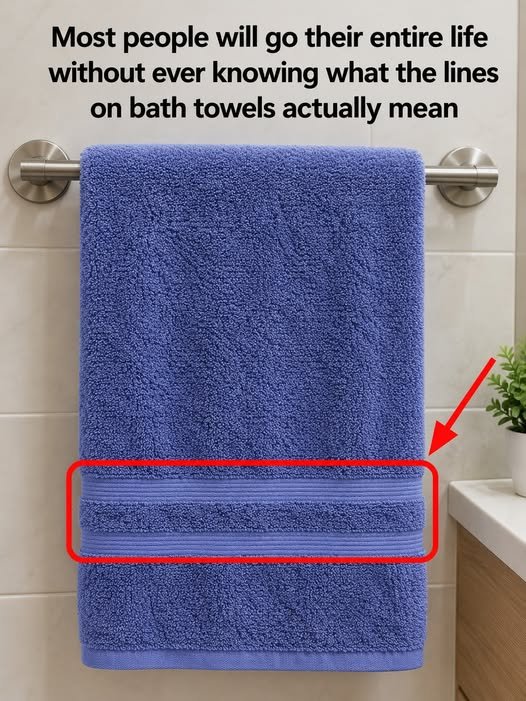
The Secret Meaning Behind the Lines on Bath Towels: It’s Not Just Decoration
The dobby border solves this problem. By weaving a flat, tight band near the ends of the towel, the manufacturer creates a dense, stable foundation. When the towel is cut, the edge is secured, preventing the terry loops from pulling apart. This is why cheap towels often fray after a few washes—their dobby borders are poorly constructed or too narrow to effectively anchor the fabric.
Anchoring the Hem
The dobby border also provides a stable base for the hem. Because the dobby area is flat and tightly woven, it folds over easily without the bulk of the terry loops. This allows for a clean, flat stitched hem that secures the towel’s edge without distorting the overall shape of the fabric.
The Functional Purpose: Draping and Hanging
While the structural purpose is vital, the dobby band also serves a highly practical, everyday function related to how we hang our towels.
The “Hanging Straight” Principle
Have you ever noticed that a towel hangs better on a rack when it is folded at the band? The dobby border is denser and heavier than the rest of the fluffy towel. When you drape a towel over a towel bar, folding it exactly at the dobby border creates a perfect, straight-hanging drape. The weight of the band acts as a counterbalance, preventing the towel from sliding off the rack and ensuring it dries evenly.
A Visual Cue
For towel designers, the band provides a visual cue to indicate the top and bottom of the towel. This is especially important when the towel is hung on a rack or folded on a shelf. If a towel has a distinct band, it is instantly recognizable as the “end” of the towel, helping to create a neat, uniform look in a bathroom. It guides you on how to fold it properly to look tidy.
The Aesthetic Purpose: Design and Branding
Beyond its functional and structural roles, the dobby border is a crucial element of design.
Adding Contrast and Elegance
For centuries, towel manufacturers have used the dobby border to add contrast to solid-colored towels. A white towel with a navy blue dobby border, or a gray towel with a crisp white border, adds a touch of tailored elegance to a bathroom. The flat, smooth texture of the band provides a pleasing visual and tactile contrast to the fluffy, nubby terry loops of the main body.
A Canvas for Branding
The flat surface of the dobby border is the perfect place for embroidery. This is why high-end hotels often feature towels with their logos embroidered directly onto the band. The tight weave holds the embroidery threads securely, and the flat surface prevents the logo from getting distorted by the terry loops.
Debunking the Myths: What the Lines Do NOT Mean
Because the dobby border is so prominent, several enduring myths have sprung up around its purpose. It is time to put them to rest.
Myth 1: The Lines Mark the “Foot End”
This is perhaps the most popular myth. Many people believe the banded end is the designated area for drying your feet, to keep the rest of the towel hygienic for your face. While this is a nice idea for personal organization, there is no historical or manufacturing basis for it. The band is simply where the towel was structurally finished, not a hygiene indicator.
Myth 2: The Lines Indicate Higher Absorbency
Some people believe the flat band is more absorbent than the fluffy loops. In reality, the terry loops are far more absorbent. The flat dobby band actually absorbs less water because it lacks the surface area of the loops.