Why You Should Think Twice Before Hanging a Tea Towel on Your Oven Handle (and the Hidden Dangers You Never Knew)
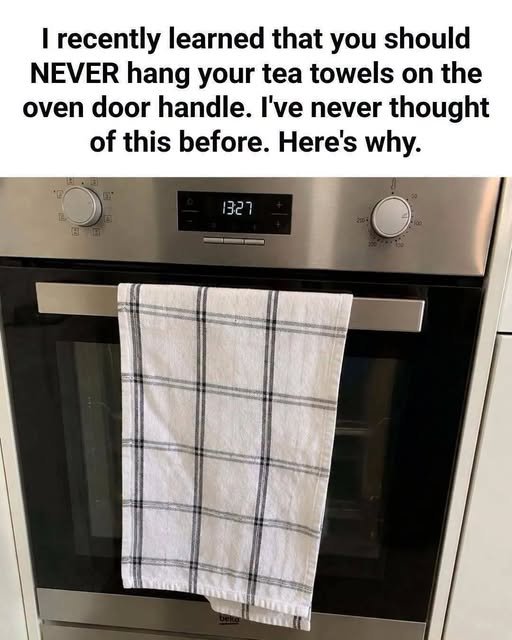
Many people assume that because the towel is on the outside of the closed oven door, it is safe. This is a dangerous misconception. The external surface of an oven is not a vacuum; it is directly subject to the extreme heat generated inside. The towel is essentially resting on a heated surface. If the oven is left on by accident, or if a broiler element is left on, the towel becomes the first point of ignition.
2. The Invisible Threat: A Bacterial Breeding Ground
Beyond the risk of fire, hanging a tea towel on the oven handle creates a perfect environment for the proliferation of harmful bacteria. The kitchen is the heart of the home, but it is also the epicenter of foodborne pathogens.
The Anatomy of a Contaminated Towel
Think about everything a kitchen towel touches in a single day. It is used to dry hands after washing, to wipe down the counters after preparing raw chicken, to dry freshly washed dishes, and to grab a hot pan. Each of these actions transfers microscopic particles to the fabric.
Moisture: A damp towel is a sponge. When you dry your hands or a wet dish, you transfer moisture to the towel.
Heat: The oven handle is often warm. Even when the oven is off, the area around it can be a warm, enclosed space.
Organic Matter: The towel is filled with tiny food particles, skin cells, and oils.
When you combine moisture, warmth, and organic matter, you create the perfect petri dish. The warm environment of the oven handle allows bacteria to multiply exponentially.
Cross-Contamination and the “Biofilm” Effect
If you use a towel that has been hanging on the oven handle to dry a clean plate, you are essentially wiping a microscopic layer of bacteria onto that plate. If you use the same towel to wipe your hands after touching raw meat, you are introducing E. coli or Salmonella to the fabric.
Because the towel is often left damp and bunched up on the handle, a biofilm can form. A biofilm is a thin, slimy film of bacteria that adheres to surfaces. It makes the bacteria highly resistant to simple rinsing and allows them to thrive for days. The oven handle becomes a permanent, hidden reservoir of pathogens, ready to be transferred to your hands, your food, and your dishes.
The Odor of Neglect
That distinct, sour, musty smell that develops on a towel left hanging for a few days is the olfactory evidence of bacterial growth. It is a sign that the towel is no longer a cleaning tool, but a source of contamination. When you smell that odor, you are smelling the metabolic waste products of millions of bacteria.
3. Appliance Damage: The Unseen Cost
Your oven is a complex piece of machinery, equipped with sensitive electronic control boards, thermostats, and ventilation systems. Hanging a towel on the handle can inadvertently cause significant damage.
Blocking Critical Vents
Most ovens have ventilation holes, usually located near the top of the door, on the control panel, or at the back of the stovetop. These vents are designed to release the hot air and moisture generated during cooking. If you hang a thick tea towel over the handle, it can easily cover or block these vents.
When the hot air cannot escape, the temperature inside the oven can become excessively high. This can lead to:
Overheating the Control Board: The electronic brain of your oven is often located right behind the control panel. Blocked vents can cause this board to overheat, leading to erratic behavior, error codes, or a complete failure of the appliance.
Thermostat Damage: The thermostat relies on accurate airflow to regulate the temperature. Blocking the vents can cause the oven to overheat or cook unevenly, ruining your food.
Cabinet Damage: The trapped heat can radiate outward, warping the finish on your kitchen cabinets or even causing the adhesive to melt.
Degradation of the Handle
The constant exposure to heat—and the weight and friction of the towel—can degrade the materials of the oven handle. Over time, the plastic or rubber grommets that hold the handle in place can dry out, crack, and break. The painted or metallic finish on the handle can also become discolored or flake off due to the constant thermal cycling.
4. The Danger to Children and Pets
If you have young children or pets, the risks of a dangling tea towel are significantly magnified.
The “Pull” Hazard
To a toddler, a brightly colored towel hanging from a handle is an irresistible invitation. They may grab it and pull with their body weight. If the oven door is closed, a heavy pull can cause the entire oven to tip forward if it is not properly secured. If the oven is open, a child could be pulled directly into the hot open door or the boiling pots on the stovetop.
Pets and the Dangling Fabric
Dogs and cats are equally curious. A cat may bat at the hanging fabric, or a dog may grab it while playing. Even a small pet can generate enough force to pull the oven door open, potentially spilling scalding hot food or causing a severe burn injury.
5. Why Do We Do It? The Psychology of the Habit
If the dangers are so clear, why is this habit so ubiquitous?
Convenience and Accessibility
The oven handle is at the perfect height. It is right where we need it when we are cooking. It requires no extra hardware or installation. It is the path of least resistance.