The Truth Behind the Viral Sink Hack: Why You Cover Your Drain Before Vacation (Part 1 of 5)
There is a specific, low-level anxiety that accompanies the final hours before leaving for a vacation. You have packed your bags, confirmed your flight, and locked the doors. But for many homeowners, the lingering thought in the back of their mind is not just about the security of their house, but the unseen biological activity taking place in their pipes. A viral social media image has recently brought this anxiety into sharp focus, offering a surprisingly low-tech solution.
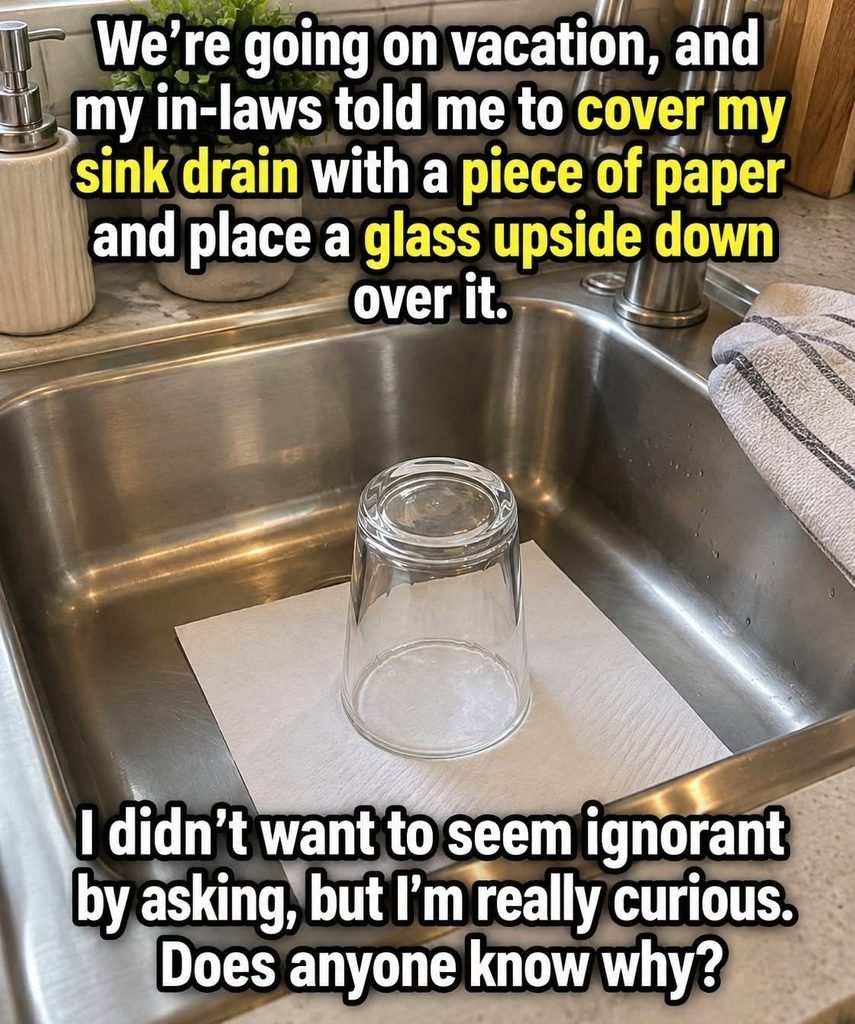
The image shows a pristine stainless steel kitchen sink. Over the drain sits a single square of white paper, topped with a standard, clear drinking glass turned completely upside down. The accompanying text reads: “We’re going on vacation, and my in-laws told me to cover my sink drain with a piece of paper and place a glass upside down over it. I didn’t want to seem ignorant by asking, but I’m really curious. Does anyone know why?”
The post has sparked thousands of comments, ranging from the dismissive to the deeply paranoid. For the uninitiated, it looks like a bizarre, superstitious ritual. Why would a piece of paper and a glass be necessary in an empty house? Is it to stop water from evaporating? To trap a ghost? Or is it an old wives’ tale passed down from a time before modern plumbing?
The reality is that this seemingly mundane kitchen hack is a brilliant, zero-cost pest control strategy. It is specifically designed to stop one of the most resilient and unwanted household guests from entering your home while you are away: the cockroach. By understanding the biology of these pests, the mechanics of your home’s plumbing, and the physics of evaporation, you can see exactly why this simple trick is a staple of pre-vacation preparation for millions of people.
However, while the hack is brilliant in its simplicity, it is not without its flaws. The use of glass introduces a significant safety hazard, and modern plumbing offers better, safer alternatives.
This comprehensive five-part guide will explore every aspect of the viral sink drain hack. In Part 1, we will break down the mechanics of the trick and the immediate threat it addresses. We will then dive into the world of household pests, explaining why cockroaches use your plumbing as a superhighway, explore the crucial role of the P-trap in preventing sewer gas, outline the safety hazards of using glass, provide alternative methods, and finish with a comprehensive pre-vacation checklist to keep your home completely safe while you are away.
The Big Reveal: It’s All About the Roaches
To understand the hack, you must first understand the enemy. Cockroaches are among the most adaptable creatures on the planet. They have been around for millions of years, and they have evolved to thrive in human environments. While there are many species, the ones most likely to invade your kitchen sink are the American cockroach (often called a water bug), the German cockroach, and the Oriental cockroach.
Why Do Roaches Love the Kitchen Sink?
Cockroaches are driven by two primal needs: food and water. The kitchen is the ultimate buffet and oasis, but the sink holds a specific, irresistible allure for several reasons.
1. The Perfect Moisture Source Cockroaches can survive weeks without food, but they cannot survive more than a few days without water. A kitchen sink, even one that is not actively being used, provides a constant source of moisture. The drain pipe, the P-trap, and the tiny droplets left behind in the basin are a lifeline for these pests.
2. The Organic Buffet The kitchen sink is not just a source of water; it is also a source of food. The drain is filled with a micro-ecosystem of organic matter—tiny particles of food, grease, soap scum, and dead skin cells that have washed down over time. This sludge is a delicacy for cockroaches, who are natural scavengers.
3. The Highway to Your Home The most critical factor is the plumbing system itself. In many urban and suburban areas, the sewer lines are heavily infested with cockroaches. The pipes that connect your home to the municipal sewer system are essentially a superhighway for roaches. They navigate through the pipes, climb up the walls of the plumbing, and emerge through the drain of the lowest sink in the house—which is often the kitchen sink on the ground floor.
4. Hiding and Breeding Once a roach enters through the drain, it finds a warm, dark, and humid environment in the cabinet under the sink, making it the ideal place to hide and breed.
How the Paper and Glass Trick Works
So, how do a piece of paper and a glass stop these tiny intruders? It is a matter of physical engineering and behavioral disruption. The hack exploits the roach’s climbing abilities and its need for a continuous path.
The Physics of the Barrier
When a cockroach climbs up the smooth, slippery walls of a PVC drain pipe, it relies on its claws and sticky pads on its feet to gain traction. When it reaches the top, it expects to find the metal edges of the sink strainer, which provide plenty of grip.
The Role of the Paper: The piece of paper (or a coffee filter, or a square of wax paper) is placed flat over the drain opening. It eliminates the textured metal surface that the roach needs to grab onto. Even if the roach pushes its head through the holes in the strainer, the paper blocks its exit. It cannot gain traction on the smooth paper to pull its body up and out.
The Role of the Glass: The glass, placed upside down over the paper, acts as a physical weight and a dome. It presses the paper flat against the drain, ensuring there are no gaps for a determined roach to squeeze through.
The Psychological Barrier and the Trap
Cockroaches have a strong survival instinct; they dislike open, exposed spaces. When a roach climbs up the drain and hits the paper barrier, it is trapped in the dark, enclosed space beneath the glass.
The glass creates a “no-man’s land.” If a roach somehow manages to push up the paper slightly, it will find itself trapped under an inverted glass. The smooth, slippery walls of the glass are impossible for the roach to climb, creating a temporary holding cell. When you return from vacation and lift the glass, you can easily dispose of the trapped pest.
While some might argue that a heavy glass isn’t completely airtight, the combination of the flat paper and the weight of the glass creates a barrier that is nearly impossible for a typical household roach to bypass. It is a simple, chemical-free solution that has been used by grandmothers and homeowners for decades.
The Historical Context of the Hack
Before the advent of modern chemical pesticides and professional exterminators, homeowners relied on clever, physical interventions to manage pests. The paper and glass trick is a perfect example of “integrated pest management” on a micro scale.
In older homes, where plumbing was less precise and gaps around pipes were common, the sink drain was a notorious entry point for insects. Without the ability to seal pipes with modern expanding foam or caulk, people had to improvise. The paper and glass method was born out of necessity, utilizing items that every household already possessed.
(End of Part 1. Continue to Part 2 to explore the biology of the pests, the anatomy of the sewer system, and the role of drain flies.)