The Kitchen Appliance You Must Unplug Before Bed: Understanding Electrical Fire Risks and How to Protect Your Home
The U.S. Fire Administration and the National Fire Protection Association both recommend unplugging small appliances when they are not in use. This advice appears in official electrical-safety checklists and is echoed by specialists who work with these organizations. The recommendation is not limited to bedtime; it applies whenever the appliance will remain idle for an extended period. Heat-producing devices receive particular emphasis because their design inherently links electricity to high temperatures.
Corey Hannahs, a senior electrical specialist associated with the NFPA, has publicly identified the toaster as a practical priority among small kitchen appliances. The point is not that toasters cause the majority of all kitchen fires, but that they combine several risk factors in a common, easily overlooked device. Air fryers and toaster ovens have drawn increased attention in recent years as their popularity has grown and as isolated overheating incidents and recalls have been reported.
Primary Evidence: How These Fires Typically Start
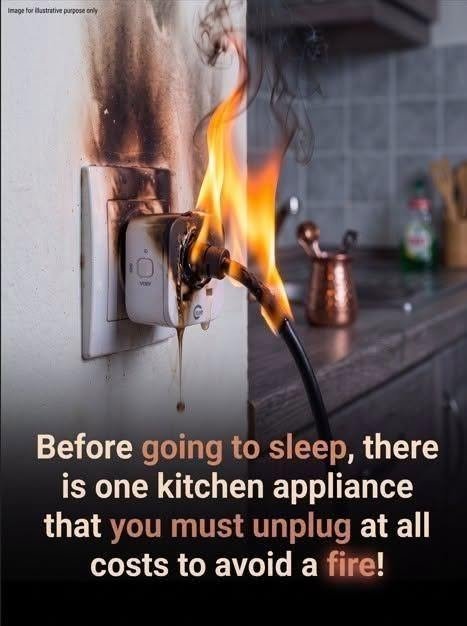
Investigations of residential electrical fires often reveal a sequence that begins with an unnoticed fault. Crumbs or grease residue provide fuel. A compromised heating element or wiring provides the ignition source. The continuous presence of power allows the fault to develop into sustained heating or arcing. Because the event occurs when the home is quiet, the fire can grow significantly before smoke detectors activate or occupants become aware.
Laboratory and field observations support the value of disconnection. Removing the appliance from the circuit eliminates the energy source that would otherwise sustain a developing fault. Cleaning the device to remove combustible debris further reduces the available fuel. Together these steps address both the ignition and the fuel sides of the fire triangle.
The Toaster as a Leading Case Study
The toaster’s design makes it an instructive example. Heating elements operate at temperatures high enough to toast bread and, under fault conditions, to ignite organic material. The crumb tray is frequently neglected. Cords can become frayed or stressed at the point where they enter the appliance. When the toaster remains plugged in, any of these weaknesses retains the potential to become active. Unplugging after use and emptying the crumb tray are therefore two of the simplest high-impact actions a household can take.