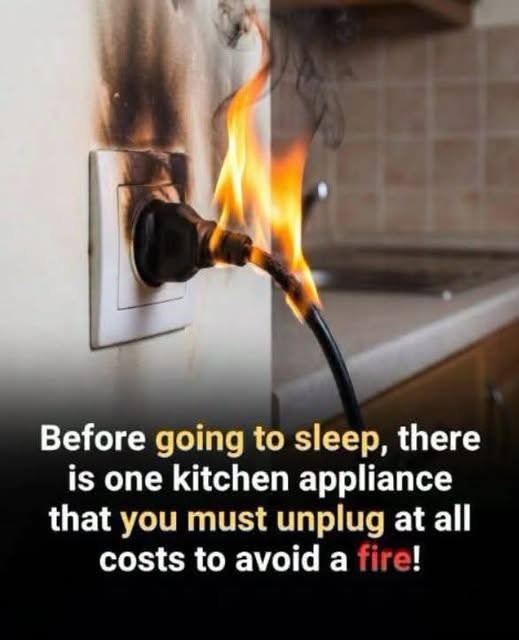
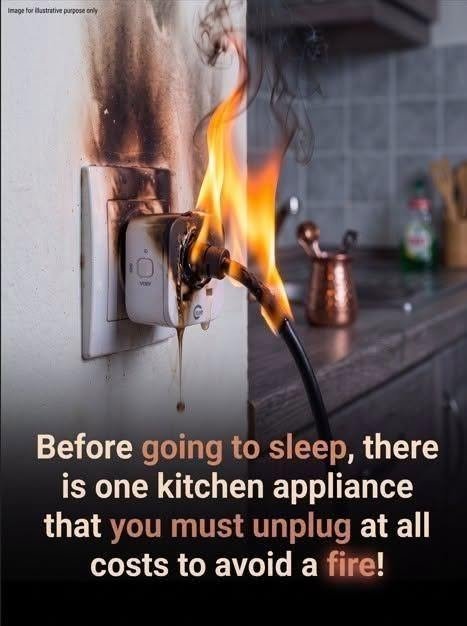
Before Going to Sleep, There Is One Kitchen Appliance You Must Unplug at All Costs to Avoid a Fire!
To understand why unplugging an appliance is so critical, we must first understand the mechanics of an electrical fire. An electrical fire is not like a wood fire or a grease fire; it is a chemical and physical reaction that can happen in seconds.
The Role of Resistance and Heat: Electricity flows through wires, and the ease with which it flows is called conductance. When electricity encounters resistance—such as a frayed wire, a loose connection, or a component inside an appliance—it has to work harder to push through. This effort generates heat. In a normal, functioning appliance, this heat is contained and managed. However, if there is a fault in the wiring, a buildup of dust, or a loose plug in the wall socket, the resistance increases exponentially. The temperature can rapidly exceed the melting point of the plastic casing and the insulation on the wires. Once the insulation melts, the live wires are exposed. If they touch each other, they create a “short circuit,” which produces a massive spark. This spark is the ignition source for an electrical fire.
The “Live” Wire Danger: The fundamental issue with leaving an appliance plugged in is that the internal components remain connected to the live electrical current in your home, even when the appliance’s primary switch is turned off. Most appliances only switch off the “hot” wire, leaving the “neutral” wire connected. If a component inside the appliance fails—say, a thermostat in a toaster gets stuck in the “on” position, or a heating element deteriorates—the appliance can spontaneously turn on without warning. Alternatively, a power surge from the grid can bypass the switch entirely and force electricity into the dormant components, causing them to overheat and ignite.