Everyone Should Unplug This Kitchen Appliance Before Going to Sleep to Prevent a Fire
Introduction: The Terrifying Reality of a Silent Threat
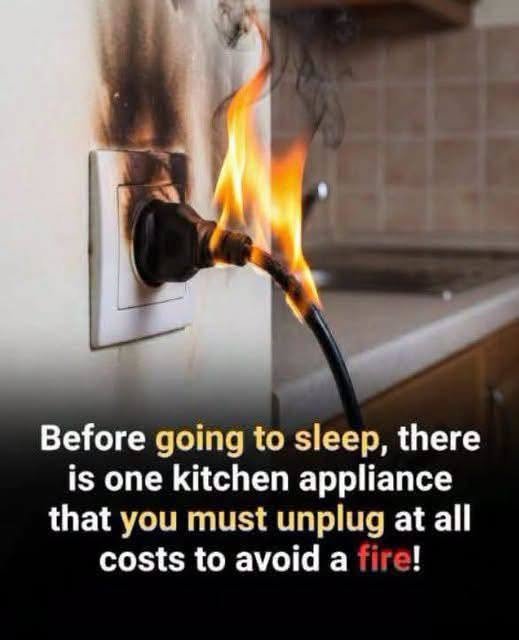
The image is shocking, almost cinematic in its destruction. Two standard black power cords are plugged into a wall outlet, but instead of delivering electricity quietly, the outlet is erupting in a violent pillar of orange and yellow flames. The heat is so intense that it has scorched the wall above it, leaving a trail of black soot. The bold text above the image serves as a stark, urgent warning: “Before going to sleep, there is one kitchen appliance that you must unplug at all costs to avoid a fire!”
For most people, the kitchen is the heart of the home. It is where we gather, cook, and share meals. But it is also the room with the highest concentration of high-voltage appliances, water sources, and flammable materials. We go to bed at night assuming that because we turned the switch off, the danger is gone. This is a dangerous misconception. Many modern appliances continue to draw power, generate residual heat, or hold electrical charge even when they are “off.”
The specific appliance this viral warning refers to is almost always the toaster (or toaster oven), though the principle applies to several other high-heat countertop devices. The toaster is uniquely dangerous because it combines extreme heat, flammable food particles (crumbs), and a heating element that remains live as long as it is plugged into the wall.
This comprehensive two-part guide will delve into the terrifying science of electrical fires. We will explore exactly why leaving certain appliances plugged in is a massive fire hazard, examine the specific dangers of the toaster and other common kitchen devices, and provide you with a comprehensive, life-saving protocol for keeping your home and family safe while you sleep.
Part 1 of 2
The Anatomy of an Electrical Fire: How Destruction Begins
To understand why unplugging an appliance is so critical, we must first understand the mechanics of an electrical fire. An electrical fire is not like a wood fire or a grease fire; it is a chemical and physical reaction that can happen in seconds.
The Role of Resistance and Heat
Electricity flows through wires, and the ease with which it flows is called conductance. When electricity encounters resistance—such as a frayed wire, a loose connection, or a component inside an appliance—it has to work harder to push through. This effort generates heat.
In a normal, functioning appliance, this heat is contained and managed. However, if there is a fault in the wiring, a buildup of dust, or a loose plug in the wall socket, the resistance increases exponentially. The temperature can rapidly exceed the melting point of the plastic casing and the insulation on the wires. Once the insulation melts, the live wires are exposed. If they touch each other, they create a “short circuit,” which produces a massive spark. This spark is the ignition source for an electrical fire.
The “Live” Wire Danger
The fundamental issue with leaving an appliance plugged in is that the internal components remain connected to the live electrical current in your home, even when the appliance’s primary switch is turned off.
Most appliances only switch off the “hot” wire, leaving the “neutral” wire connected. If a component inside the appliance fails—say, a thermostat in a toaster gets stuck in the “on” position, or a heating element deteriorates—the appliance can spontaneously turn on without warning. Alternatively, a power surge from the grid can bypass the switch entirely and force electricity into the dormant components, causing them to overheat and ignite.
The Chemistry of Burning Plastic
When an electrical fire starts, it is not just the appliance that burns; it is the plastic housing, the wire insulation, and the surrounding materials. Modern plastics are petroleum-based and burn incredibly hot and fast. As they burn, they release toxic, black smoke that can incapacitate a sleeping person within minutes. The image of the black soot on the wall is a testament to this toxic combustion.
The Primary Culprit: The Humble Toaster
Why is the toaster at the top of the “must unplug” list? It is a combination of its design, its function, and the environment in which it operates.
The Crumb Tray of Doom
Every time you make toast, microscopic particles of bread fall to the bottom of the toaster. Over weeks and months, these crumbs accumulate in the crumb tray. Bread is highly flammable, and when it dries out, it becomes excellent tinder.
The heating elements inside a toaster are designed to reach temperatures of over 600 degrees Fahrenheit to toast bread quickly. If a large crumb falls directly onto a live heating element, it can catch fire almost instantly. If the toaster is unplugged, the fire will likely smother itself or burn out without spreading. However, if the toaster is plugged in, the heating element remains live. The fire can spread to the plastic casing, and from there, to the cabinets, the wallpaper, or the curtains.
Mechanical Failure and “Stuck” Switches
A toaster works via a mechanical lever that pushes the bread down and engages the circuit. Over time, the mechanism can become sticky from grease or dust, or the internal thermostat (which pops the toast up when done) can fail.
If the thermostat fails while the toaster is plugged in, the heating elements will continue to glow red hot indefinitely. The toaster will eventually melt, ignite the plastic, and set the kitchen on fire. Unplugging the device physically severs the connection to the power grid, rendering this scenario impossible.
The Surge Protector Illusion
Many people believe that plugging their toaster into a surge protector adds a layer of safety. While a surge protector can protect the appliance from voltage spikes, it does not protect your home from a faulty appliance. In fact, if a toaster catches fire while plugged into a surge protector, the fire can easily spread to the plastic housing of the power strip, creating a much larger and more intense blaze.
The Second Culprit: The Coffee Maker
While the toaster is the most common answer to this viral warning, the coffee maker is arguably just as dangerous.
Water and Electricity: A Fatal Mix
Coffee makers combine water and high-voltage electricity in close proximity. The heating element is designed to boil water rapidly. If a seal fails, a hose cracks, or the carafe overflows, water can leak directly onto the live heating element or the electrical wiring at the base of the machine.
This creates an immediate short circuit, a shower of sparks, and a potential fire. If this happens while you are asleep in another room, the fire can quickly consume the plastic machine and spread to the kitchen counter.
The Auto-Start Feature
Modern coffee makers often feature programmable auto-start functions. These rely on a digital clock and internal memory. While convenient, they mean the machine is in a constant state of “standby,” drawing power 24/7. A sudden power surge, a lightning strike, or a software malfunction could theoretically trigger the heating element at 3:00 AM, boiling the machine dry and igniting the plastic casing.