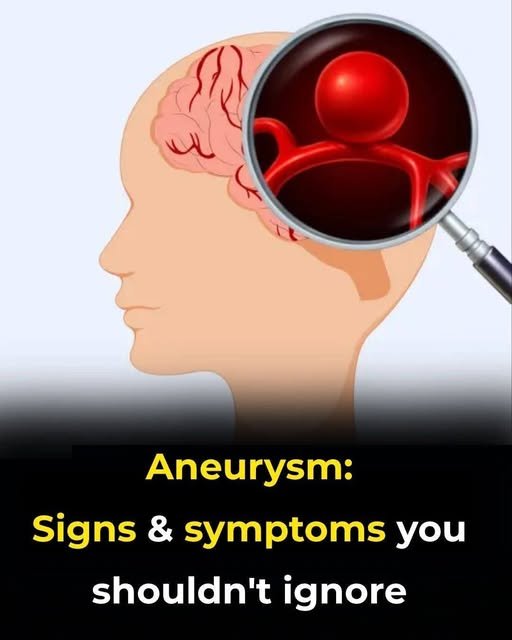
The image is a striking medical illustration of a human head in profile, revealing the complex network of blood vessels that supply the brain. At the base of the skull, near the back of the eye socket, a bright, glowing red bulbous sac protrudes from an artery. A yellow arrow points directly to this abnormality. The text below is a stark, urgent warning: “Aneurysm: Symptoms You Shouldn’t Ignore.”
An aneurysm is a balloon-like bulge in the wall of an artery. It occurs when the wall of the blood vessel becomes weakened and begins to bulge outward under the pressure of normal blood flow. While aneurysms can develop in any artery in the body, they are most dangerous when they occur in the brain. A brain aneurysm (also known as a cerebral aneurysm) is a silent, ticking time bomb. It often goes unnoticed for years, causing no symptoms. But if it ruptures, it can cause a devastating, life-threatening stroke.
The key to surviving an aneurysm is early detection and intervention. While some aneurysms can be monitored, others require surgical repair. Recognizing the warning signs of an unruptured aneurysm, and the sudden, catastrophic symptoms of a ruptured aneurysm, can save your life. This two-part article will explore the critical symptoms of an aneurysm, explain the difference between unruptured and ruptured aneurysms, and provide you with the knowledge to act quickly in a medical emergency.