Before Going to Sleep, There Is One Kitchen Appliance You Must Unplug at All Costs to Avoid a Fire!
The Hidden Danger in Your Kitchen
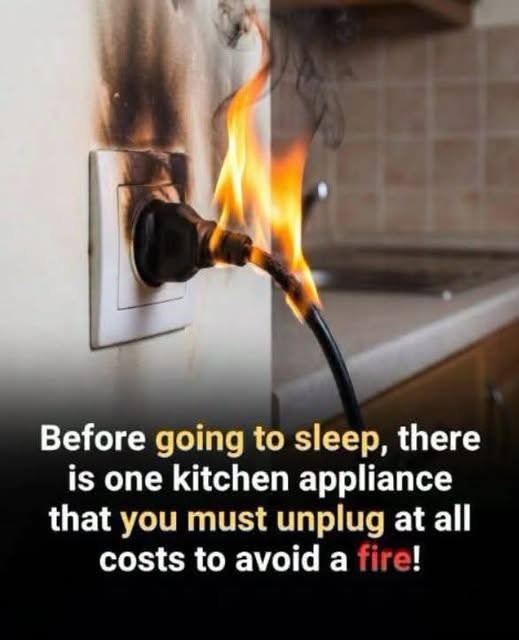
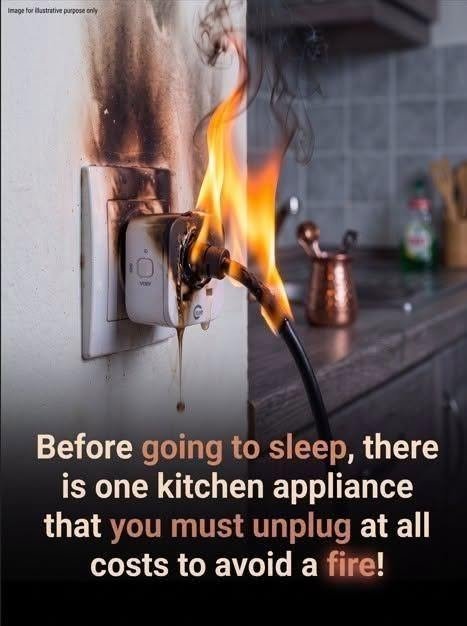
The image is a terrifying, nightmare-inducing scene. A standard wall outlet in a kitchen is engulfed in bright orange and yellow flames. A thick black power cord is plugged into the socket, and the fire is rapidly climbing up the cord and scorching the wall above it, leaving a trail of black, toxic soot. The text below delivers a stark, urgent warning: “Before going to sleep, there is one kitchen appliance that you must unplug at all costs to avoid a fire!”
For most of us, the kitchen is the heart of the home. It is where we gather, cook, and share meals. But it is also the room with the highest concentration of high-voltage appliances, water sources, and flammable materials. We go to bed at night assuming that because we turned the switch off, the danger is gone. This is a dangerous misconception. Many modern appliances continue to draw power, generate residual heat, or hold electrical charge even when they are “off.”
The specific appliance this viral warning refers to is almost always the toaster (or toaster oven), though the principle applies to several other high-heat countertop devices. The toaster is uniquely dangerous because it combines extreme heat, flammable food particles (crumbs), and a heating element that remains live as long as it is plugged into the wall. This comprehensive two-part guide will delve into the terrifying science of electrical fires, explore exactly why leaving certain appliances plugged in is a massive fire hazard, and provide you with a life-saving protocol for keeping your home and family safe while you sleep.