The Wrist Test Debunked: What Your Finger Overlap Really Says About Your Body Type
Social media is endlessly fascinated with quick, accessible tests that promise to reveal hidden truths about our bodies, our health, and our personalities. From personality quizzes to optical illusions, the internet loves a good categorizing exercise. One of the most persistent and widely shared trends is the “wrist test.”
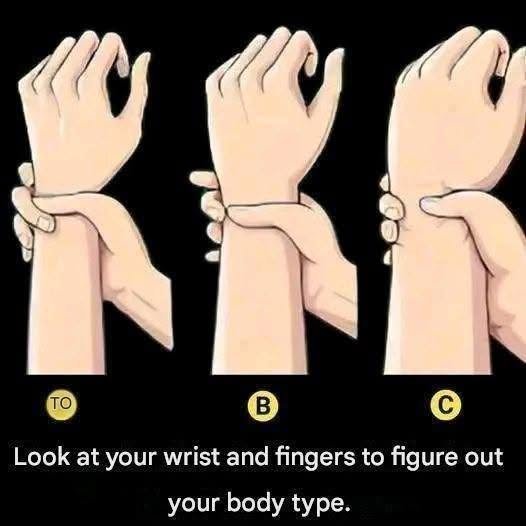
The image provided captures this viral trend perfectly. It shows three hands, each demonstrating a different way the thumb and index finger of one hand interact when wrapped around the opposite wrist. The labels beneath them read “TO” (likely a typo for “A”), “B,” and “C.” The accompanying text challenges the viewer: “Look at your wrist and fingers to figure out your body type. A, B or C? I tried this wrist test! Which one are you?”
For millions of people who have tried this, the results seem to offer a neat categorization: small frame, medium frame, or large frame. But is this test scientifically accurate? Does your finger overlap actually determine your metabolic rate, your genetic potential for muscle growth, or your overall “body type”?
The short answer is: it is a fun parlor trick that gives a rough estimate of your skeletal frame size, but it is an oversimplification of human anatomy. It does not dictate your health, your fitness potential, or your ideal weight.
This comprehensive guide will dissect the wrist test, explain the anatomical reality behind the overlap, explore the history of “body typing,” and provide a deeper, evidence-based understanding of how to truly assess your body composition and health.
Decoding the Wrist Test: What A, B, and C Actually Mean
Before delving into the science, let us look at what the viral image is actually asking you to do. The test involves wrapping the thumb and middle finger (or index finger) of one hand around the wrist of the other hand, just below the wrist bone.
Here is what the three results typically indicate in the context of the trend:
Result “TO” (A): Fingers Overlap
If your thumb and finger overlap significantly, the internet will tell you that you have a small frame (often associated with the “ectomorph” body type).
The typical narrative: You are naturally slender, have a fast metabolism, have difficulty gaining weight or muscle, and have thin wrists and ankles.
Result B: Fingers Just Touch
If your thumb and finger barely touch end-to-end, you are categorized as having a medium frame (the “mesomorph”).
The typical narrative: You have a balanced, athletic build. You can gain muscle relatively easily and lose fat without extreme effort. You have a proportional bone structure.
Result C: Fingers Do Not Touch
If there is a gap between your thumb and finger, you are told you have a large frame (the “endomorph”).
The typical narrative: You have a broader, more solid bone structure. You may be prone to storing body fat more easily and might struggle with weight loss.
The Anatomical Reality: Why Fingers Overlap
While the internet labels these results as definitive “body types,” the test is actually measuring something much simpler: the circumference of your wrist compared to the length of your fingers.
Bone Structure and Skeletal Frame
Human beings come in a vast array of shapes and sizes. The skeletal structure is determined by genetics. The test essentially measures the thickness of the bones in your wrist. People with naturally larger bones will have a larger wrist circumference, making it harder for their fingers to meet. Conversely, people with smaller bones will have thinner wrists, allowing their fingers to overlap.
The Flawed Logic of Finger Length
The primary flaw in the test is that it assumes finger length and wrist circumference are perfectly proportional to overall skeletal size and body fat.
Imagine a person who is 6’4″ with massive, long hands and fingers, but a relatively thin, small-boned wrist. Their fingers might overlap easily, leading the test to categorize them as “small-framed,” even though they are physically huge. Conversely, a shorter person with thick, stubby fingers might find a gap, classifying them as “large-framed” despite a petite overall build. The test is highly dependent on the ratio of finger length to wrist girth, not absolute body size.
The History of Body Typing: From Ancient Greece to the Internet
The desire to categorize human bodies is not new. It dates back thousands of years and has often been used to link physical traits to personality or health outcomes.
The Somatotypes of the 1940s
The terms ectomorph, mesomorph, and endomorph were popularized in the 1940s by American psychologist William Sheldon. He developed a theory of somatotypes, suggesting that human bodies could be categorized based on three extreme body shapes, which were related to embryonic development.
Ectomorph: Thin, long limbs, low body fat, small frame.
Mesomorph: Muscular, athletic, broad shoulders, low body fat.
Endomorph: Softer, rounder bodies, higher body fat, large frame.
The Scientific Consensus Today: Modern science regards Sheldon’s original somatotypes as pseudoscientific. The idea that body shape dictates personality traits (which Sheldon strongly promoted) has been thoroughly debunked. While fitness professionals still use the terms as loose descriptors for bodybuilding strategies, they are not recognized as distinct biological categories. Human bodies are a complex continuum, and most people are a blend of all three types.
Why the “Body Type” Label is Misleading
Relying on the wrist test to define your “body type” can be not only inaccurate but also harmful, as it can create a false sense of limitation or expectation.
Muscle vs. Fat vs. Bone
Your body is composed of several different tissues, including bone, muscle, fat, and water. The wrist test only measures bone. It says nothing about your body composition—how much muscle you have versus how much fat.
You can be “small-framed” (A) but carry excess body fat, or you can be “large-framed” (C) and be incredibly lean and muscular. The frame size does not dictate your metabolism or your propensity for weight gain.
The Metabolism Myth
There is a pervasive myth that “small-framed” people have fast metabolisms and “large-framed” people have slow metabolisms. While basal metabolic rate (BMR) does vary based on body size (larger bodies require more calories just to exist), it is not rigidly tied to your wrist size. Your metabolism is primarily driven by your muscle mass, age, sex, activity level, and genetics.
How to Actually Measure Your Body Frame Size
If you are curious about your actual skeletal frame size (which can be useful for determining a healthy weight range or buying watch bands and bracelets), the finger-overlap test is too imprecise.
Medical professionals and nutritionists use a more accurate formula that considers your height and wrist circumference.
The Standard Frame Size Formula
Measure your wrist: Use a flexible measuring tape to measure the circumference of your wrist just below the wrist bone.
Measure your height: Measure your height in inches or centimeters.
The Formula for Women:
Small frame: Height under 5’2″ (157 cm) and wrist less than 5.5 inches (14 cm); or Height 5’2″ to 5’5″ (157-165 cm) and wrist 6 inches (15.2 cm); or Height over 5’5″ (165 cm) and wrist 6.25 inches (15.9 cm).
Medium frame: Height under 5’2″ and wrist 5.5-5.75 inches (14-14.6 cm); or Height 5’2″ to 5’5″ and wrist 6.25-6.5 inches (15.9-16.5 cm); or Height over 5’5″ and wrist 6.5-6.75 inches (16.5-17.1 cm).
Large frame: Height under 5’2″ and wrist over 5.75 inches; or Height 5’2″ to 5’5″ and wrist over 6.5 inches; or Height over 5’5″ and wrist over 6.75 inches.
The Formula for Men:
Small frame: Height over 5’5″ (165 cm) and wrist 5.5 to 6.5 inches (14-16.5 cm).
Medium frame: Height 5’5″ to 5’11” (165-180 cm) and wrist 6.5 to 7.5 inches (16.5-19 cm).
Large frame: Height over 5’11” (180 cm) and wrist over 7.5 inches.
This formula, while still an estimate, provides a much more accurate picture of your skeletal structure than wrapping your fingers around your wrist.
Better Ways to Assess Your Health and Body Composition
If your goal is to understand your health, lose weight, or improve your fitness, frame size is a minor detail. You need to look at metrics that assess your actual body composition and overall health.
1. Body Mass Index (BMI)
BMI is a widely used screening tool that calculates a ratio of weight to height. While it is a good population-level metric, it has significant flaws. It does not distinguish between muscle and fat. A highly muscular, large-framed athlete may have a BMI that classifies them as “obese,” even though they have very low body fat. Conversely, someone with a “normal” BMI might be “skinny fat” (normal weight but high body fat percentage and low muscle mass).
2. Waist Circumference and Waist-to-Hip Ratio
Where you carry your body fat matters more than how much you have. Visceral fat (the fat around your internal organs) is far more dangerous than subcutaneous fat (the fat under your skin).
Waist circumference: Measure around the narrowest part of your torso. A waist over 35 inches for women or 40 inches for men is associated with a higher risk of cardiovascular disease and type 2 diabetes.
Waist-to-hip ratio: Measure your waist and your hips, then divide the waist measurement by the hip measurement. A ratio higher than 0.85 for women or 0.90 for men indicates a higher health risk.
3. Body Fat Percentage
This is the most accurate way to understand your body composition.
DEXA Scan: The gold standard for measuring body fat, muscle mass, and bone density.
Bioelectrical Impedance Analysis (BIA): Found in smart scales and gyms, it sends a small electrical current through the body to estimate fat percentage. It is convenient but can be affected by hydration levels.
Skinfold Calipers: A trained professional uses calipers to pinch and measure fat in specific areas of the body.
The Psychological Impact of Internet “Tests”
The viral wrist test and similar social media categorizations can have a subtle but real psychological impact.
Self-Fulfilling Prophecies
If someone takes the wrist test, finds they are a “C” (large frame), and reads that they have a “slow metabolism and struggle to lose weight,” they might adopt a defeatist attitude. They might believe that diet and exercise won’t work for them because of their “body type,” leading to unhealthy behaviors.
The Danger of Oversimplification
Human biology is extraordinarily complex. Your health is determined by thousands of interacting factors, including genetics, environment, lifestyle, diet, sleep, and stress. Reducing your entire physiological profile to a single finger-overlap test is a massive oversimplification that ignores the nuances of real health.
What Your Wrist Test Actually Tells You (If Anything)
If you have tried the test and found your result, what is the takeaway?
If your fingers overlap (A/TO): You have a thinner wrist relative to your finger length. You have small bones.
If your fingers touch (B): You have a medium wrist relative to your finger length. You have medium bones.
If your fingers don’t touch (C): You have a thicker wrist relative to your finger length. You have larger bones.
That is the full extent of the scientific information you can glean from this test. It is a fun, quick anatomical quirk, but it does not dictate your metabolism, your personality, your athletic potential, or your health.
Conclusion
The viral wrist test is a fascinating example of how the internet simplifies complex biology into bite-sized, engaging content. While it can be a fun conversation starter or a quick way to estimate your skeletal frame size, it is not a medical tool. It does not accurately categorize your body type or predict your health outcomes.
Your “body type” is a unique combination of your genetic makeup, your lifestyle, and your environment. It cannot be defined by the gap between your thumb and index finger. If you are interested in your health and fitness, ignore the viral tests and focus on the fundamentals: a balanced diet, regular exercise, quality sleep, and routine check-ups with your healthcare provider. The best measure of your body is not how your fingers wrap around your wrist, but how you feel, how you function, and how you care for yourself.
Frequently Asked Questions
Q: Is the wrist test scientifically accurate? No. The wrist test is a very rough, unscientific estimate of skeletal frame size. It does not account for finger length, overall body size, or body composition, making it inaccurate for determining a “body type.”
Q: What is the “TO” in the image? The “TO” in the image is almost certainly a typo or a digital artifact. The test typically presents three options: A, B, and C, representing small, medium, and large frame sizes.
Q: Does a small wrist mean I have a fast metabolism? Not necessarily. Your resting metabolic rate is primarily determined by your muscle mass, age, sex, and activity level. Wrist size is not a reliable predictor of metabolic speed.
Q: Can I change my body frame size? No. Your skeletal frame size is determined by your genetics and is set for life. You cannot change the thickness of your bones. However, you can change your muscle mass and body fat, which affects your overall body shape.
Q: How do I know if I have a small, medium, or large frame? The most accurate way to determine your frame size is by using the height-to-wrist circumference formula used by nutritionists, or by having a professional assess your body composition.
Q: Are ectomorph, mesomorph, and endomorph real? These terms, known as somatotypes, were developed in the 1940s. Modern science considers them pseudoscientific for categorizing human health or personality. They are still loosely used in bodybuilding, but most people are a blend of all three.
Q: Does my body type determine what exercises I should do? No. Everyone benefits from a combination of strength training, cardiovascular exercise, and flexibility work. Your exercise routine should be based on your goals, your current fitness level, and your preferences, not a label from an internet test.
Q: What is the most accurate way to measure body fat? A DEXA scan is considered the gold standard for measuring body fat percentage and bone density. However, a combination of waist circumference, BMI, and a bioelectrical impedance scale can provide a good overall picture.
Q: Why do people love these internet tests so much? Psychological studies suggest that humans have a natural desire to categorize themselves and others. These tests provide a sense of identity and community (e.g., “I’m an A, just like you!”), even if the categorization is not scientifically valid.