Visible Veins on Your Hands: What They Really Reveal About Your Body—and When to Pay Attention
Broader Implications: What Vascularity Says About the Body as a Whole
The appearance of the veins on your hands is a window into a complex interplay of anatomy, physiology, and lifestyle. It reflects your body fat distribution, your genetic inheritance, the thickness of your skin, and the dynamic demands you place on your circulatory system. It is not a static feature; it changes with age, activity, temperature, and hydration.
The Fitness Signal: Vascularity as a Marker of Cardiovascular Responsiveness
In the context of fitness, visible veins are often a sign of a well-trained cardiovascular system. The ability of superficial veins to dilate and accommodate increased blood flow is a marker of vascular responsiveness. Research suggests that exercise training can improve endothelial function, the ability of blood vessels to dilate in response to increased demand. This is a positive physiological adaptation, not a warning sign. However, it is important to recognize that vascularity is not a direct measure of cardiovascular health. A person with visible veins is not necessarily “healthier” than a person without them, and a person without visible veins is not necessarily less fit.
The Aging Trajectory: Normal Changes, Not Decline
The increasing visibility of hand veins with age is a normal, predictable consequence of thinning skin and weakening venous valves. It is not a sign of decline or disease. It is a reminder that the body is a dynamic, changing system, and that the visible markers of aging are often simply the result of mechanical and structural shifts rather than pathological processes. Understanding this can help reduce anxiety and foster a more accepting relationship with the body’s changes.
Conclusion: Reading the Signals Without Fear
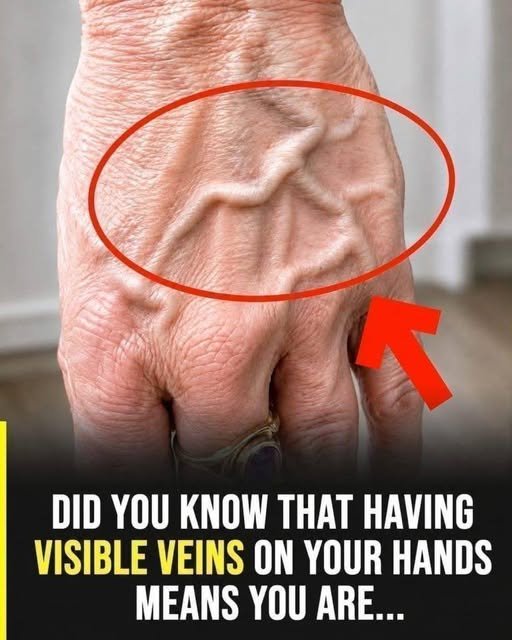
The viral image of the bulging hand vein, circled in red and paired with an ominous caption, is designed to provoke anxiety. But the truth is far more reassuring. Visible hand veins are, in the vast majority of cases, a normal and harmless feature of human anatomy. They are the result of low body fat, genetics, skin thickness, age, exercise, and heat—factors that are entirely unrelated to “toxic blood” or hidden disease.
The key is to read the signals without fear. If your veins are visible but painless, symmetrical, and have been that way for as long as you can remember, there is no reason for concern. If, however, you notice a sudden change—a vein that becomes painful, red, warm, or swollen—then it is time to seek medical advice. This is not about living in fear of your own body; it is about understanding it. Your hands are a map of your physiology, and like any map, they are useful when read correctly. The goal is not to erase the veins from your hands, but to understand what they are telling you—and to know when the message requires a professional’s attention.
Frequently Asked Questions
1. Is it normal to have visible veins on my hands? Yes. Visible veins on the hands are extremely common and are usually a normal, benign feature of human anatomy. They are typically caused by low body fat, genetics, thin skin, age, exercise, or heat, and they do not indicate a health problem in the vast majority of cases.
2. Do visible hand veins mean I have “toxic blood” or poor circulation? No. There is no scientific evidence that visible hand veins are a sign of “toxic blood” or poor circulation. The blue-green appearance of veins is an optical effect, and their visibility is related to anatomy and blood flow, not the purity of the blood. In fact, visible veins can be a sign of a responsive circulatory system.
3. Why do my hand veins become more visible when I exercise? During exercise, your blood pressure rises and blood flow to your muscles increases. Your superficial veins dilate to accommodate this increased volume, which pushes them closer to the skin’s surface and makes them more visible. This is a normal, temporary physiological response.
4. Can low body fat cause prominent hand veins? Yes. Subcutaneous fat acts as a cushion that conceals veins. People with low body fat, whether due to genetics, weight loss, or an athletic lifestyle, often have more visible veins because there is less tissue between the vein and the skin.
5. At what age do hand veins typically become more visible? Hand veins often become more pronounced with age, typically becoming more noticeable in middle age and beyond. This is due to the thinning of the skin and the weakening of venous valves, which can cause blood to pool and the veins to enlarge.
6. When should I see a doctor about my hand veins? You should see a doctor if a vein suddenly becomes painful, red, warm, swollen, or hard, or if you notice a new, unexplained prominence in one hand. These could be signs of superficial thrombophlebitis or a more serious condition like deep vein thrombosis (DVT), which requires medical evaluation.
7. Are visible hand veins a sign of fitness or good health? Visible hand veins are often associated with leanness and frequent exercise, and they can be a sign of a responsive circulatory system. However, they are not a direct measure of overall health or fitness. A person with visible veins is not necessarily healthier than a person without them, and vice versa.
8. Can I reduce the appearance of visible hand veins? If you are concerned about the cosmetic appearance of your hand veins, there are treatment options available, including sclerotherapy and laser therapy. However, these are typically considered cosmetic procedures and may not be covered by insurance. For most people, visible hand veins do not require any treatment and are simply a normal part of their anatomy.