The Mystery of the Viral Grandfather Sticker: Unraveling the Mushroom Face Illusion
Introduction: A Simple Photo That Sparked a Global Conversation
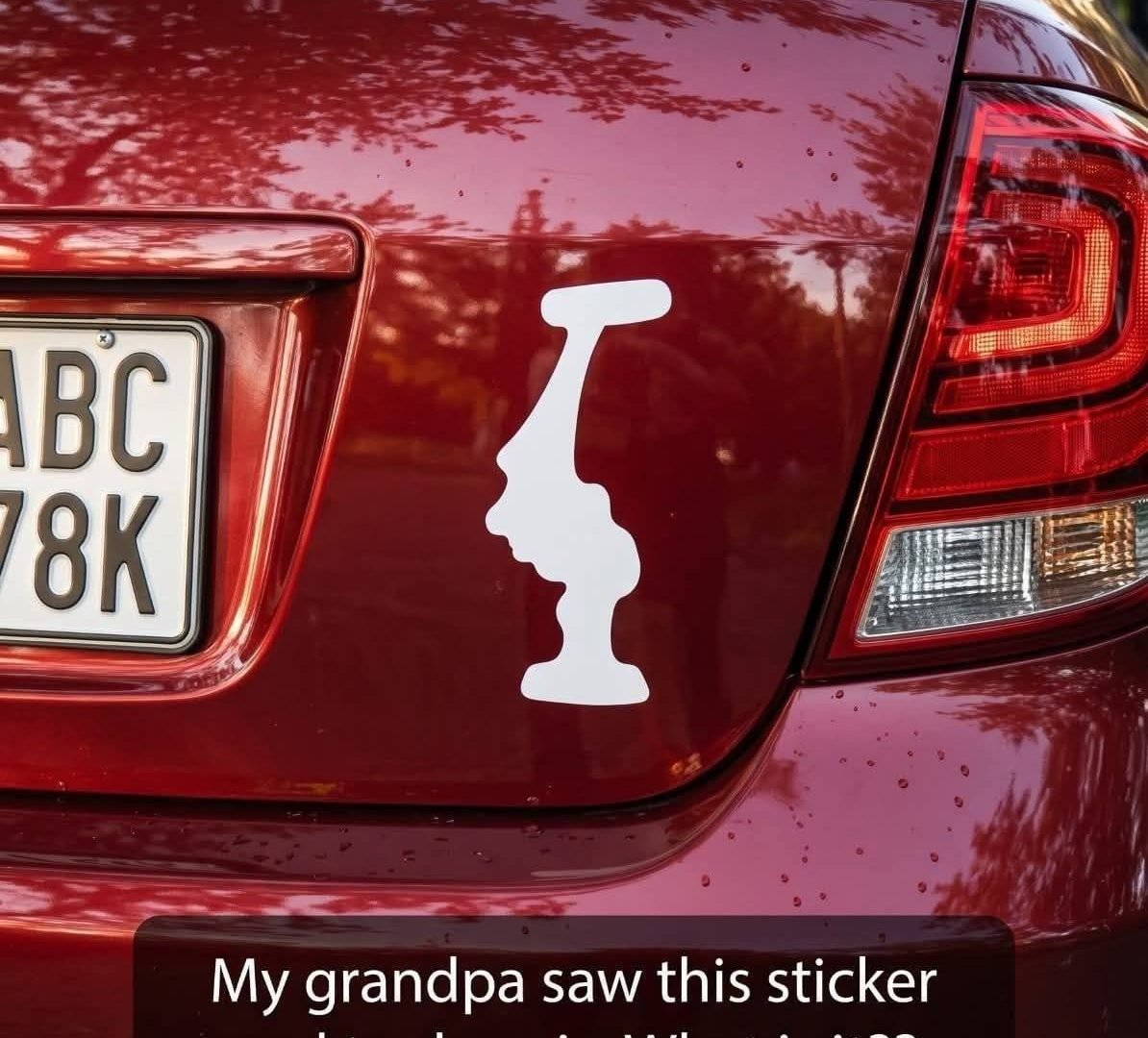
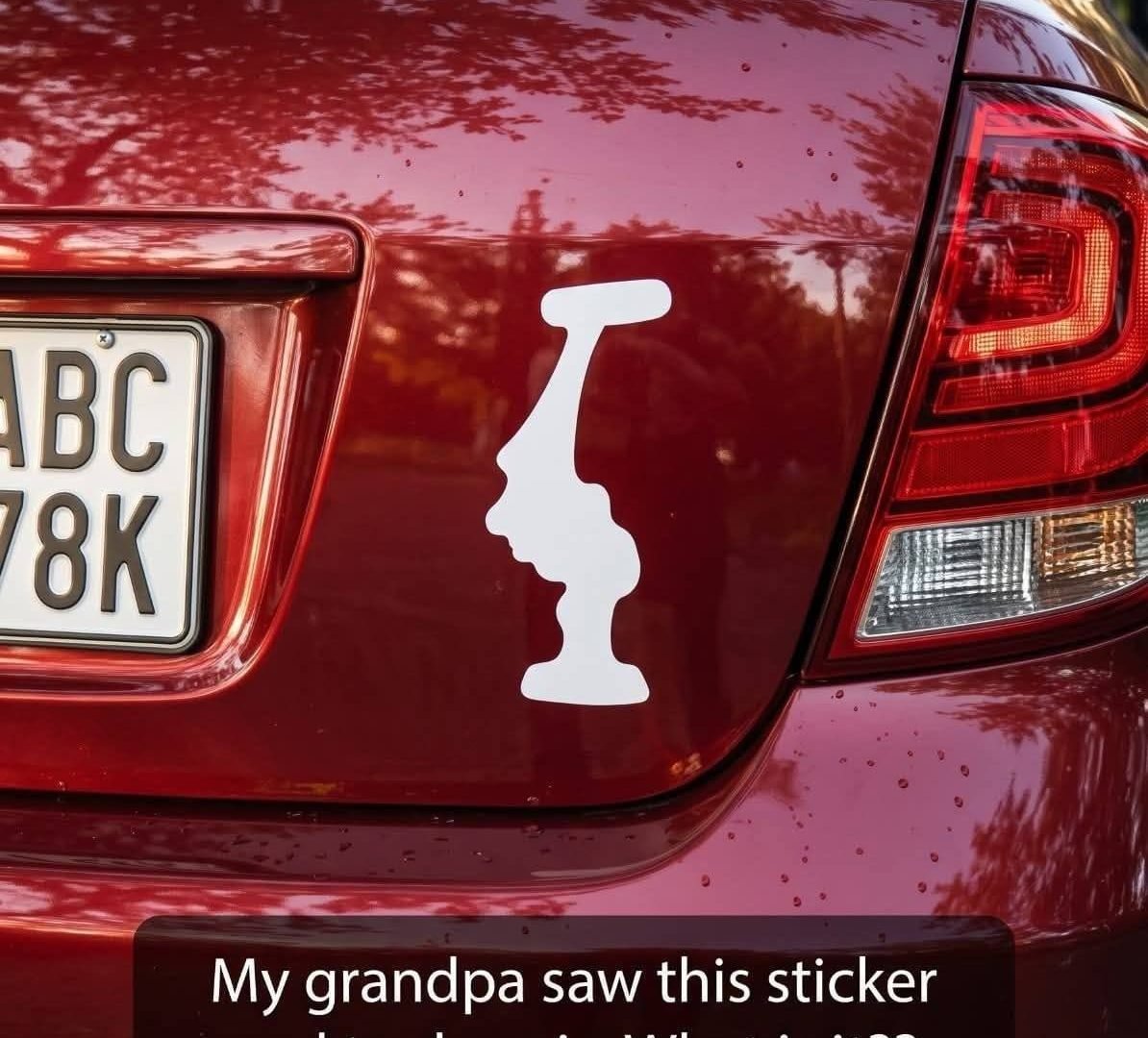
In the age of endless digital content, where millions of images are uploaded every single hour, it is rare for a simple, unassuming photograph to capture the collective imagination of the internet. Yet, that is precisely what happened when an individual shared a picture taken by their grandfather. The premise was remarkably straightforward. The grandfather, driving or walking through a parking lot, noticed a peculiar white sticker affixed to the rear bumper of a red car. Puzzled by the design, he pulled out his phone, snapped a photograph, and sent it to his grandchild with a simple, direct question: “What is it?? He wants to know.”
This innocent inquiry, paired with the image of the sticker, transformed into a viral sensation. The photograph showed a solid white silhouette against the glossy red paint of the vehicle. To some, it looked like a bizarre, asymmetrical mushroom. To others, it appeared to be the side profile of a human face looking to the left. The caption added by the grandchild, explaining the grandfather’s genuine confusion, acted as a catalyst. It invited the entire internet to weigh in, turning a private moment of curiosity into a massive, crowd-sourced puzzle.
This comprehensive two-part article will explore the phenomenon surrounding this specific photograph. We will dissect the visual mechanics of the sticker, delve into the psychological reasons why such images capture our attention, and examine the broader cultural context of viral mysteries. We will explore how a simple bumper sticker became a Rorschach test for the internet, forcing viewers to confront the fascinating ways in which the human brain processes visual information.
The Visual Puzzle: Deconstructing the Bumper Sticker
To understand why the grandfather was so confused—and why millions of others shared his bewilderment—it is essential to examine the sticker itself. The design is a masterclass in minimalist graphic art, relying entirely on the manipulation of negative space and silhouette to create a dual image.
The Mushroom Interpretation
At first glance, the most immediate interpretation for many viewers is that of a mushroom. The white shape features a wide, flat top that resembles the cap of a standard button mushroom. Below the cap, the shape narrows into a thick, irregular stem. The overall silhouette is slightly asymmetrical, with the left side featuring jagged, uneven edges, while the right side is relatively smooth. For someone scanning the back of a car, the brain quickly categorizes this shape as a piece of fungi. This is the most literal, straightforward reading of the image, and it is likely what the creator of the sticker intended as the initial visual hook.
The Human Profile
However, the true brilliance of the sticker lies in the second interpretation. By shifting focus to the jagged left edge, the image completely transforms. The protruding section near the top becomes a forehead. The indentation below it forms the bridge of a nose. The next outward protrusion is the tip of the nose, followed by the distinct curves of the upper lip, lower lip, chin, and finally, the neck.
Suddenly, the “mushroom” is no longer a plant. It is the side profile of a human face, looking off to the left. Once the viewer sees the face, it becomes almost impossible to unsee it. The brain locks onto the recognizable human features, and the mushroom interpretation recedes into the background. The visual flip between these two distinct images is instantaneous and involuntary, creating a moment of cognitive dissonance that is deeply engaging.
The Role of Negative Space
The sticker relies heavily on the concept of negative space. In art and design, negative space is the area around and between the subject of an image. In this case, the white sticker is the positive space, but the shape is defined by the empty red space surrounding it. The creator has cleverly used the outline of the white shape to imply the contours of a face, demonstrating how the human brain is wired to find familiar patterns even in abstract forms. It is a visual trick that forces the viewer to actively participate in the creation of the image, making the experience highly interactive.
The Psychology of Ambiguous Images: Why Our Brains Flip
The grandfather’s confusion is a natural human reaction to an ambiguous image. When presented with a visual stimulus that can be interpreted in more than one way, the human brain does not simply see both images simultaneously. Instead, it alternates between them, a phenomenon known in psychology as a “bistable perception.”
Figure-Ground Organization
This phenomenon is closely related to the Gestalt principle of figure-ground organization. According to this principle, the human mind organizes visual information into a “figure” (the object of focus) and a “ground” (the background). In the case of the bumper sticker, the brain struggles to decide which part of the image is the figure and which is the ground.
When you see the mushroom, the white shape is the figure, and the red car is the ground. When you see the face, the white shape is still the figure, but the internal contours are interpreted differently, shifting the perspective of the brain. The brain is constantly trying to make sense of the world by categorizing visual input. When an image resists a single, definitive categorization, the brain enters a state of mild conflict, cycling back and forth between the possible interpretations. This cognitive “flipping” is what makes optical illusions so fascinating and often addictive to look at.
Pareidolia: The Human Tendency to See Faces
The ability to see the human profile in the sticker is a specific example of a broader psychological phenomenon known as pareidolia. Pareidolia is the tendency for the human mind to perceive a specific, often meaningful image in a random or ambiguous visual pattern. The most common form of pareidolia is seeing faces in inanimate objects—such as seeing a face in the front of a car, in the clouds, or in a piece of toast.
Evolutionary psychologists believe that this tendency is deeply ingrained in human biology. For our ancestors, the ability to quickly recognize a human face—whether friend or foe—was a critical survival skill. The brain is thus heavily optimized to detect facial patterns, sometimes even when they are not actually there. The bumper sticker triggers this ancient survival mechanism, which is why the face interpretation is so compelling and immediate for many viewers.
The Power of the “Grandpa” Narrative
While the sticker itself is an interesting optical illusion, it is the caption accompanying the photograph that turned it into a viral hit. The text reads: “My grandpa saw this sticker on a car and took a pic, What is it?? He wants to know.” This simple sentence provided a narrative framework that dramatically amplified the image’s appeal.
The Wholesome Factor
The internet is often characterized by cynicism, sarcasm, and hostility. In this environment, a story about a grandfather genuinely confused by a modern optical illusion feels refreshingly wholesome. It evokes a sense of intergenerational connection, reminding users of their own older relatives who might struggle with new technology or contemporary cultural trends. The grandfather is not portrayed as foolish; rather, his curiosity is presented as endearing. He saw something he didn’t understand, and his first instinct was to learn more about it. This makes him a highly sympathetic figure, and audiences are naturally inclined to want to help him.
The Call to Action
The phrase “He wants to know” functions as a gentle call to action. It invites the audience to step in and provide the answer. This transforms the passive act of scrolling past a picture into an active participation in a community effort. Comments sections on posts like this often fill up with people offering their interpretations, some helpful and some humorous. The shared mission of explaining the sticker to the grandfather creates a sense of collective purpose, even if it is entirely trivial. It is a bonding experience for a digital community.
Bridging the Generational Divide
The post also highlights the gap between older and younger generations when it comes to visual literacy and internet culture. While a younger person might immediately recognize the image as a popular type of optical illusion or a trendy piece of meme art, the grandfather approaches it with fresh eyes. He is not burdened by the context of viral trends; he simply sees a confusing shape on a car. This gap in understanding makes the post relatable to younger users who often find themselves explaining modern internet phenomena to their parents or grandparents. It is a shared cultural experience that resonates across demographic boundaries