The Mystery of the Bumper Panel Solved: What That Little Square Cover Is Really For
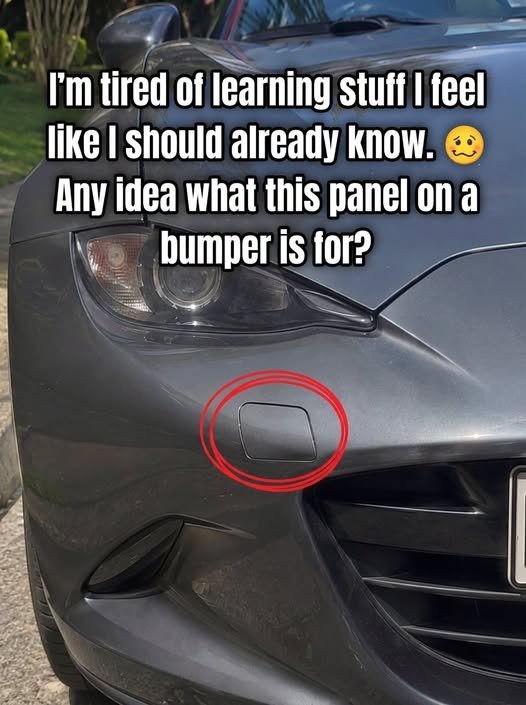
We have all experienced those moments of sudden, embarrassing realization where we discover we have been completely oblivious to the function of an everyday object. The viral social media post featuring a grey car bumper perfectly captures this universal feeling. The image highlights a small, square plastic panel located just below the headlight, circled in red, with the accompanying caption: “I’m tired of learning stuff I feel like I should already know. Any idea what this panel on a bumper is for?”
The internet is full of guesses when these images pop up. Some speculate it is a secret button to open a hidden compartment, like something out of a James Bond movie. Others assume it is a sensor for parking assist or a covered fog light. But the truth is far more practical and incredibly important for the safety and recovery of your vehicle.
That small, seemingly insignificant square of painted plastic is known as a tow hook cover (or tow eye cap). It is a crucial, if often overlooked, component of modern automotive design. It hides the threaded socket where you screw in an emergency towing eye, allowing a tow truck to pull your vehicle out of a ditch or onto a flatbed without damaging the chassis.
This comprehensive guide will explore every detail about this mysterious bumper panel. We will break down why it exists, how to use it when you are stranded, the essential safety warnings you must know, the common myths surrounding it, and what to do if yours goes missing. By the end, you will never look at a car bumper the same way again.
The Big Reveal: What Is a Tow Hook Cover?
The panel in the image is a removable plastic cap designed to blend seamlessly into the painted bumper of your car. Beneath this cap is a strong steel loop or a threaded hole.
The Anatomy of the Towing System
To understand the cover, you must understand the system it protects. Modern cars are no longer built like the heavy, steel-framed land yachts of the 1960s. To meet strict fuel economy standards and improve safety, cars are now built with unibody construction, using lightweight metals and specifically designed “crumple zones” to absorb impact in a crash.
Because the front and rear ends of modern cars are designed to crush upon impact, they do not have sturdy external bumpers to attach a tow strap to. If a tow truck were to wrap a chain around your front axle or bumper to pull you out, it would likely rip the bumper off or cause thousands of dollars in structural damage.