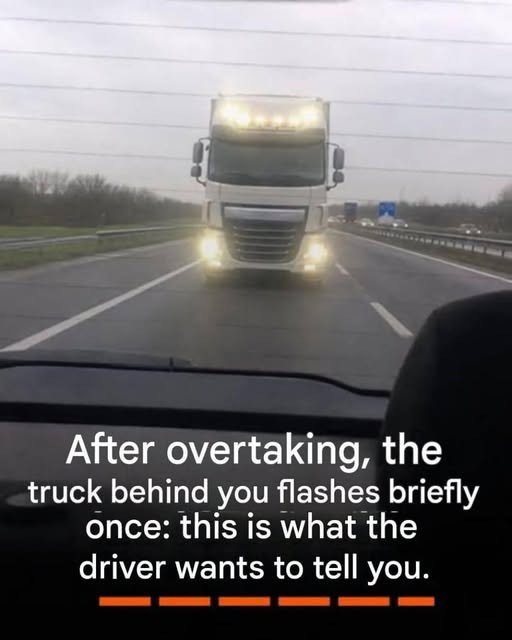
After Overtaking, the Truck Behind You Flashes Briefly Once: The Hidden Language of the Highway
Part 1 of 2: Decoding the Flash
Introduction: The Silent Conversation on the Open Road
The highway is often perceived as a solitary place, a landscape of individual vehicles moving in parallel, each enclosed in its own metal bubble. Yet, beneath this surface of isolation, a complex and vital system of non-verbal communication is constantly taking place. Drivers are engaged in a continuous, silent conversation, using a shared vocabulary of signals, gestures, and light flashes to navigate the complexities of traffic. For those who know how to listen, the road speaks volumes. One of the most important and frequently misunderstood phrases in this silent language occurs when you have just completed an overtaking maneuver: a brief, singular flash of headlights from the truck you just passed.
The image accompanying this article captures a familiar and somewhat intimidating scenario. You are driving on a multi-lane highway, and you have just accelerated past a massive, eighteen-wheel semi-truck. You check your rearview mirror and see the truck looming behind you. Suddenly, the truck’s headlights flash once. For a novice driver, this can be a moment of confusion or even anxiety. Is the truck driver angry? Are they warning you of a danger ahead? Are they trying to tell you to speed up or get out of the way?
The reality is far more mundane, yet profoundly important for highway safety. That single flash is almost always a gesture of professional courtesy and a critical safety warning. It is the truck driver telling you, in the clearest way possible, “You are clear. You have enough space. It is safe to pull back into the lane.” Understanding this simple signal is more than just a fun piece of trivia; it is an essential skill for anyone who shares the road with commercial vehicles. It is a key that unlocks a greater understanding of the physics of large trucks, the dangers of blind spots, and the unwritten rules of the road that keep us all safe.
The Physics of the Pass: Why You Need the Signal
To fully appreciate why that flash of light is so crucial, we must first understand the physical realities of passing a large commercial truck. A standard semi-trailer can be seventy to eighty feet long and weigh up to 80,000 pounds when fully loaded. These are not just big cars; they are rolling behemoths with fundamentally different driving dynamics than the average passenger vehicle.
When you decide to overtake a truck, you are entering a high-stakes maneuver. You accelerate into the passing lane, move alongside the cab, and then face a daunting stretch of sheer, flat metal as you traverse the length of the trailer. During this time, you are highly vulnerable. Your vehicle is in the passing lane, and you need to merge back into the right lane as soon as it is safe to do so. The problem is that as you pass the truck, your own rearview mirror becomes useless for seeing the front of the truck. You are essentially driving blind regarding the truck’s exact position relative to your rear bumper.
This is where the truck driver’s perspective becomes invaluable. The driver sits high up in the cab, with a commanding view of the road ahead and, crucially, a wide-angle view of their own front bumper through their side mirrors. As you pass, the driver watches your car clear the front of their cab. They can see the exact distance between your rear bumper and their front grille. When that distance is safe—when you are far enough ahead that they can see your entire vehicle in their mirror and have enough room to brake without hitting you—they flash their high beams. It is a gift of visibility. They are using their superior vantage point to ensure your safety.
The Rule of the Road: The “All Clear” Signal
In the professional trucking community, the single flash of the headlights is widely recognized as the “all clear” signal. It is a long-standing tradition that dates back decades, passed down from veteran drivers to rookies. It is a simple, efficient way to communicate a complex piece of information: “I see you. You are past my cab. You have enough room to merge over. Go ahead.”
For the driver in the passing lane, this flash is a massive relief. It removes the guesswork from the merge. Instead of having to estimate the distance visually—a task made difficult by the sheer size of the truck and the lack of a clear reference point—you can rely on the truck driver’s trained eye. They know exactly how much space is needed to prevent a collision. By flashing their lights, they are effectively giving you permission to re-enter the right lane. It is a small act of kindness that smooths the flow of traffic and reduces the likelihood of a dangerous cut-off maneuver.
The Danger of the “Cut-Off”: Why Space Matters
The flash from the truck driver is not just a friendly gesture; it is a crucial safety measure designed to prevent one of the most dangerous scenarios on the highway: the cut-off. When a driver overtakes a truck and merges back into the right lane too soon, they are forcing the truck driver to react. Because of the massive weight of the truck, its stopping distance is exponentially greater than that of a car. A fully loaded semi-truck can take the length of two football fields to come to a complete stop from highway speeds.
If you merge back in front of a truck and immediately slow down or encounter traffic, the truck driver may not have enough time or space to stop. They cannot simply slam on the brakes like a car; their momentum is too great. In a collision between a car and a semi-truck, the car will always be the loser. The single flash of the headlights is the truck driver’s way of protecting you from yourself. They are telling you, “Wait. Don’t cut me off. Give me enough space to maintain a safe following distance.” When you see that flash, it means you have finally achieved that safe distance, and the driver is comfortable with you being in front of them.
Beyond the Flash: Other Uses of Headlight Flashing
While the single flash after an overtaking maneuver is a specific “all clear” signal, it is important to recognize that headlight flashing is a versatile communication tool with multiple meanings. Context is everything. A flash of headlights can mean:
Police Ahead: If an oncoming driver flashes their lights at you, they are often warning you of a speed trap or a police presence ahead. It is a modern form of the old citizen band (CB) radio warning.
Your Headlights Are Off: If a driver is flashing their lights at you at night, they might be trying to tell you that your headlights are not on, or that your high beams are blinding them.
A Hazard Ahead: A flash can also be a warning of an accident, debris on the road, or a sudden traffic jam ahead.
“Thank You”: Sometimes, a quick flash is used as a gesture of gratitude, similar to a wave, when another driver lets you merge or change lanes.
However, in the specific context of having just overtaken a large truck, the most probable and universally understood meaning is the “all clear” signal. It is the language of the highway, a shared code that helps drivers navigate the complexities of the road with a little more safety and a lot more courtesy.