The Mystery of the Viral Grandfather Sticker: Unraveling the Mushroom Face Illusion
A Brief History of the Bumper Sticker as a Canvas
The fact that this optical illusion was found on a bumper sticker is significant. Bumper stickers have a long and storied history as a medium for personal expression, political commentary, and humor. Understanding the cultural context of the bumper sticker helps explain why this specific image might have ended up on a car in the first place.
From Politics to Pop Culture
The modern bumper sticker traces its roots back to the 1940s and 1950s, when advances in adhesive technology and vinyl manufacturing made it possible to print durable, weather-resistant decals. Early bumper stickers were largely used for political campaigns and promoting tourism. By the 1960s and 1970s, they had evolved into a tool for counterculture expression, featuring slogans about peace, love, and environmentalism.
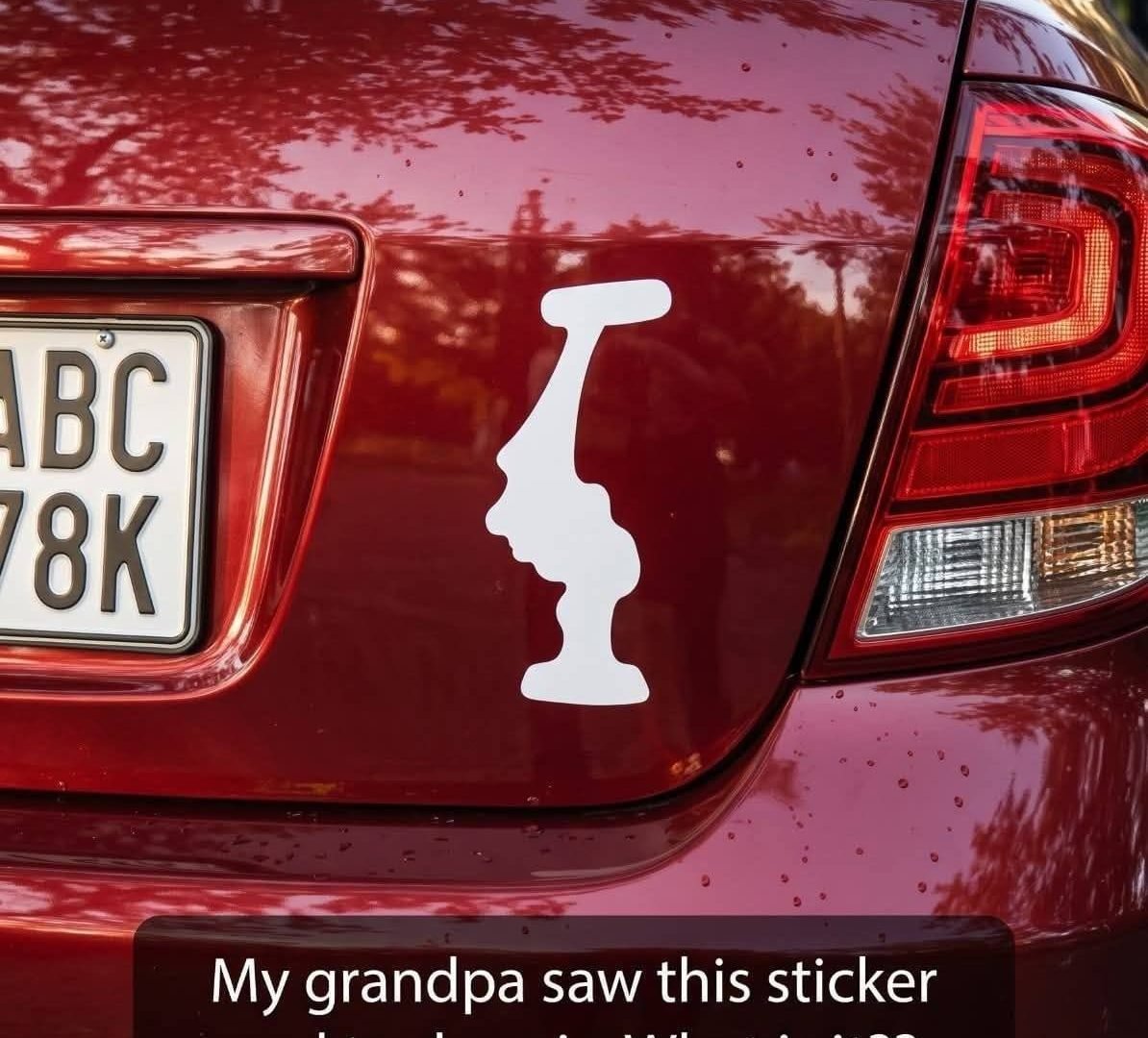
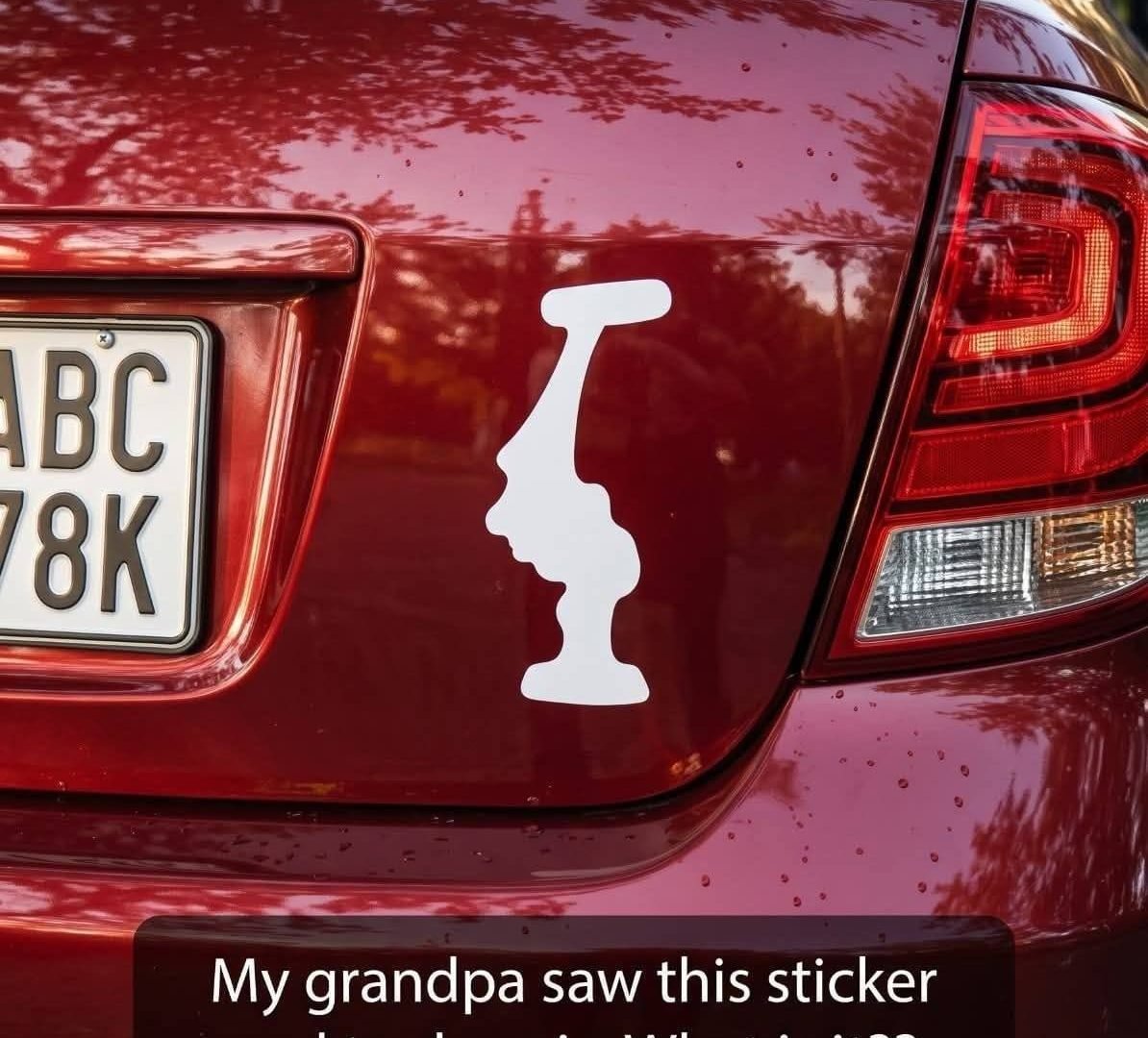
In recent decades, the bumper sticker has become a way to signal personal identity. People use them to show support for sports teams, express religious beliefs, display a sense of humor, or share a favorite piece of art. The sticker in the photograph is a perfect example of the latter category. It is a piece of visual wit, designed to provoke a reaction—whether that reaction is confusion, amusement, or an appreciation for the clever design. The driver of the red car chose this sticker because it is a conversation starter, a small piece of public art that invites the viewer to think.
The Rise of the “Car Decal” Trend
In recent years, the bumper sticker has seen a resurgence in popularity, often referred to as “car decals” or “vinyl decals.” These modern iterations are often more intricate and stylized than their predecessors, reflecting the influence of digital design tools and platforms like Etsy, where independent artists sell custom designs. The mushroom-face illusion perfectly fits this trend. It is minimalist, monochromatic, and highly graphic, making it ideal for a vinyl cutout. It is the kind of design that suggests the owner is stylish, appreciates a good visual trick, and has a slightly offbeat sense of humor.
The Viral Lifecycle: How a Simple Photo Captures the Internet
The journey of the grandfather’s photograph from a private text message to a viral post is a textbook example of how content spreads in the digital age. It illustrates the mechanics of virality and the types of stories that capture the collective imagination.
The Initial Spark: Relatability
The first ingredient for virality is relatability. For a post to be shared widely, it needs to strike a chord with a broad audience. The grandfather’s story is universally understandable. Everyone has an older relative who might ask a seemingly simple question that turns out to have a complex answer. The image itself is also inherently shareable. It is a visual puzzle that demands to be solved. Viewers who figure it out immediately want to test others, sharing the image to see if their friends and family can see the hidden face.
The Engagement Engine: The Comments Section
The true engine of virality lies in the comments section. A post that generates a high volume of comments is heavily favored by social media algorithms, which then push the post to even more users. The grandfather’s question is perfectly designed to generate comments. Everyone has an opinion, and everyone wants to be the first to provide the answer. The comments section becomes a lively debate, with some users arguing that it is clearly a mushroom, others insisting it is a face, and still others trying to find a third, hidden meaning. This high level of engagement signals to the algorithm that the content is valuable and keeps the post circulating for days or even weeks.
The Memeification of the Image
When an image goes viral, it rarely stays in its original context for long. The mushroom-face sticker has likely been memeified, appearing in new contexts and paired with different captions. Users might create variations of the sticker, insert it into other images, or use it as a reaction image to express confusion. This remixing and repurposing of the content extends its lifespan and broadens its reach. The image becomes a piece of internet folklore, a shared cultural reference that people recognize and understand without needing the original context.
Famous Precedents: Other Optical Illusions That Captivated the World
The mushroom-face sticker is just the latest in a long line of optical illusions that have captured the public’s attention. These viral images serve as fascinating case studies in human perception and the nature of internet culture.
The Dress: Blue and Black or White and Gold?
Perhaps the most famous viral optical illusion of the digital age is “The Dress.” In 2015, a photograph of a dress at a wedding went viral because people could not agree on its colors. Some saw it as blue and black, while others saw it as white and gold. The debate was so intense that it divided households and sparked countless scientific explanations about how the brain interprets color in different lighting conditions. The Dress demonstrated that optical illusions are not just party tricks; they reveal profound truths about how our individual brains construct reality.
The Rubber Pencil Illusion
Another popular viral illusion is the “rubber pencil” trick. This is a real-world illusion where a person holds a pencil and moves it up and down rapidly while looking at it out of the corner of their eye. The motion of the hand and the blurring effect create the illusion that the pencil is bending like rubber. This illusion relies on the way our visual system processes motion and peripheral vision, creating a momentary lapse in perception that is both surprising and delightful.
The Ambiguous Figure: The Duck-Rabbit
The most direct historical antecedent to the mushroom-face sticker is the famous “duck-rabbit” illusion. This is a classic ambiguous figure that can be seen as either a duck facing left or a rabbit facing right. It was used by philosopher Ludwig Wittgenstein to illustrate the nature of seeing and interpretation. The duck-rabbit, like the mushroom-face, relies on the brain’s ability to flip between two different interpretations of the same visual data. These classic illusions remain popular because they tap into a fundamental aspect of human cognition: the brain’s ceaseless effort to impose order and meaning on the world.
The Neuroscience of Seeing: What Happens in the Brain?
The experience of looking at the sticker and flipping between the mushroom and the face is a window into the complex processes of the human visual system. When light from the image hits the retina, it is converted into electrical signals that are sent to the visual cortex at the back of the brain.
The visual cortex does not simply record the image like a camera. Instead, it actively processes the information, breaking it down into lines, edges, shapes, and colors. Higher-level brain areas then attempt to integrate these features into a recognizable object. When an image is ambiguous, different parts of the brain compete to impose their own interpretation.
Brain imaging studies on ambiguous figures like the duck-rabbit have shown that when a person’s perception flips from one image to the other, there is a corresponding shift in activity in the brain’s visual processing areas. The brain is not just passively receiving information; it is actively constructing the reality we see. The sticker is a reminder that what we perceive is not always a direct reflection of what is actually there. It is a construct, a best guess based on the available sensory data.
Conclusion: A Simple Sticker with a Big Impact
The story of the grandfather who photographed a mysterious bumper sticker is a charming reminder of the power of human curiosity. A simple white shape on a red car sparked a global conversation, uniting people in a shared effort to solve a visual puzzle. The sticker itself is a clever piece of design, a masterful use of negative space that plays with the brain’s tendency to find familiar patterns in ambiguous shapes. It is a mushroom, it is a face, and it is a testament to the fascinating ways in which we see the world.
The viral success of the image speaks to the enduring appeal of optical illusions. They surprise us, delight us, and remind us that our perception of reality is far more complex than we might assume. They also highlight the positive side of internet culture, where a wholesome story and a clever puzzle can bring people together in a moment of shared curiosity and connection. The grandfather may have just wanted to know what the sticker was, but in asking, he gave the internet a perfect little mystery to enjoy.
Frequently Asked Questions
What exactly is the sticker in the viral photo?
The sticker is a dual-image optical illusion. It is designed to look like a mushroom when viewed as a single solid shape, but it also contains the side profile of a human face looking to the left.
Why did the grandfather take a picture of the sticker?
According to the caption, the grandfather saw the sticker on a car and was confused by its appearance. He took a picture to ask his grandchild what it was meant to be.
Is it a mushroom or a face?
It is both. It is an ambiguous image designed to flip between the two interpretations. Some people see the mushroom first, while others immediately see the face. Neither interpretation is “wrong,” as the image is specifically designed to contain both.
What is this type of illusion called?
This is known as an ambiguous figure or a figure-ground illusion. It relies on the brain’s tendency to alternate between two different interpretations of a visual stimulus.
Why does my brain keep flipping between the two images?
This is due to a phenomenon called bistable perception. The brain cannot process both interpretations simultaneously, so it alternates between them. The visual cortex is constantly trying to find the most logical interpretation, causing the image to “flip” back and forth.
Are there other famous examples of this kind of illusion?
Yes, the most famous examples include the Rubin vase (which looks like a vase or two faces in profile) and the duck-rabbit illusion (which looks like a duck facing left or a rabbit facing right).
Why do some people see the face instantly while others only see a mushroom?
Visual perception varies from person to person. Factors such as familiarity with optical illusions, visual acuity, and even cultural background can influence how quickly someone perceives the hidden image. Squinting or looking at the image from a distance can sometimes help the face appear.