The Dashboard Button Most Drivers Ignore—And Why It Actually Matters
Introduction: The Mystery of the U-Turn Arrow
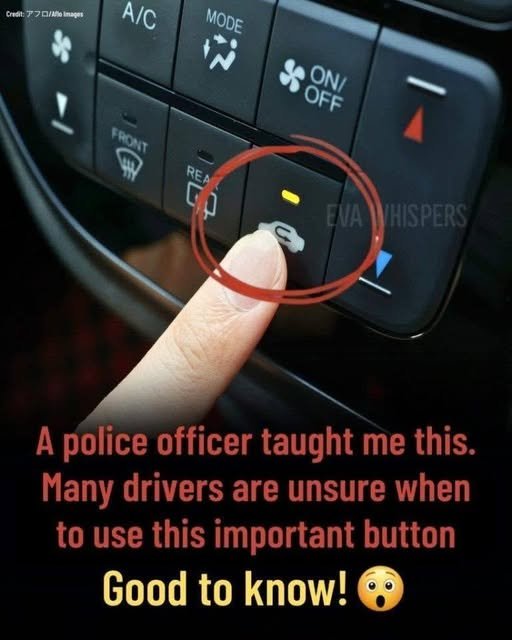
Look down at your car’s center console or dashboard, and you will be confronted with a dizzying array of buttons, dials, and illuminated symbols. There is the familiar fan speed dial, the temperature control, the front and rear defrost buttons, and the ubiquitous A/C switch. But nestled among these controls is a button that frequently goes unnoticed, misunderstood, or entirely ignored by a vast number of drivers. It features a simple icon: a car silhouette with a U-turn arrow inside it. This is the air recirculation button.
Recently, a viral social media post featuring a finger pressing this exact button sparked a wave of curiosity across the internet. The text overlay read, “A police officer taught me this. Many drivers are unsure when to use this important button. Good to know! 😲” The post struck a chord because it highlighted a universal truth about driving: most of us were taught how to operate the steering wheel, the pedals, and the turn signals, but very few of us were ever formally educated on the nuances of our vehicle’s climate control system. We simply get in, turn on the air, and hope for the best.
Yet, understanding this single button—what it does, when to press it, and perhaps more importantly, when to avoid it—can have a profound impact on your driving experience. It affects everything from your safety and alertness to your fuel efficiency, your health, and even the longevity of your vehicle’s air conditioning components. This comprehensive two-part guide will explore the science and practical application of the air recirculation button. We will delve into the scenarios where it is your greatest ally, the situations where it can become a dangerous liability, and the specific reasons why law enforcement officers pay close attention to this often-overlooked feature.
Part 1 of 2: Understanding the Science of Cabin Air
To fully grasp the importance of the recirculation button, it is essential to understand the basic mechanics of your car’s Heating, Ventilation, and Air Conditioning (HVAC) system. When you turn on your car’s climate control, the system is essentially managing the flow and temperature of air inside the cabin.
The Two Modes of Airflow: Fresh Air vs. Recirculation
Your car’s HVAC system operates in two primary modes:
Fresh Air Mode: When recirculation is off (usually indicated by an icon of an arrow coming from outside the car into the cabin), the system draws air from the outside environment. This air passes through a cabin air filter, which is designed to trap dust, pollen, and other particulates, before being heated, cooled, or simply blown into the cabin. This mode ensures a continuous supply of oxygen and helps prevent the buildup of moisture and carbon dioxide inside the vehicle.
Recirculation Mode: When you press the button with the U-turn arrow, a flap or blend door inside the HVAC system closes off the outside air intake. The system then draws air from inside the cabin, passes it through the filter (if the system is designed that way), and re-circulates it back into the cabin. In this mode, no new air is introduced from the outside.
Understanding this fundamental difference is the key to knowing when to use the button. It is a trade-off between isolating the cabin from the outside environment and relying on the existing air inside.
Scenario 1: Heavy Traffic and Exhaust Fumes
One of the most critical and universally recommended uses for the recirculation button is when driving in heavy, stop-and-go traffic. When you are stuck behind a large truck, a bus, or a line of idling cars, the air outside your vehicle is heavily polluted with exhaust fumes. These fumes contain carbon monoxide, nitrogen oxides, and particulate matter, all of which are harmful to your health.
If your HVAC system is set to fresh air mode, it will continuously pump these toxic fumes directly into your cabin. By pressing the recirculation button, you isolate the cabin from the outside air, allowing you to breathe the filtered air already inside. Law enforcement officers and professional drivers frequently use this technique when navigating congested urban environments or when stuck behind heavily polluting vehicles. It is a simple, effective way to protect your respiratory system from the immediate hazards of roadway pollution.
Scenario 2: Extreme Weather and HVAC Efficiency
The recirculation button plays a significant role in how quickly and efficiently your car’s heating and cooling systems work.
Cooling in Summer: If you get into a car that has been baking in the sun, the air inside is often hotter than the air outside. In this specific instance, it is actually better to roll down the windows for a minute to let the superheated air escape. However, once you start driving, pressing the recirculation button helps your air conditioning system work more efficiently. Instead of constantly drawing in hot, humid outside air and working hard to cool it, the system draws in the already-cooled air from inside the cabin, chills it further, and recirculates it. This can cool the cabin faster and reduce the strain on your AC compressor.
Heating in Winter: Similarly, in the winter, recirculating the air can help the cabin warm up faster. The heater core is drawing heat from the engine coolant. By recirculating the air already inside the cabin, the system is reheating air that is already somewhat warm, rather than constantly heating freezing air from the outside.
Scenario 3: Navigating Tunnels and Construction Zones
Tunnels are notoriously poorly ventilated spaces where exhaust fumes can accumulate. When driving through a long tunnel, pressing the recirculation button is a standard safety practice to prevent the buildup of carbon monoxide inside your vehicle. Similarly, if you are driving through a construction zone where there is heavy dust, debris, or the smell of asphalt, switching to recirculation mode helps keep these particulates out of your cabin. It acts as an extra layer of defense, supplementing the work of your cabin air filter.
Scenario 4: Wildfire Smoke and Severe Allergies
In regions prone to wildfires, air quality can deteriorate rapidly, with smoke and ash filling the air. During these events, health officials often advise residents to stay indoors and use air purifiers. If you must drive, using the recirculation button is essential. It prevents the smoke from entering the cabin, provided your cabin air filter is in good condition. For individuals who suffer from severe seasonal allergies, driving with the recirculation button engaged can also provide a safe haven from pollen and other airborne allergens. It creates a micro-environment that is significantly cleaner than the outside air.