If Your Veins Are Visible in Your Hand: What It Actually Says About Your Health and Cardiovascular System
Introduction: The Viral Warning That Sparked Concern
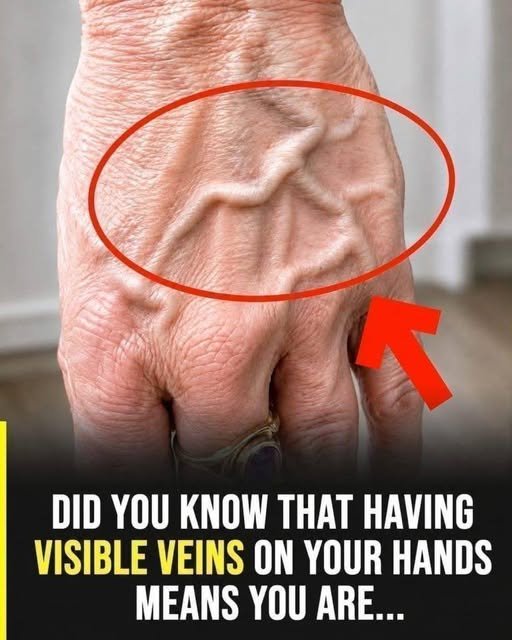
The image is striking and slightly alarming. A close-up of a hand, the skin deeply wrinkled with age, reveals a network of thick, protruding, and bulging veins. The veins are circled in bright red, with another red arrow pointing to a prominent ring on one of the fingers. The text overlay issues a chilling warning: “If your veins are visible in your hand, it is a signal of ca…” The sentence is cut off, leaving the viewer to fill in the blank with their worst fears—cancer, cardiovascular disease, or an imminent heart attack.
For millions of people who look down at their own hands and see prominent veins, this viral post triggers immediate anxiety. We are conditioned to view changes in our bodies as warning signs, and the sight of raised, visible veins is often perceived as an indicator that something is wrong with our circulatory system.
However, the truth about visible hand veins is far more nuanced than a terrifying social media caption. In the vast majority of cases, prominent veins in the hands are a completely normal, benign, and even healthy physiological occurrence. They are a product of genetics, body composition, age, and environmental factors.
That said, there are specific circumstances where visible veins can be a signal of an underlying health issue, such as venous insufficiency or cardiovascular strain.
This comprehensive guide will separate fact from fiction. We will explore the anatomy of the venous system, the most common reasons why veins become visible, and the specific warning signs that indicate you should seek medical attention. By the end, you will have a clear, evidence-based understanding of what your hands are actually telling you about your health.<br> <hr> <h1 align=”center”>🛑 PART 1 OF 2 🛑</h1> <hr> <br>
The Anatomy of the Vein: Why Do They Look Blue and Bulge?
To understand why veins become visible, we must first understand how they function. The circulatory system is a closed loop. Arteries carry oxygen-rich blood away from the heart to the extremities, while veins carry oxygen-depleted blood back to the heart.
Because veins are working against gravity (especially in the hands and legs), they have a much lower pressure than arteries. They are also thinner-walled and more flexible. To push blood back up to the heart, veins rely on a system of one-way valves and the surrounding muscles to squeeze them.
The “Blue” Illusion
Veins do not actually contain blue blood; the blood inside them is dark red. However, they appear blue or green due to the way light penetrates the skin. When light hits the skin, red wavelengths are absorbed by the blood, while blue wavelengths are reflected back to our eyes.
The Bulging Effect
When veins bulge or become highly visible, it means they are engorged with blood. The venous walls have stretched to accommodate a larger volume of blood, or the surrounding tissue has thinned, making the veins more prominent.
Reason 1: Low Body Fat and Genetics (The “Fit” Factor)
One of the most common reasons for visible hand veins is a low percentage of body fat.
The Fat Insulation
Body fat acts as a thick, insulating blanket under the skin. If you have a low body fat percentage—whether due to a fast metabolism, a rigorous fitness routine, or genetics—there is less fat padding between your skin and your veins. This lack of insulation makes the veins push closer to the surface, making them highly visible.
The Genetic Blueprint
Genetics play a massive role. If your parents or grandparents had prominent hand veins, you are highly likely to have them too. Genetics dictate the thickness of your skin, where your veins are positioned anatomically, and how easily your blood vessels dilate. In the context of low body fat and genetics, visible hand veins are a sign of a lean physique, not a disease.
Reason 2: Age and Skin Thinning (The Collagen Loss)
The image shows an older hand, and this is a critical clue. As we age, our skin undergoes significant structural changes.
Loss of Subcutaneous Fat
The layer of fat just beneath the skin (subcutaneous fat) naturally thins out as we get older, especially in the hands. This is why the hands are often one of the first places to show signs of aging.
Collagen Depletion
Collagen and elastin are the proteins that give our skin its strength, elasticity, and plumpness. After the age of 20, we lose about 1% of our collagen production every year. When the skin loses its elasticity and becomes paper-thin, it can no longer hide the veins beneath it. The veins may also become more prominent because the connective tissue that normally keeps them in place begins to weaken. This is a completely natural, cosmetic part of aging, not a sign of disease.
Reason 3: Exercise and Vasodilation (The Muscle Pump)
If you notice your veins popping out during or immediately after a workout, it is a sign that your circulatory system is working exactly as it should.
Increased Blood Flow
When you exercise, your muscles require significantly more oxygen and nutrients. The heart pumps faster, increasing the volume of blood flowing through the system. The veins dilate (widen) to accommodate this increased blood flow and to help return the blood to the heart more efficiently.
The “Vascularity” Goal
In the bodybuilding and fitness community, visible veins (often called “vascularity”) are highly sought after. They are a sign of low body fat, intense muscle pump, and a healthy, efficient cardiovascular system. If your hand veins are prominent during a workout but return to normal at rest, it is a sign of excellent cardiovascular health, not a problem.
Reason 4: Heat and Temperature Regulation
The body has a sophisticated internal thermostat. When you are in a hot environment, or if you take a hot shower, your blood vessels dilate to release heat from the body.
The Cooling Mechanism
By bringing more blood to the surface of the skin, the body allows the heat to dissipate into the air. This vasodilation is why your veins become much more visible in the summer, after a hot bath, or when your hands are exposed to warm water. This is a normal, healthy physiological response.