Only Young Brains Can Find Both Hidden Children: Decoding the Viral Optical Illusion
The Golden Age of Optical Illusions
The late 19th and early 20th centuries saw a surge in the popularity of optical illusions. Artists and psychologists like W.E. Hill (who created the famous “My Wife and My Mother-in-Law” illusion) explored the limits of human perception. These images were not just entertainment; they were tools used by scientists to study how the brain processes visual information.
From Print to Pixels
Today, these vintage puzzles have found a new life on social media. The internet has amplified their reach, turning them into viral challenges. Platforms like Facebook and Twitter are perfectly designed for sharing images that elicit strong emotional reactions—whether it is the frustration of not being able to find the hidden object or the triumph of finally seeing it.
The Benefits of Visual Puzzles for Brain Health
While the “young brains only” claim is false, there is no denying that engaging with visual puzzles is excellent for cognitive health.
1. Improving Concentration and Focus
Puzzles require sustained attention. In a world full of constant digital distractions, taking five minutes to focus intently on a single image is a form of mindfulness. It trains your brain to ignore extraneous information and focus on the task at hand.
2. Enhancing Visual Acuity
Regularly challenging your visual perception can help keep your eyes and brain sharp. It encourages you to look beyond the obvious and notice details that you might otherwise overlook in your daily life.
3. Slowing Cognitive Decline
Like any muscle, the brain benefits from exercise. Activities that require problem-solving, pattern recognition, and mental flexibility can help build cognitive reserve and may help slow down age-related cognitive decline.
4. Stress Relief
Finding the solution to a puzzle provides a sense of closure and accomplishment. The dopamine release that accompanies the “aha” moment can reduce stress and improve mood.
Other Famous Hidden Image Illusions
If you enjoyed this puzzle, you might be familiar with other famous examples of ambiguous or hidden images.
The Rubin Vase
This classic illusion features a white vase in the center and two black profiles of faces on the sides. Your brain can see either the vase or the faces, but it cannot process both simultaneously. It is the most famous example of figure-ground organization.
The Duck-Rabbit Illusion
This image can be interpreted as either a duck facing left or a rabbit facing right. It illustrates the brain’s ability to flip between two stable interpretations of a single ambiguous image.
The Old Woman / Young Woman
This famous illusion shows a young woman looking away over her right shoulder, or an old woman with a large nose looking down. The young woman’s ear is the old woman’s eye, and the young woman’s necklace is the old woman’s mouth.
How to Get Better at Solving Hidden Image Puzzles
If you want to improve your ability to spot hidden objects in these types of puzzles, here are a few tips:
Look at the Negative Space: Instead of focusing on the objects that are drawn, look at the empty space between them. Often, the hidden image is formed by the negative space.
Squint Your Eyes: Blurring your vision slightly can help you stop over-analyzing the details and see the broader shapes and outlines.
Tilt Your Head: Looking at the image from a different angle can sometimes break your brain’s pattern recognition and allow you to see the hidden details.
Look for Eyes: In hidden face puzzles, the artist often uses an existing feature (like a button, an ear, or a knot) as the eye of the hidden face. Look for these anchor points.
Walk Away and Come Back: Sometimes, stepping away from the image for a few minutes and returning with fresh eyes is all you need to solve the puzzle.
Conclusion: Seeing the Unseen
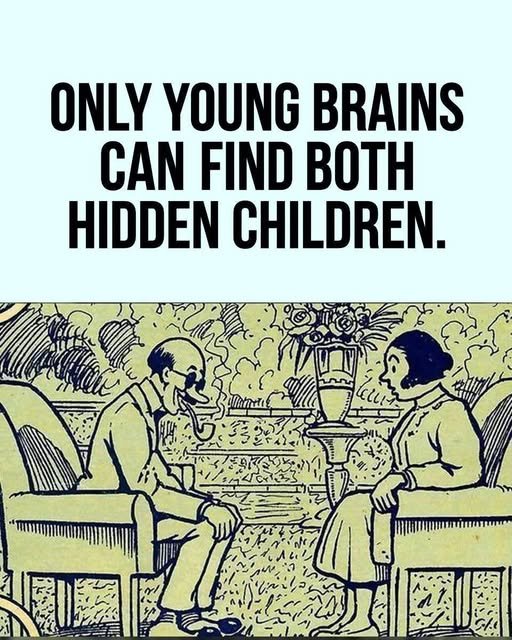
The viral image of the two hidden children is a brilliant piece of visual trickery. It reminds us that our perception of reality is heavily filtered by our brain’s expectations, past experiences, and its need to organize the world into familiar patterns. It is not a test of whether you have “young brains,” but rather a playful challenge to look at the world from a different perspective.
Whether you found the children instantly or had to read the solution to see them, the exercise is a valuable reminder of the complexity of human vision. So, the next time you see a viral brain teaser, do not get frustrated. Embrace the challenge, look at the negative space, and enjoy the satisfying rush of the “aha” moment.
Frequently Asked Questions
Where exactly are the hidden children in the image?
There are two children. The first is hidden in the outline of the man’s head and collar on the left—his ear is the child’s eye. The second is hidden in the edge of the woman’s dark hair on the right, with the white background forming the child’s face.
Why is it so hard to find the hidden children?
Our brains use “top-down processing” and “figure-ground organization.” We expect to see an older man and woman, so our brain filters out the alternative shapes formed by the contours and negative space.
Is it true that only young brains can find the hidden children?
No, this is a clickbait headline. While younger brains have higher neuroplasticity and may switch perspectives faster, older adults have better pattern recognition and visual experience. Anyone can find them with the right perspective.
What is the psychology behind this optical illusion?
The illusion relies on a psychological principle called figure-ground organization, where the brain separates the main subjects (figures) from the background (ground). It also uses perceptual blindness, where focusing on one thing makes you miss other obvious details.
How can I train my brain to see hidden images better?
Practice looking at the negative space, squinting to see broader shapes, and consciously shifting your perspective. These habits can help you break free from your brain’s automatic pattern recognition.
Who created this specific puzzle?
The exact artist is unknown, but this style of puzzle dates back to vintage magazines and activity books from the early-to-mid 20th century, which often featured hidden image illusions.
Are visual puzzles good for brain health?
Yes. They improve concentration, enhance visual acuity, provide a sense of accomplishment (releasing dopamine), and help build cognitive reserve, which can slow age-related cognitive decline.
What is another famous example of a hidden image illusion?
The “Rubin Vase” is a classic example, where you can see either a white vase or two black faces, depending on what your brain interprets as the figure and the ground.