10 Early Signs of Dementia You Should NEVER Ignore
Introduction: Separating Viral Myths from Medical Realities
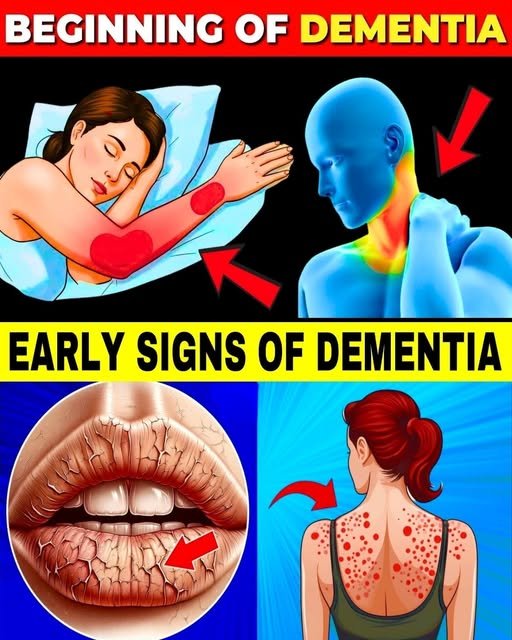
A striking and alarming graphic has been circulating on social media, designed to capture attention and incite fear. The image, divided into two sections, claims to show the “Beginning of Dementia” and “Early Signs of Dementia.” It features a woman sleeping with glowing red pain zones on her arm, a figure with neck and shoulder pain, a close-up of severely cracked lips, and a woman with a heavily spotted, rash-covered back. The bold text screams a warning that these are signs you should never ignore. For millions of viewers, this image triggers immediate anxiety. We have all experienced a stiff neck from sleeping wrong, dry lips in the winter, or a random skin irritation. Does a bad night’s sleep mean our brains are deteriorating?
It is crucial to approach such viral medical graphics with a critical eye. While the image effectively captures attention, it uses a tactic common in clickbait health content: linking common, benign physical ailments to a devastating neurological disease. To be clear, while extreme physical neglect or sudden changes in sleep patterns can sometimes occur alongside cognitive decline, arm pain, cracked lips, and back rashes are not clinical diagnostic criteria for dementia. They are often the result of poor sleeping positions, dehydration, medication side effects, or dermatological issues.
However, the underlying concern that drives these viral posts is valid. Dementia is a terrifying prospect, and the desire to catch it early is completely understandable. Early detection is indeed critical, as it allows for better management, planning, and access to treatments that may slow progression. But to truly recognize the early signs, we must look beyond viral graphics and focus on the established, medically recognized symptoms.
This comprehensive two-part guide will explore the actual, scientifically validated early warning signs of dementia. We will differentiate between normal age-related forgetfulness and the cognitive changes that warrant a medical evaluation. By understanding the real signs, you can protect yourself and your loved ones, ensuring that genuine concerns are addressed promptly and accurately.
Understanding Dementia: More Than Just Memory Loss
Before delving into the specific signs, it is essential to understand what dementia is. Dementia is not a single disease; it is an umbrella term for a decline in cognitive function severe enough to interfere with daily life. Alzheimer’s disease is the most common cause, accounting for 60% to 80% of cases, but there are many other types, including vascular dementia, Lewy body dementia, and frontotemporal dementia.
Dementia is caused by damage to brain cells. This damage interferes with the ability of brain cells to communicate with each other. When brain cells cannot communicate normally, thinking, behavior, and feelings can be affected. It is a progressive condition, meaning symptoms gradually worsen over time. Recognizing the early stages is vital for early intervention, but it requires looking for patterns of cognitive and behavioral change, not isolated physical symptoms.
Normal Aging vs. Dementia: The Crucial Difference
As we age, our brains naturally change. It is entirely normal to occasionally forget where you put your keys, struggle to remember a new acquaintance’s name, or lose your train of thought mid-sentence. This is often referred to as “senior moments.” The key difference between normal aging and dementia lies in the frequency, severity, and impact of these lapses. Normal forgetfulness is annoying but manageable. The cognitive decline associated with dementia disrupts daily life, affects independence, and often leaves the individual unaware of the extent of their impairment.
The 10 True Early Warning Signs of Dementia
The Alzheimer’s Association has outlined 10 warning signs that are the gold standard for identifying potential cognitive decline. If you or a loved one are experiencing any of these, it is time to consult a healthcare professional.
1. Memory Loss That Disrupts Daily Life
This is the most well-known sign, but it is important to understand its specific nature. It is not just forgetting a name; it is forgetting recently learned information to the point that it affects daily functioning. This might involve repeating the same questions over and over within a short period, forgetting important dates or events, or relying heavily on memory aids (like sticky notes or phone reminders) for things they used to handle independently. Asking for the same information repeatedly or forgetting an entire conversation that just happened is a classic red flag.
2. Challenges in Planning or Solving Problems
Individuals in the early stages of dementia may experience changes in their ability to develop and follow a plan or work with numbers. This can manifest in familiar tasks like following a familiar recipe, keeping track of monthly bills, or balancing a checkbook. They may struggle to concentrate and take much longer to do things than they did before. You might notice that their financial management suddenly becomes chaotic or that they are making uncharacteristic errors in calculations.
3. Difficulty Completing Familiar Tasks at Home, at Work, or at Leisure
People with dementia often find it hard to complete daily tasks they have done many times before. They might forget how to drive to a familiar location, how to use the microwave, or how to play a game they have enjoyed for years. They may become confused about the sequence of steps required to complete a task, such as getting dressed (putting shoes on before socks) or making a cup of coffee. This loss of procedural memory is a significant early indicator.
4. Confusion with Time or Place
Individuals with dementia can lose track of dates, seasons, and the passage of time. They may have trouble understanding something if it is not happening immediately. Sometimes, they may forget where they are or how they got there. They might become disoriented in familiar environments, believing they are in a different city, or they might confuse the time of day, wandering outside at night thinking it is morning.
5. Trouble Understanding Visual Images and Spatial Relationships
Vision problems can be a sign of dementia, but they are not related to the physical eye (which may explain why the viral image showed physical discomfort). Instead, the brain struggles to process visual information. This can lead to difficulty reading, judging distance, and determining color or contrast. This spatial disorientation can be dangerous. A person might have difficulty navigating stairs, might misjudge the distance to the curb, or might not recognize their own reflection in a mirror, leading to fear or confusion.