Only Young Brains Can Find Both Hidden Children: Decoding the Viral Optical Illusion
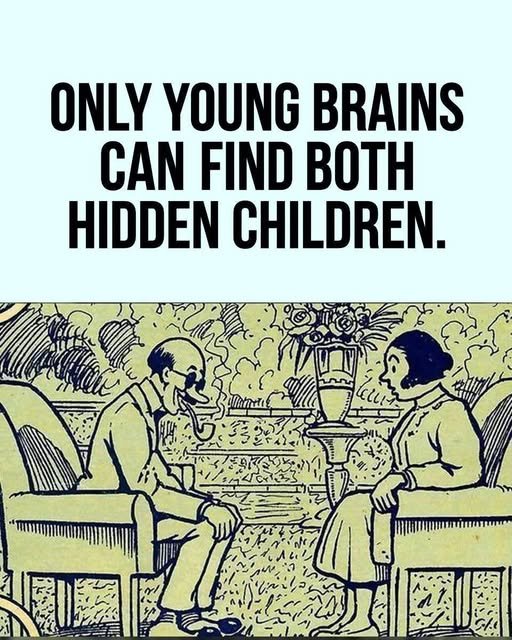
The child is depicted in profile, facing to the right, towards the woman. The man’s ear serves as the child’s eye, and the shading on the man’s head creates the contours of the child’s face.
The Second Hidden Child (The Woman’s Hair)
Now, shift your gaze to the woman sitting on the right side of the image. She is also depicted in profile, facing the man, with dark, short hair.
Look closely at the shape of her hair and the negative space (the white background) immediately in front of her face.
The Face: The edge of the woman’s dark hair, just in front of her forehead and nose, forms the profile of a child facing to the left.
The Details: The white space acts as the child’s face, with the outline of the woman’s hair creating the child’s forehead, nose, and mouth. The woman’s eye is located just behind the child’s head.
Once you see the children, it becomes almost impossible to “unsee” them. They snap into focus, and suddenly, the image looks entirely different. The man is no longer just a man; he is a man with a child’s face drawn into his head.
The Neuroscience of Seeing: Why Did We Miss Them?
The fact that these children are so difficult to spot is not a sign of a “weak brain.” It is a testament to the incredible efficiency of the human visual system. Our brains are not cameras that passively record reality; they are active interpreters that constantly make split-second decisions to make sense of the world.
1. Figure-Ground Organization
The primary reason we miss the hidden children is a psychological principle known as figure-ground organization. Formulated by Danish psychologist Edgar Rubin in 1915, this principle describes how our brains separate an object (the “figure”) from its background (the “ground”).
When you first look at the image, your brain instantly categorizes the man and the woman as the “figures” and the background (the garden, the chairs) as the “ground.” Because your brain has successfully identified the main subjects, it stops analyzing the image. It filters out the “noise” to give you a clear picture. The hidden children are created using the contours and negative space of the figures. To see them, you have to consciously force your brain to shift its perspective and treat the edges of the figures as the boundaries of a new image.
2. Top-Down Processing
Our brains rely heavily on top-down processing, which means we use our past experiences, expectations, and context to interpret what we see. When you glance at this image, you immediately see a recognizable scene: an older man and woman having a conversation.
Because your brain has contextually categorized this as a scene of adults, it does not expect to see children hidden in the contours of their heads. Your expectations literally blind you to the alternative interpretation.
3. Perceptual Blindness
This puzzle is a classic example of perceptual blindness (or inattentional blindness). When you are focused on one specific task or aspect of a scene, you can completely miss other elements, even if they are right in front of your eyes. You were so focused on finding a “small person” hidden in the bushes or behind a chair that you completely ignored the larger structural lines of the image.
Debunking the “Only Young Brains” Claim
The headline “Only Young Brains Can Find Both Hidden Children” is a brilliant piece of engagement bait, but it has no basis in neuroscience.
Neuroplasticity and Perspective Shifting
It is true that younger brains exhibit higher levels of neuroplasticity, the ability to adapt and form new neural connections. This can sometimes make children faster at switching between different visual interpretations of an ambiguous image. They are less rigid in their thinking and more willing to look at things from unconventional angles.
However, older adults possess distinct advantages. They have superior pattern recognition, a wealth of visual experience, and often a higher degree of patience. Solving these puzzles is not about the speed of your brain; it is about the flexibility of your perspective. An older adult who takes the time to look at the negative space will find the children just as easily as a child who happens to glance at the right spot.
The “Eureka” Effect
The moment of realization—the “aha!” moment when the hidden image suddenly pops out—is associated with a burst of dopamine in the brain. This reward mechanism is the same regardless of your age. The satisfaction of solving the puzzle is a universal human experience.
The History of Hidden Image Puzzles
The viral image of the two older adults is a classic example of a vintage puzzle, likely originating from the early to mid-20th century. These puzzles were a staple of magazines, newspapers, and children’s activity books long before the internet existed.