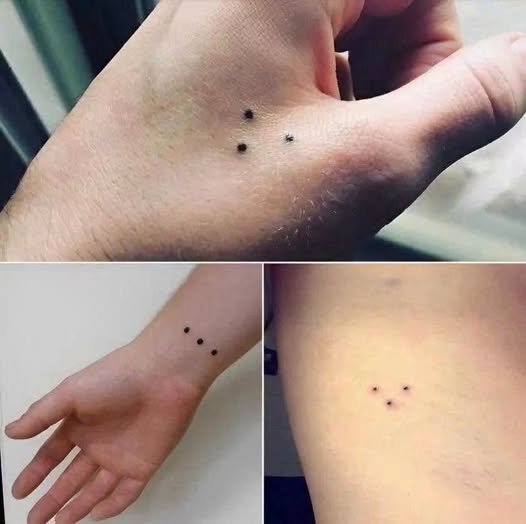
If you see someone with a three-point tattoo, run as far as you can.
The image presents a striking and slightly alarming visual: three small, dark dots arranged in a triangle on different body parts—a hand, a wrist, and an arm. The text below is designed to induce immediate anxiety: “If you see someone with a three-point tattoo, run as far as you can.”
It is a sensationalist statement, the kind that spreads rapidly across social media, fueling fear and misunderstanding. While it is true that the three-dot tattoo has historically been associated with a dangerous subculture, the reality is far more nuanced. Tattoos are deeply personal, culturally fluid, and highly contextual.
To understand why someone would get three dots in a triangle, you cannot look at the ink in isolation. You have to look at the person, their background, where they live, and when they got it. The three-dot tattoo has been claimed by gang members, political revolutionaries, pop stars, and teenagers exploring body art.
This comprehensive guide will decode the complex history of the three-dot tattoo. We will explore its origins in gang culture, its surprising connections to the French Revolution, its popularity in pop culture, its significance in mental health awareness, and ultimately, why “running away” is an overreaction to a symbol that means vastly different things to different people.
The Most Notorious Meaning: “Mi Vida Loca”
When people issue warnings about the three-dot tattoo, they are almost always referencing its most famous association: “Mi Vida Loca” (My Crazy Life).
The Chicano and Gang Connection
Originating in the mid-to-late 20th century within the Chicano (Mexican-American) communities of Los Angeles and the American Southwest, the three dots represent a life of street culture. While often associated with gang affiliations, it was not exclusive to one gang. Instead, it symbolized the three components of the “crazy life”: the prison, the hospital, and the grave.
It was a statement of survival, worn by individuals who had survived the harsh realities of street violence, addiction, and incarceration. For many young men and women in the 1980s and 90s, the dots were a sign of unity among those who had lived through shared trauma.
The Prison Significance
In the penal system, tattoos carry heavy significance. The three dots were sometimes used to represent the concept of “doing time.” It was a badge of honor or a warning to others that the wearer was not to be trifled with.
However, it is crucial to understand that the meaning of this tattoo has evolved. In the past, it was an explicit declaration of gang affiliation. Today, it is often treated as a relic of that culture, adopted by people who have never been in a gang but resonate with the aesthetic or the narrative of having lived a hard life.
The Pop Culture Effect: From the Streets to the Mainstream
If the tattoo is a gang sign, why do so many celebrities and everyday people have it? The answer lies in the power of pop culture, which is constantly absorbing and neutralizing subcultures.
The Mac Miller Phenomenon
The late, great rapper Mac Miller famously had three dots tattooed on his face (and often wore a ring with three dots). Miller was a hugely influential figure in music, and his adoption of the symbol sparked a massive wave of imitation among his fans.
For Miller, the dots represented the “crazy life” of fame, addiction, and mental health struggles. His fans, many of whom had no connection to gang culture, got the tattoo as a tribute to his music and as a symbol of their own struggles with mental health or addiction.
The “Aesthetic” Tattoo
In the era of Instagram and Pinterest, the minimalist three-dot tattoo has become popular purely for its aesthetic appeal. It is small, easy to hide, symmetrical, and relatively painless to get. Many young people get it simply because it looks cool and edgy. To them, it is no different than getting a tiny heart or a star.
The Historical and Political Meanings
Long before it was associated with street gangs, the three dots carried significant political and historical weight.
“Mort aux Vaches” and the French Underworld
In France, the three dots (often arranged vertically, but sometimes horizontally or in a triangle) historically meant “Mort aux vaches” (Death to the cows), a slang phrase used by the French underworld meaning “death to the police.” It was popularized by anarchists and members of the criminal underworld in the late 19th and early 20th centuries.
The French Revolution
Conversely, the three dots can also be interpreted as a symbol of the French Revolution: Liberté, Égalité, Fraternité (Liberty, Equality, Fraternity). It is a symbol of resistance against tyranny.
The Filipino Connection
In the Philippines, three dots (often arranged horizontally) are commonly understood to mean “I love you” or “I miss you.” It is a romantic or familial symbol, completely devoid of any aggressive meaning.
The Three Dots and Mental Health
In recent years, a new meaning has been attached to the three-dot tattoo: mental health awareness.
Bipolar Disorder
The three dots are sometimes used by individuals with bipolar disorder to represent the three distinct phases of the condition: the manic high, the depressive low, and the baseline state in between.
The Semicolon Connection
Like the semicolon tattoo (which represents a pause, but not the end, of a story), the three dots have become a subtle way for people to connect over shared struggles with mental illness. It signifies “you are not alone” in the chaotic experience of mental health challenges.
Why the “Run” Mentality is Flawed
The prompt in the image—”run as far as you can”—is a dangerous oversimplification that promotes prejudice and fear.
Context is Everything
To assume that everyone with three dots is a violent gang member is as absurd as assuming that everyone who drives a fast car is a criminal.
An elderly French man might have them to symbolize his political beliefs.
A teenage girl might have them because she loves Mac Miller.
A Filipino man might have them to honor his wife.
A survivor of bipolar disorder might have them to represent their journey.
The Evolution of Tattooing
Tattoos are no longer the exclusive domain of sailors, bikers, and gang members. They have become a mainstream form of self-expression. The three-dot tattoo has been effectively “co-opted” by the masses, making its original gang meaning obsolete in most everyday contexts.
Where is the Tattoo?
Location also matters. A three-dot tattoo on the face or neck (especially in a specific geographic area) might be more likely to have a gang connection. A three-dot tattoo on a wrist or behind the ear of a suburban teenager is almost certainly a stylistic choice.
When Should You Actually Be Concerned?
While you should not “run” from someone with a three-dot tattoo, there are extreme contexts where tattoos are used as explicit gang identifiers. If a person is wearing specific colors, displaying other known gang insignia, and has the three dots on a highly visible area like the face or hands, it could be a sign of affiliation.
However, even in that scenario, a tattoo alone does not make someone dangerous. It is important to treat every individual with basic human respect and avoid making snap judgments based on a single piece of body art.
Conclusion: Look Beyond the Ink
The image’s claim that you should “run as far as you can” from someone with a three-point tattoo is a textbook example of sensationalism. It takes a complex, multi-faceted symbol and reduces it to a single, frightening narrative.
The three dots in a triangle are a Rorschach test of meaning. They are a badge of survival in gang culture, a symbol of French anarchy, a tribute to a beloved rapper, a sign of love in the Philippines, and a statement of mental health awareness.
Instead of running, the best response is curiosity and cultural awareness. Tattoos are a way for people to tell their story, and the three dots are just one line in a much longer book. To judge a person solely on three tiny dots of ink is to miss the incredible diversity of human experience.
Frequently Asked Questions
What does a three-dot triangle tattoo mean?
The most common meaning is “Mi Vida Loca” (My Crazy Life), associated with Chicano and gang culture. However, it can also mean mental health awareness (bipolar disorder), a tribute to pop culture (like Mac Miller), or have military/political significance.
Is the three-dot tattoo a gang sign?
Historically, yes. It originated in the Chicano street and prison cultures of the American Southwest. However, today it is often worn by people with no gang affiliation whatsoever, making it a mainstream aesthetic choice.
Why did Mac Miller have three dots on his face?
Mac Miller’s three-dot tattoo was a reference to “Mi Vida Loca” (My Crazy Life), symbolizing his experiences with fame, addiction, and mental health struggles.
Can you get a three-dot tattoo if you are not in a gang?
Yes. Many people get the tattoo for aesthetic reasons, as a tribute to a celebrity, or to represent a personal struggle. It is a highly popular minimalist tattoo.
What do three dots mean in Filipino culture?
In the Philippines, three dots (usually horizontal) often mean “I love you” or “I miss you.”
What do three dots mean in France?
In France, the three dots historically meant “Mort aux vaches” (Death to the cops), popularized by the anarchist and criminal underworlds. It can also symbolize the French Revolution’s motto: Liberté, Égalité, Fraternité.
How does the three-dot tattoo relate to bipolar disorder?
Some people with bipolar disorder use the three dots to represent the three stages of the condition: the manic phase, the depressive phase, and the balanced baseline state.
Should I be afraid of someone with a three-dot tattoo?
No. Making an assumption about a person’s character based solely on a tattoo is unfair. The tattoo has many meanings and is widely worn by ordinary people.