The Emotional Meaning of Shoulder Pain: What Your Body Is Trying to Tell You
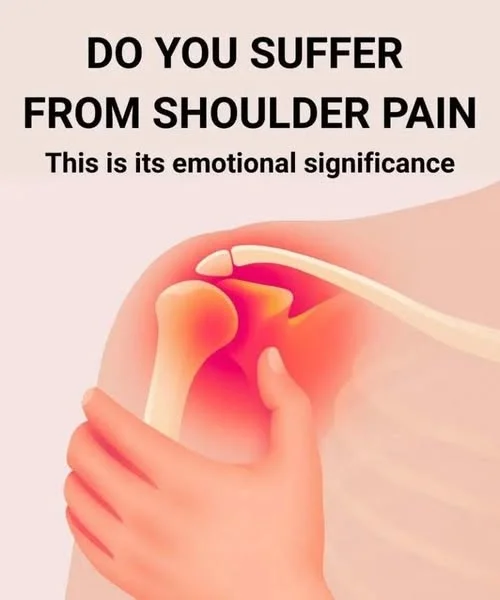
The image before us is a universal portrait of discomfort. A person’s hand gently but firmly grips the top of their shoulder, their fingers pressing into the fleshy junction where the neck meets the arm. The area is highlighted with an inflamed, glowing red hue, visually translating the deep, throbbing ache that so many people carry with them daily. Above the illustration, a direct question is posed: “Do you suffer from shoulder pain? This is its emotional significance.”
For millions of people around the world, shoulder pain is a chronic, nagging companion. It dictates how we sleep, restricts our movement, and turns simple tasks like reaching for a high shelf or putting on a jacket into painful reminders of our physical limitations. When we experience this pain, our first instinct is to look for a mechanical cause. We blame an old sports injury, a poor ergonomic setup at our desks, the wear and tear of aging, or a specific movement that “tweaked” something. We visit physical therapists, apply ice and heat, and take anti-inflammatory medications.
While these physical interventions are essential and often effective, they frequently fail to provide lasting relief. Why? Because they sometimes miss the underlying catalyst. In the fascinating realm of mind-body medicine, somatic psychology, and ancient energetic traditions, the shoulders are far more than just a complex mechanical hinge. They are the symbolic seat of our burdens, the physical embodiment of how we carry responsibility, and the emotional bridge between our hearts and our hands.
When shoulder pain becomes chronic, recurring, or seemingly disconnected from a physical injury, it is often a profound message from the subconscious. It is the body’s way of saying that we are carrying an invisible weight that is too heavy. This comprehensive guide will explore the deep emotional significance of shoulder pain. We will examine why the shoulders represent the “weight of the world,” uncover the distinct emotional meanings associated with the left and right sides, and explore the hidden psychological stressors—from over-giving and grief to perfectionism and suppressed anger—that manifest as physical tension.
The Language of the Body: Shoulders as the Seat of Burden
Across nearly every culture, language, and era, the shoulders have been inextricably linked to the concept of carrying a load. We do not speak of “stomaching” the weight of the world; we speak of “shouldering” it. We talk about a “weight on our shoulders” when we are stressed, and we offer a “shoulder to cry on” to those in distress. When we are overwhelmed, we say we are “carrying too much.”
These are not merely linguistic coincidences. They are linguistic echoes of our physiological reality. The human body responds to emotional stress in highly specific, predictable ways.
The Anatomy of Tension
Anatomically, the shoulders and the upper back are the primary areas where we hold physical tension. The trapezius muscles—the large, diamond-shaped muscles that run from the base of the skull, down the neck, and across the shoulders to the mid-back—are highly sensitive to stress. When we are in a state of “fight or flight,” these muscles involuntarily contract and elevate, pulling the shoulders up toward the ears. This is a primal protective reflex, designed to shield the neck and vital organs from attack.
In the modern world, the “attack” is rarely a physical predator. The threat is a looming deadline, a toxic relationship, financial anxiety, or the relentless pressure to meet societal expectations. Because we cannot physically run away from these abstract stressors, our bodies remain trapped in a state of chronic, low-grade tension. The shoulders stay hunched, the muscles become fatigued, and this constant contraction eventually restricts blood flow, causing pain, stiffness, and a reduced range of motion.
The Subconscious Burden
In somatic psychology, the shoulders are often referred to as the “holding place for responsibilities.” When you feel you must “hold it together” for your family, your job, or your community, your shoulders physically brace to hold that emotional weight. A strain in the shoulder can be a physical manifestation of an internal belief that one must do it all, that resting is not allowed, or that the world will fall apart if you take your hands off the wheel.
The Silent Language of Left and Right
In many energetic and metaphysical frameworks, including Traditional Chinese Medicine (TCM) and some schools of psychology, the body exhibits a lateralized language. The left and right sides correspond to different aspects of our emotional and psychological experience. While these associations are not rigid rules, they provide a valuable map for self-inquiry.
The Left Shoulder: The Feminine, the Past, and Receptivity
The left side of the body is traditionally associated with the feminine principle. It is the side of the receptive, the intuitive, the emotional, and the internal world. It is also often linked to the past and the family, particularly the maternal line.
Emotional Weight and Grief: Pain in the left shoulder frequently surfaces during periods of intense emotional strain, grief, or heartbreak. It can be the physical manifestation of carrying the emotional pain of others. If you have “gone numb to your own needs” or are processing a deep loss, the left shoulder may ache.
Difficulty Receiving: People who struggle to receive love, help, or care often develop tension in their left shoulder. It is as if the shoulder is bracing against the vulnerability of being supported. You may be the person who gives everything, but feels deeply uncomfortable when someone tries to give back to you.
Inherited Family Burdens: In some psychological frameworks, the left shoulder represents the weight of inherited family expectations, unresolved trauma from a parent, or a compulsion to take on the emotional responsibilities of a maternal figure.
The Right Shoulder: The Masculine, the Future, and Action
The right side of the body is traditionally linked to the masculine principle. It is the side of action, logic, structure, outward expression, and the future.
Over-Responsibility and Duty: Right-shoulder tightness often appears in seasons of intense over-responsibility or when we are pushing too hard in our careers. It is the shoulder that carries the heavy lifting of life. When this shoulder hurts, it is often asking the question: “What am I trying to control, and why am I doing it all alone?”
Conflict with Authority: Pain in the right shoulder can also arise from friction with authority figures (bosses, partners, or societal structures). It represents the strain of fighting for your place in the world or struggling against external rules.
The Burden of Doing: The right shoulder absorbs the stress of the “doing.” If you are the primary breadwinner, the fixer, or the one who always has to be strong, your right shoulder will eventually protest the unyielding pressure.
The Frozen Shoulder: A Metaphor for Emotional Paralysis
One of the most painful and restrictive conditions of the shoulder is adhesive capsulitis, commonly known as a “frozen shoulder.” The joint capsule thickens and tightens, causing excruciating pain and a severe loss of mobility. It often takes months or even years to resolve.
From an emotional and somatic perspective, a frozen shoulder is a powerful metaphor for feeling stuck. It often affects people who are holding back—those who are suppressing anger, grief, or frustration, or those who are afraid to move forward in their lives. The physical freezing of the joint mirrors a psychological freezing. You may feel trapped in a situation—a dead-end job, a loveless marriage, or a cycle of caretaking—where your boundaries have been crossed, and you have lost the ability to reach out for what you truly want. The body is literally creating a physical boundary because the emotional boundaries have been ignored.
Grief and the Heart-Shoulder Connection
One of the most poignant themes in the literature of mind-body medicine is the deep connection between the shoulders and grief. The shoulder is described as an elegant hinge between doing and feeling; it helps us reach, receive, and release.
When the Heart’s Reach is Blocked
Chronic shoulder pain is often described not just as a tissue problem, but as a story—one woven from posture, protection, and unspoken emotion. The ache may run along the “heart line,” creating a sense that something inside is slightly off, unnamed, and asking to be heard. This is particularly true when the pain is linked to a broken heart, a betrayal by a loved one, or the loss of a dream.
When we grieve, we often physically slump, rounding our shoulders forward to protect our chest and our heart. This posture is a primal defense mechanism. Over time, the muscles of the shoulders and chest become chronically shortened and tight, leading to pain. The emotional message is clear: the physical pain is a manifestation of the heart’s inability to fully express or process its sorrow.
Over-Giving and the Loss of Boundaries
A common personality trait among people with chronic shoulder pain is a tendency toward over-giving. These individuals are deeply empathetic, highly responsible, and often the “fixers” in their social circles. They say “yes” to every request, take on extra work, and prioritize the needs of others above their own.
However, the body keeps score. Extending ourselves beyond our energetic resources creates immense physical tension. When you chronically ignore your own needs and allow your boundaries to be crossed, the body attempts to create a barrier for you. The shoulder pain becomes a physical way of saying, “Stop. Put it down.”
The chronic over-giver often suffers from a condition that holistic practitioners call the “helper’s shoulder.” The tension is located in the upper back and shoulders, a constant state of readiness to spring into action for someone else. Healing requires learning the radical act of receiving, delegating, and saying no without guilt.
Suppressed Anger and Resentment
While we often associate shoulder tension with sadness or responsibility, it is also a prime storage center for anger. In an era where expressing anger is often socially taboo—especially in professional or family settings—we swallow our frustration. We “bite our tongue” and “hold our peace.”
However, that suppressed anger doesn’t disappear; it becomes physically lodged in the body. The shoulders can become rigid, raised, and locked as a way of holding back words, impulses, or boundaries. When you are angry but cannot express it, you are essentially bracing yourself against your own emotions.
The pain can feel sharp or locked. The emotional work here is to practice healthy boundaries, to express needs clearly, and to allow anger to be felt and channeled constructively, rather than suppressed.
The Role of Perfectionism and Control
People who are perfectionists or who feel responsible for outcomes often carry immense tension in their shoulders. They may believe that if they relax, if they stop striving, something will fall apart. The shoulder becomes the physical expression of hyper-vigilance.
This often manifests as the “burning” or “aching” sensation in the upper trapezius muscle, as the person unconsciously braces against the fear of failure. The emotional message is about trust. It is an invitation to accept imperfection, to release the illusion of control, and to recognize that not everything can be meticulously managed.
The Mind-Body Science: What Psychosomatic Medicine Says
While the symbolic and metaphysical interpretations offer profound material for self-reflection, it is crucial to ground this discussion in established medical and psychological research. The field of psychosomatic medicine studies how psychological factors influence physical health, and it has produced compelling evidence that the mind and shoulder are intimately connected.
Research has shown that psychological factors such as depression, anxiety, pain-specific fears, and a history of trauma or PTSD are significant predictors of shoulder pain. A 2022 conceptual review titled “The Unhappy Shoulder” highlighted that chronic pain is a multifaceted disorder genuinely entangled with psychic and psychosomatic symptoms.
When you experience chronic stress, anxiety, or unexpressed anger, your nervous system remains in a state of hyperarousal. The brain sends constant signals to the muscles to remain braced for action. The trapezius muscles, highly responsive to this signal, restrict blood flow, leading to ischemia (lack of oxygen) and the accumulation of metabolic waste products in the muscle tissue. This creates the physical sensation of pain and trigger points.
The pain is not “all in your head.” It is a real, physical manifestation of an emotional state. The mind-body approach simply acknowledges that emotional stress is a significant, often overlooked, contributor to chronic physical pain.
Holistic Healing Practices for Shoulder Pain
If your shoulder pain has an emotional component, addressing the underlying emotional stress is crucial. Here are several evidence-based and holistic practices that can help release both the emotional burden and the physical tension.
1. Mindful Breathwork
Deep, conscious breathing is a direct line to the parasympathetic nervous system (the “rest and digest” state). Try box breathing: inhale for 4 counts, hold for 4, exhale for 4, hold for 4. As you breathe, imagine the shoulders softening and the weight lifting with every exhale.
2. Somatic Movement
Gentle shoulder rolls, arm circles, and stretching can release physical tension. Move slowly and breathe. Notice where you hold tension and allow movement to be an emotional release as well as a physical one. When you stretch, don’t just focus on the muscle; imagine you are physically putting down a heavy backpack.
3. Journaling with Intention
Take five minutes to journal without editing. Use these prompts to explore the emotional meaning of your pain:
What am I carrying that does not belong to me?
Who am I trying to protect?
What would it feel like to ask for help?
What grief have I not allowed myself to feel?
Where in my life am I saying “yes” when I want to say “no”?
4. Setting Boundaries
The most powerful physical therapy for an emotional shoulder burden is learning to set boundaries. Practice saying no to one unnecessary responsibility. Ask for help with one task. Notice the feelings that arise. Setting boundaries is an emotional skill that can reduce the physical burden on the shoulders over time.
5. Reiki and Energy Healing
Some people find profound relief through Reiki or other energy healing modalities. These practices focus on moving stagnant energy and promoting relaxation, which can help release the physical manifestation of emotional blockages.
When to See a Doctor: Red Flags for Shoulder Pain
While exploring the emotional and symbolic dimensions of shoulder pain can be deeply illuminating, it is crucial never to ignore or dismiss physical symptoms. Shoulder pain can be a sign of serious medical conditions, including rotator cuff tears, frozen shoulder, arthritis, or, in rare cases, heart problems.
Seek immediate medical attention if your shoulder pain is accompanied by:
Chest tightness, shortness of breath, dizziness, or pain that radiates down the arm (signs of a possible heart attack).
Sudden severe pain after an injury.
Inability to move the arm.
Visible deformity.
Swelling, redness, or warmth around the joint.
Fever.
Consult a doctor or physical therapist if your pain is severe, persists for more than a few weeks, or significantly limits your range of motion. A holistic approach to healing is most effective when it is built upon a foundation of accurate medical diagnosis and care.
Conclusion: Listening to the Wisdom of the Shoulders
The emotional meaning of shoulder pain is not a simple formula, but a rich and nuanced invitation to self-awareness. The shoulders, those remarkable joints that allow us to reach, to push, to pull, and to embrace, are also the physical seat of our burdens. When they ache, they may be telling a story—a story of too much responsibility, of unexpressed grief, of the chronic over-giving that leaves no room for receiving.
By approaching shoulder pain with curiosity rather than fear, and by combining appropriate medical care with practices that address the emotional and energetic dimensions of your life, you can begin to put down the invisible weights you have been carrying. The message of the shoulder may simply be a gentle reminder: you do not have to carry everything alone. It is okay to set some of it down.
Frequently Asked Questions
What is the emotional meaning of shoulder pain?
In holistic and metaphysical traditions, shoulder pain is often associated with carrying burdens, excessive responsibility, and feeling overwhelmed by life’s demands. It can symbolize the weight of duty, the strain of over-giving, or the grief of unmet emotional needs. The specific meaning can vary depending on whether the pain is in the left or right shoulder.
What does left shoulder pain mean emotionally?
The left shoulder is frequently linked to the feminine principle, the emotional realm, and the past. Pain here may reflect emotional burdens, the weight of relationships, unexpressed grief, or a difficulty in receiving love and support. It can also be associated with pressures inherited from family.
What does right shoulder pain mean emotionally?
The right shoulder is often associated with the masculine principle, action, duty, and the future. Pain on this side may indicate over-responsibility, the strain of pushing too hard in one’s career, friction with authority figures, or an overwhelming need to protect and provide for others.
Is there scientific evidence that emotions can cause shoulder pain?
Yes. Research in psychosomatic medicine has shown that psychological factors such as depression, anxiety, pain-specific fears, and a history of trauma or PTSD are significant predictors of shoulder pain. Chronic pain is understood as a multifaceted disorder in which psychological and physical factors are deeply intertwined. Emotional distress can contribute to muscle tension and the persistence of pain.
How can I release emotional tension in my shoulders?
Holistic approaches include mindful breathwork, gentle chest-opening exercises, journaling to explore the emotional meaning of the pain, and practicing the art of discernment—learning to identify and set down responsibilities that are not truly yours. These practices are best used in conjunction with professional medical care.
Can shoulder pain be a sign of a heart attack?
Yes, in some cases. Shoulder pain, particularly on the left side, can be a symptom of a heart attack, especially when accompanied by chest tightness, shortness of breath, dizziness, or pain radiating down the arm. This is a medical emergency, and you should seek immediate help. Never ignore severe or sudden shoulder pain without a medical evaluation.
What is the “unhappy shoulder” concept?
“The Unhappy Shoulder” is a term used in a 2022 review of psychosomatic research on shoulder pain. It refers to the finding that chronic shoulder pain is often entangled with psychological and psychosomatic symptoms, and that factors like depression, anxiety, trauma, and pain catastrophizing play a significant role in the development and persistence of the condition.
Are left and right shoulder pain meanings the same in all traditions?
No. The specific associations can vary across different cultural and healing traditions. However, a common theme in many Western holistic and metaphysical frameworks is the link between the left side and the feminine, emotional, and past-oriented aspects of experience, and the right side with the masculine, active, and future-oriented aspects. These are offered as tools for self-reflection, not as universal laws.
How do I know if my shoulder pain is physical or emotional?
Shoulder pain is rarely exclusively physical or exclusively emotional; it is usually a combination of both. If you have a history of injury, poor posture, or repetitive strain, the cause is likely primarily physical. However, if the pain is chronic, migrates, or flares up during times of stress, there is likely an emotional component. A medical evaluation is necessary to rule out serious physical conditions.
What is the best sleeping position for shoulder pain?
Sleeping on your side can often exacerbate shoulder pain. If you must sleep on your side, place a pillow between your knees to keep your spine aligned, and hug a body pillow in front of you to prevent your shoulder from rolling forward. Sleeping on your back with a supportive pillow under the affected arm can also help reduce pressure on the joint.