Decoding the “How Many Horses?” Optical Illusion: A Journey Into the Human Mind
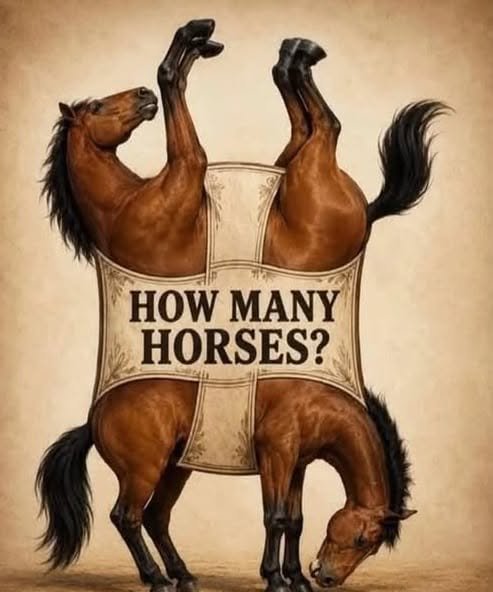
Optical illusions have a unique way of capturing our attention and confounding our senses. They are visual puzzles that challenge the very way we perceive reality, forcing us to question whether what we see is truly what is there. A striking example of this is a viral image featuring a complex, interlocking drawing of equine figures with a scroll in the center boldly asking, “How many horses?”
At first glance, the image appears to be a chaotic jumble of equine legs, heads, and tails. The brain struggles to make sense of the overlapping lines, the vintage sepia tone, and the intertwined bodies. Some people see two horses; others swear they see three, four, or even more. The image is not just a fun internet puzzle; it is a masterful example of a “figure-ground” illusion, a visual phenomenon that reveals the intricate, sometimes flawed, ways our brains process the world around us.
Understanding how this specific illusion works provides a fascinating window into neuroscience, the psychology of perception, and the evolutionary shortcuts our brains take to make sense of visual data. This comprehensive guide will not only reveal the answer to the puzzle but will also explore the science behind why the image is so difficult to decipher, the history of Gestalt psychology, the different types of optical illusions, and what these visual tricks tell us about the incredible power and limitations of the human mind.
The Answer to the Puzzle: How Many Horses Are There?
Let us first resolve the mystery of the image. The answer to the “How many horses?” puzzle is two horses.
The illusion is designed to confuse the viewer by intertwining the bodies so heavily that the brain struggles to trace the outline of a single animal. The two horses are positioned in a highly unusual and symmetrical way:
The First Horse (Upright): Focus on the left side of the image. You will see a horse’s head facing left, with its mane flowing. Its front legs are tucked upward, and its body extends down toward the bottom right of the image.
The Second Horse (Inverted): Now, focus on the right side. There is a horse’s head facing downward toward the ground. Its body extends upward and to the left, crossing over the body of the first horse. Its legs are raised high in the air at the top right.
The visual confusion arises because the legs of the upright horse and the inverted horse interlock perfectly, creating the illusion of a single, multi-legged, twisted creature. The central scroll with the text acts as a visual anchor, breaking the continuity of the bodies and making it even harder to trace the anatomy of either animal.
The Neuroscience of Sight: Why Is the Illusion So Difficult to See?
To understand why this image is so tricky, we must look at the biology of sight. Seeing is not a passive process, like a camera taking a photograph. It is an active, highly complex construction project undertaken by the brain.
The Physics of Vision
The process begins when light bounces off the image and enters the eye, hitting the retina. The retina converts these light photons into electrical signals. However, the retina does not send a complete picture to the brain. It sends fragmented data regarding edges, contrasts, colors, and movement.
The Visual Cortex
These fragmented signals travel along the optic nerve to the back of the brain, to a region called the visual cortex. The visual cortex is organized into a hierarchical system of processing centers (V1, V2, V3, V4, etc.).
V1 (Primary Visual Cortex): Processes basic information like edges and orientation.
V2 and V4: Process contours, shapes, and color.
The Ventral Stream: This pathway, often called the “what” pathway, is responsible for object recognition. It tells us that we are looking at a drawing of horses, not just a series of lines.
Top-Down Processing and Memory
Crucially, the brain does not just rely on the data from the eyes. It uses “top-down processing.” Your brain takes the fragmented visual data and combines it with your past experiences, memories, and expectations to form a complete picture.
When you look at the horse illusion, your brain recognizes the texture and the general shapes associated with horses (manes, hooves, tails). However, because the image violates the normal rules of anatomy—animals do not interlock their legs in this way—your brain’s pattern-recognition software is overwhelmed. It tries to apply its stored templates of a “horse” and fails because the intersecting lines do not match a standard anatomical layout.
Figure-Ground Organization: The Key to the Illusion
This specific image is a classic example of a figure-ground illusion, a concept rooted in Gestalt psychology.
What is Gestalt Psychology?
Gestalt psychology, developed in Germany in the early 20th century by theorists like Max Wertheimer, Kurt Koffka, and Wolfgang Köhler, is based on the idea that human beings experience things as unified wholes. The famous Gestalt maxim is, “The whole is greater than the sum of its parts.” The brain naturally organizes visual elements into groups or patterns.
The Figure and the Ground
One of the core principles of Gestalt psychology is figure-ground organization. When we look at an image, our brain automatically separates the visual field into two parts:
The Figure: The object we are focusing on (the horse).
The Ground: The background against which the object sits.
In a standard image, this distinction is clear. In the horse illusion, the artist has deliberately made the figure and the ground ambiguous. The lines that make up the negative space (the background) between the first horse are used to create the positive space (the body) of the second horse.
When you look at the image, your brain is constantly trying to assign “figure” status to different parts of the drawing. It is why, for a brief moment, you might see only two horses standing upright, and then, with a sudden cognitive shift (the “Aha!” moment), you see the inverted horse and the image flips into a different configuration.
The Science of the “Aha!” Moment: Perceptual Reversals
The moment you finally see the second horse is an example of a perceptual reversal. This is when the brain suddenly reorganizes the visual data into a new, coherent pattern.
Famous examples of this include the “Rubin Vase” (which looks like either a vase or two faces) and the “Duck-Rabbit” illusion (which looks like a duck facing left or a rabbit facing right).
Can You See Both at Once?
One of the most fascinating aspects of these illusions is that the human brain cannot perceive both interpretations simultaneously. When you are looking at the upright horse, the inverted horse completely disappears from your conscious perception. The brain can rapidly switch between the two images, but it can only “hold” one interpretation at a time.
This reveals a fundamental truth about human consciousness: we do not perceive the world in its entirety. We perceive a constructed model of the world, and we can only focus our attention on one model at a time.
The Artist’s Intent: Deception Through Symmetry
The artist who created this illusion utilized several clever techniques to maximize the confusion.
1. Symmetry
The image is highly symmetrical. The legs on the top right mirror the legs on the top left. This symmetry lulls the brain into expecting a mirrored image, making it harder to realize that the two halves of the drawing represent completely different anatomical orientations.
2. The Scroll
The central scroll serves as a visual barrier. By breaking the bodies of the horses in half, the artist prevents the eye from tracing a continuous line from the head to the tail. This forces the brain to guess how the legs connect to the bodies, a process that leads to the visual confusion.
3. Muted Tones
The vintage, sepia-toned, monochromatic color palette removes color cues. If the upright horse were painted brown and the inverted horse painted white, the illusion would fail completely. The uniform color forces the brain to rely entirely on line and shape to differentiate the animals.
Historical and Cultural Perspectives on Optical Illusions
Optical illusions are not a modern invention. Humans have been fascinated by visual tricks for thousands of years.
Ancient Origins: The ancient Greeks and Romans created geometric illusions in their architecture, making floors appear to extend further than they actually did.
The Middle Ages: Artists used forced perspective to create complex, mind-bending images in religious art.
The 19th Century: The Victorian era saw a boom in optical illusions, such as the “impossible trident” and the Necker cube. This was a time of intense interest in the science of perception.
The Digital Age: The internet has brought optical illusions to the masses. Images like the blue/gold dress, the white/gold shoe, and the “How many horses?” puzzle go viral because they tap into our shared human biology while simultaneously sparking debate and conversation.
Are You the Only One Who Can’t See It?
If you stared at the image for several minutes and still struggled to see the second horse, you might feel a sense of frustration. However, there is no need to worry.
The ability to quickly decipher optical illusions is influenced by a variety of factors, including:
Eye Movement: People who use deliberate, systematic eye movements (scanning the image methodically) tend to solve illusions faster than those who take a quick, holistic glance.
Attention and Fatigue: If you are tired or distracted, your brain’s pattern-recognition centers are less efficient.
Neurodivergence: Some research suggests that individuals with certain neurological conditions, such as Autism Spectrum Disorder, may actually be better at spotting the details in ambiguous figures because their brains prioritize local processing over global processing. Conversely, individuals with Alzheimer’s disease may struggle with figure-ground illusions as part of the general cognitive decline.
Experience: A person who frequently works with visual puzzles, such as a radiologist (who is trained to spot subtle shapes in medical scans) or an artist, may have a more flexible visual system.
The Benefits of Optical Illusions for Brain Health
Engaging with optical illusions is more than just a fun distraction; it is a legitimate form of cognitive exercise.
1. Promoting Neuroplasticity
Trying to solve a visual puzzle forces the brain to build new neural pathways. The moment of perceptual reversal—the “Aha!” moment—is a mini-explosion of brain activity, stimulating neuroplasticity, which is the brain’s ability to reorganize itself by forming new neural connections.
2. Improving Attention and Focus
Searching for the hidden image requires sustained attention and focus, skills that are increasingly valuable in our highly distracted, digital world.
3. Early Detection of Cognitive Decline
Interestingly, visual perception tests are now being used in clinical settings as early screening tools for conditions like Alzheimer’s disease and stroke. By monitoring how a patient’s brain interprets ambiguous figures, doctors can gain early insights into the health of their visual processing centers.
4. Fun for All Ages
Optical illusions are a fantastic tool for engaging children in science and critical thinking. They encourage children to ask questions about how their brains and eyes work, demystifying the complex world of neuroscience from a young age.
Frequently Asked Questions
Q: What is the answer to the “How many horses?” puzzle? There are two horses in the image. One is standing upright on the left, and the other is positioned upside down on the right.
Q: Why is the image so confusing to look at? The image is a “figure-ground” optical illusion. The artist has intertwined the legs and bodies of the two horses so precisely that your brain struggles to determine what is the object (the figure) and what is the background (the ground).
Q: Why can’t I see both horses at the same time? The human brain is designed to focus on one interpretation at a time. When you are looking at the upright horse, your brain is suppressing the visual data that forms the inverted horse. The brain rapidly switches between the two interpretations, but it cannot hold both simultaneously.
Q: Are optical illusions a sign of a healthy brain? Yes, engaging with and solving optical illusions is generally a sign of healthy visual processing and cognitive flexibility. It shows that your brain is actively trying to make sense of complex visual data.
Q: Can animals see optical illusions? Research has shown that some animals, such as monkeys, dogs, and even fish, are susceptible to certain optical illusions. This suggests that the neural mechanisms that create these illusions are deeply rooted in evolutionary history.
Q: What is the difference between a hallucination and an optical illusion? An optical illusion is a misinterpretation of a real, external visual stimulus by a healthy visual system. A hallucination is a perception in the absence of an external stimulus, often associated with neurological or psychiatric conditions.
Q: Is the horse illusion a trick of the eyes or the brain? It is entirely a trick of the brain. The eyes simply receive the light patterns. The brain is the organ that processes the lines, shapes, and colors, and it is the brain that becomes confused by the conflicting data.
Q: What is the name of the artist who created this illusion? The exact artist is often debated and often lost to history due to the image’s widespread circulation on the internet. However, it is a classic example of vintage graphic design and illusory art, similar to the work of artists like Octavio Ocampo.
Conclusion
The “How many horses?” image is a brilliant and enduring optical illusion. It masterfully demonstrates the complex interplay between the eyes, the visual cortex, and our conscious perception. It serves as a powerful reminder that our perception of reality is not a direct reflection of the external world, but a constructed model built by the brain using incomplete data.
Whether you saw two horses immediately, or had to stare at the image for ten minutes before the second horse suddenly appeared, the puzzle provides a fascinating glimpse into the inner workings of the human mind. By exploring these visual mysteries, we can better understand the intricate, subjective, and endlessly fascinating nature of human consciousness.