Why Daily Showers After 65 May Do More Harm Than Good: The Ideal Bathing Frequency for Healthy Aging
5. How Often Should People Over 65 Shower?
There is no single bathing schedule that is medically appropriate for every person over 65.
The ideal frequency depends on individual circumstances, including physical activity, sweating, skin condition, personal preferences, climate, and medical needs.
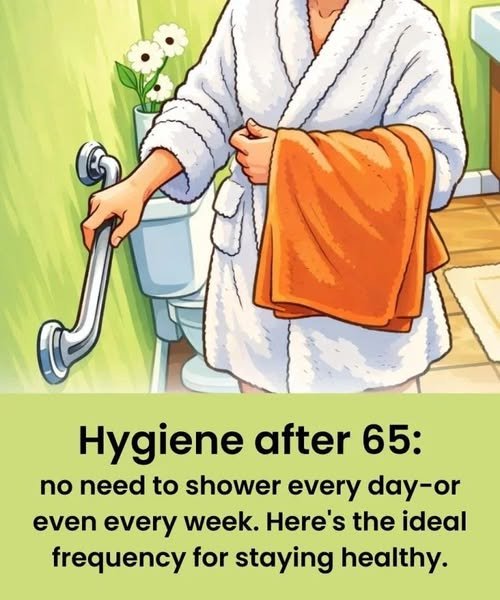
However, for many older adults who are not particularly physically active and do not become excessively sweaty or dirty, taking a full shower approximately two or three times a week may be sufficient.
This can help maintain cleanliness while reducing unnecessary exposure to hot water and cleansing products.
The NHS guidance for supporting older adults with personal hygiene recommends bathing or showering at least twice a week, while washing important areas daily. NHS
It is important to understand that this is a general practical guideline, not a strict rule for everyone.
A practical bathing schedule
For someone with relatively low physical activity and dry skin, a possible routine could include:
Day
Suggested hygiene routine
Monday
Full shower
Tuesday
Daily essential washing
Wednesday
Daily essential washing
Thursday
Full shower
Friday
Daily essential washing
Saturday
Daily essential washing
Sunday
Full shower if needed
This is only an example. Someone who exercises, sweats heavily, works outdoors, or becomes dirty may need to shower more frequently.
Likewise, someone with a skin condition or specific medical instructions may require a different routine.
The goal is to balance cleanliness with skin protection.
6. Which Body Parts Should Be Washed Every Day?
Reducing full-body shower frequency does not mean neglecting personal hygiene.
Certain areas of the body benefit from regular daily cleaning because they naturally accumulate sweat, oils, and microorganisms.
These areas include:
Underarms
The underarms contain sweat glands, and sweat can combine with bacteria on the skin to produce body odor.
Gently washing this area with water and a mild cleanser can help maintain freshness.
Groin and external genital area
The groin is a warm area where moisture and sweat can accumulate.
Regular gentle cleaning helps maintain comfort and reduce unpleasant odors.
Avoid harsh soaps and strongly fragranced products, particularly around sensitive genital skin.
Feet
Feet can accumulate sweat and develop unpleasant odors, especially when covered by socks and shoes throughout the day.
Washing them regularly and drying carefully between the toes can help maintain good foot hygiene.
Face
The face is exposed to environmental dirt, sweat, and natural oils.
Gentle daily washing can help remove these substances without unnecessarily irritating the skin.
Hands
Hand hygiene is particularly important because hands frequently come into contact with surfaces, food, and other people.
Wash your hands regularly with soap and water, especially after using the toilet, before preparing food, and before eating.
These daily hygiene habits are important even when someone does not take a full shower every day.
7. Why Moisturizing Becomes More Important With Age
If there is one skincare habit older adults should pay particular attention to, it is regular moisturizing.
As skin becomes drier with age, applying an appropriate moisturizer can help improve comfort and support the protective skin barrier.
Moisturizers work through different mechanisms.
Some ingredients attract water to the skin, while others help reduce water loss by forming a protective layer.
Examples include:
Glycerin: Helps attract and retain moisture.
Ceramides: Help support the skin’s protective barrier.
Petrolatum: Helps reduce water loss from the skin.
Hyaluronic acid: Helps attract water to the outer skin layers.
Shea butter: Provides moisturizing and softening effects.
When should moisturizer be applied?
One particularly useful time is immediately after bathing.
After showering, gently pat the skin with a clean towel, leaving it slightly damp.
Then apply a suitable moisturizer while the skin still contains some moisture.
The American Academy of Dermatology recommends applying a creamy, fragrance-free moisturizer within approximately three minutes after bathing. American Academy of Dermatology+1
For particularly dry skin, thicker creams or ointments may provide more lasting moisture than lightweight lotions.
8. What Happens When Older Adults Use Harsh Soaps?
Not all soaps and body washes are equally suitable for aging skin.
Some cleansing products contain fragrances, strong detergents, or other ingredients that may irritate sensitive skin.
Products that create a very strong lather are not necessarily better at maintaining skin health.
For an older adult experiencing dryness, selecting a gentle, fragrance-free cleanser may be more appropriate.
Look for products labeled:
Fragrance-free.
For sensitive skin.
Moisturizing cleanser.
Gentle or soap-free cleanser.
Avoid products that consistently leave the skin feeling tight, itchy, or irritated.
It is also worth remembering that natural fragrances and essential oils can cause irritation in some individuals. A product being marketed as natural does not automatically mean it is suitable for sensitive skin.
If a particular soap repeatedly causes discomfort, changing to a gentler alternative may help.