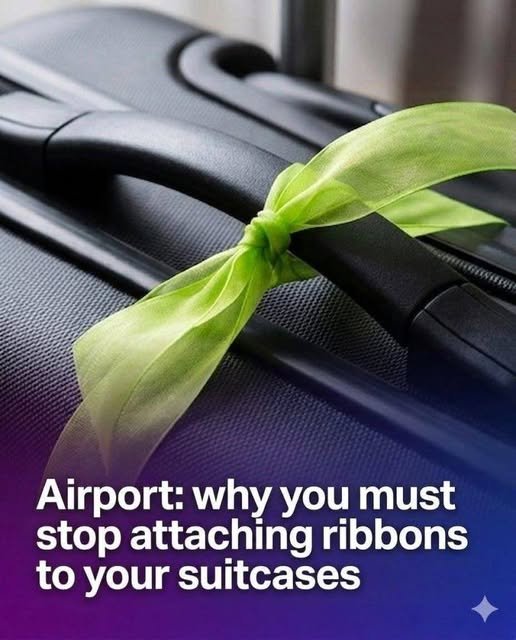
Why Baggage Handlers Say You Should Never Tie a Ribbon to Your Luggage
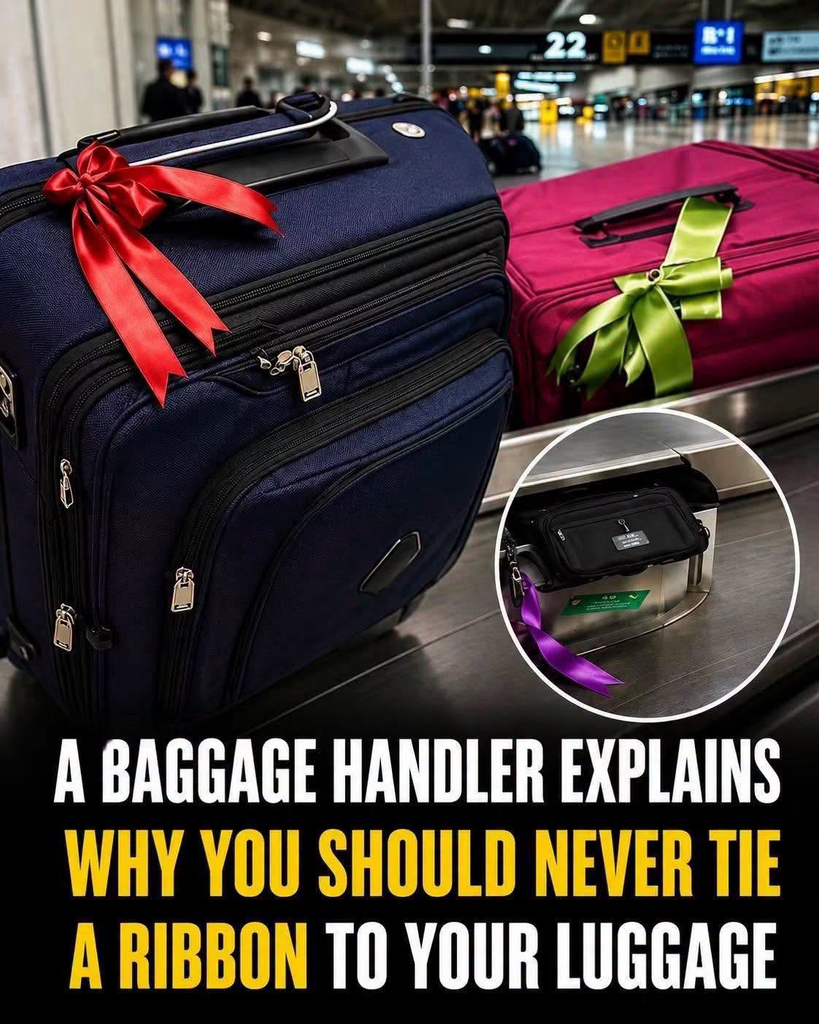
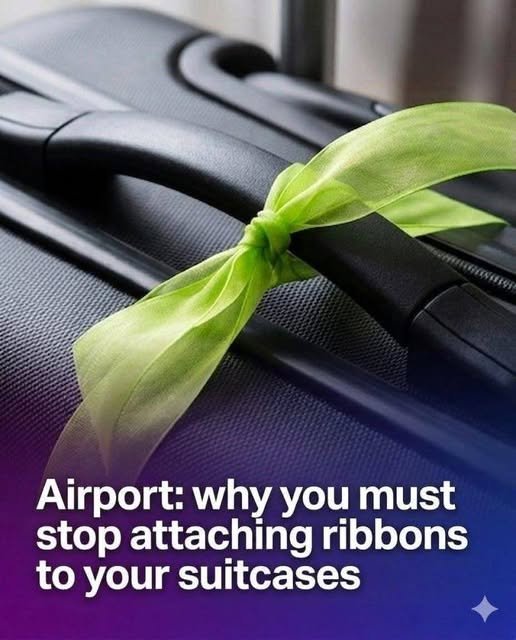
For decades, the brightly colored ribbon tied to a suitcase handle has been one of the most popular and seemingly innocuous travel hacks. The logic is simple and relatable: airport baggage carousels are a sea of identical black, navy, and gray suitcases. To avoid the anxiety of accidentally grabbing a stranger’s bag, travelers attach a bright red bow, a neon green ribbon, or a distinctive piece of fabric to make their luggage instantly recognizable.
It feels like a harmless, clever solution. However, a growing chorus of airport baggage handlers and travel experts is issuing a stark warning: that cheerful ribbon might be the very reason your bag is delayed, damaged, or permanently lost. A viral social media post featuring a baggage handler’s advice has sparked widespread debate, warning travelers to stop tying ribbons to their luggage immediately.
The reality is that the modern airport is a highly complex, automated logistical machine, and our attempts to personalize our bags often interfere with the technology designed to move them efficiently. From causing catastrophic jams in the conveyor belt system to preventing crucial barcodes from being scanned, the decorative ribbon is a significant liability.
This comprehensive guide will explore the hidden dangers of the luggage ribbon. We will examine the technical reasons why these accessories wreak havoc on automated baggage systems, the potential consequences for your belongings, other items you should avoid attaching to your bags, and the safer, more effective alternatives for making your suitcase stand out without risking its safe arrival.
The Journey of a Checked Bag: A High-Speed Logistics Operation
To understand why a simple ribbon is such a problem, it is essential to understand what happens to your bag after you hand it over at the check-in counter. The moment your suitcase disappears behind the rubber flaps, it enters a high-speed, largely automated labyrinth.
The Automated Sorting System
Modern airports rely on complex baggage handling systems (BHS) designed to process thousands of bags per hour with minimal human intervention. The journey typically begins with a series of conveyor belts that transport the bag to a series of scanners.
The most critical piece of technology is the Automated Tag Reader (ATR). These lasers and cameras read the barcode printed on the bag tag attached at check-in. Once the barcode is scanned, the system’s computer knows exactly which flight the bag belongs to and routes it through a network of diverters, chutes, and tilt-tray sorters to the correct make-up area.
The Need for Speed and Precision
This system relies on split-second timing. The belts move quickly, and the scanners have only a fraction of a second to read the tag. If the system runs smoothly, your bag travels from the check-in desk to the airplane’s cargo hold without ever being touched by human hands again. However, if the automated system encounters an anomaly—such as an unreadable tag or a physical obstruction—the process breaks down.
The Hidden Dangers of the Decorative Ribbon
The luggage ribbon is fundamentally incompatible with this high-speed automated environment. While it may look charming to the human eye, it is a nuisance to the machines. Here is exactly how ribbons cause problems.
1. Interference with Barcode Scanners
This is the most common and immediate problem. The barcode tag attached by the airline is designed to be flat and easily read. A dangling ribbon can easily flop over the barcode, obscuring it from the laser scanner.
When the scanner cannot read the tag, the bag is flagged as an “exception.” It is automatically diverted off the main line and sent to a manual processing area. Here, an airport employee must physically intervene, lift the bag, locate the tag, and manually scan it. This intervention takes time. In an industry where a few minutes can mean the difference between a bag making its flight or missing it entirely, a ribbon can directly cause a delay.
2. Catastrophic Entanglement in Machinery
Beyond scanning issues, there is a severe physical danger. The conveyor belt system is a complex web of moving parts, rollers, and tight corners. The long, dangling ends of a ribbon are highly susceptible to getting caught in these mechanisms.
If a ribbon snags on a roller or a joint, it can pull tight, stopping the bag dead in its tracks. This can cause a jam that shuts down the entire conveyor line. The impact can also damage your suitcase as the machinery continues to pull on the caught ribbon, potentially ripping the handle clean off or tearing the exterior fabric. In worse-case scenarios, a severe jam can delay the luggage of hundreds of passengers on multiple flights while maintenance crews work to clear the obstruction.
3. The “Unique Identifier” Fallacy
There is a psychological trap in the ribbon strategy. Travelers believe their ribbon makes their bag unique. In reality, a red or neon green ribbon is one of the most common choices. If there are five bags on the carousel with identical ribbons, the marker becomes useless.
Furthermore, if the ribbon gets torn off during transit and hangs onto a piece of machinery, it might eventually attach itself to a different bag, leading to a chaotic mix-up. Finally, old, faded ribbons and stickers from previous trips can confuse scanners, which may try to read an old barcode instead of the current one, potentially sending your bag to the wrong destination.
Other Items You Should Never Attach to Your Checked Bag
The advice to remove ribbons is part of a broader caution against attaching loose, dangling, or obstructive items to the exterior of your checked bag. Travel experts recommend avoiding or carefully securing the following:
Loose scarves or bandanas: These are particularly prone to getting caught in machinery and can easily fall off, getting lost forever.
Long, floppy luggage tags: While a standard identification tag is essential for checked bags, a long tag can pose the same entanglement and scanning risks as a ribbon. Choose a sturdy, compact tag that lies flat against the bag.
Bulky external accessories: Items that protrude significantly from the bag’s profile can interfere with the smooth operation of conveyor belts and scanning equipment.
Fragile items: Anything that can break or shatter (like a ceramic name tag) should be avoided, as the vibrations and impacts of the baggage system will likely destroy it.
The Real-World Consequences: Delays, Loss, and Frustration
The theoretical risks of a ribbon translate into very real consequences for travelers. A delayed bag can derail a vacation, especially if it contains essential medications, clothing, or work equipment.
The U.S. Department of Transportation reports that millions of bags are mishandled every year. While the vast majority are eventually reunited with their owners, the stress, inconvenience, and time lost are significant. When a bag is delayed due to a non-readable tag or a machine jam, the airline’s resources are diverted to manual handling, which increases the chances of further errors. By removing a decorative ribbon, you are significantly reducing your risk of joining the statistical ranks of the mishandled.
Safe and Effective Alternatives for Identifying Your Luggage
The desire to easily spot your bag is entirely reasonable. The solution is not to abandon identification altogether, but to use methods that are compatible with the airport’s automated systems.
1. Heavy-Duty, Brightly Colored Luggage Straps
A luggage strap that wraps around the entire suitcase is the gold standard alternative. These straps provide a large, visible band of color that is easy to spot from a distance. Crucially, because they are wrapped tightly around the bag’s center of gravity, they do not have loose ends that can become entangled. Many straps also add an extra layer of security, helping to keep the suitcase closed if the zipper bursts.
2. Distinctive, Flat Stickers or Tape
Applying a unique, durable sticker to the side of your suitcase is another safe and effective method. You can also use a strip of brightly colored duct tape. These flat, integrated markings do not interfere with scanners or machinery and make your bag instantly recognizable. Just make sure to remove any old airline barcodes before applying new ones.
3. Choose a Uniquely Colored or Patterned Suitcase
The most foolproof solution is to start with a bag that is not black. Black is the most common suitcase color, and it is the hardest to identify on a carousel. Choosing a suitcase in a vibrant color—such as red, yellow, or green—or one with a distinctive pattern can eliminate the need for any external accessories.
4. Protective Luggage Covers
A stretchy, brightly colored, or patterned luggage cover slips over the entire suitcase. This serves a dual purpose: it makes your bag highly visible and protects it from scratches and dirt during handling. Because the cover fits snugly, it does not pose the same risks as a dangling ribbon.
5. GPS Trackers
For peace of mind, a small GPS tracker (like an Apple AirTag or a Tile) placed inside the suitcase can help you locate your bag if it goes missing. This is a modern, discreet technological solution that does not interfere with any airport systems and provides real-time tracking data directly to your phone.
What to Do If You Have Already Tied a Ribbon
If you are reading this while waiting in the check-in line with a ribbon on your bag, do not panic. Simply untie the ribbon or remove the dangling accessory before handing your suitcase to the agent. If you want to keep the ribbon for sentimental reasons, place it inside the bag.
If the agent has already taken your bag, it is likely too late to intervene. In this case, the best you can do is ensure your contact information is securely placed inside the suitcase, and keep your baggage claim ticket safe.
Conclusion: Leave the Ribbon at Home
The viral warning from baggage handlers is not a myth or a scare tactic; it is a genuine piece of practical advice born from the realities of airport logistics. The modern baggage handling system is a marvel of automation, but it is also highly sensitive to disruption. A decorative ribbon, while cute and well-intentioned, is an obstruction that can lead to scanning failures, mechanical jams, and ultimately, a delayed or damaged bag.
The next time you pack for a trip, resist the urge to tie a ribbon to your handle. Instead, opt for a brightly colored luggage strap, a distinctive sticker, or a uniquely designed suitcase. By making choices that work with the automated system rather than against it, you can increase the chances that your bag arrives with you, exactly when and where it is supposed to.
Frequently Asked Questions
Are ribbons on luggage actually dangerous?
Yes, in the context of airport operations. They can obscure barcode scanners, causing delays, and they can get tangled in the conveyor belt machinery, leading to damage to your bag or a system jam.
Can a ribbon cause my luggage to be lost?
Indirectly, yes. If a ribbon prevents the bag from being scanned automatically, it is diverted for manual processing. This increases the time the bag spends in the system and the number of times it is handled, raising the risk of it being misplaced or missing its scheduled flight.
What should I use instead of a ribbon to identify my bag?
The safest options are brightly colored luggage straps that wrap tightly around the suitcase, flat stickers, or choosing a suitcase with a distinctive pattern or color. GPS trackers inside the bag are also excellent for peace of mind.
Are luggage tags safe?
A standard, sturdy luggage tag with your contact information is essential and generally safe. However, avoid long, dangling tags that could get caught in machinery. Choose a compact tag that lies flat against the bag.
Do ribbons cause problems on carry-on bags?
The primary risks are associated with checked bags that go through the automated sorting system. A ribbon on a carry-on bag that stays with you is less likely to cause a problem, but it is still best to avoid dangling items that could get caught on other things during your journey.
Why do old stickers on a suitcase cause problems?
Old airline stickers and barcodes can confuse the automated scanning equipment. The scanner may try to read an old barcode instead of the current one, which can cause routing errors and send your bag to the wrong destination. Always remove old tags before checking a bag.
Can I use a ribbon to tie my bag shut if the zipper breaks?
If your zipper breaks, you should use a heavy-duty luggage strap or ask the airline for a plastic security bag to secure the contents. Never use a thin ribbon to secure a broken bag, as it will not hold and will definitely get caught in the machinery.