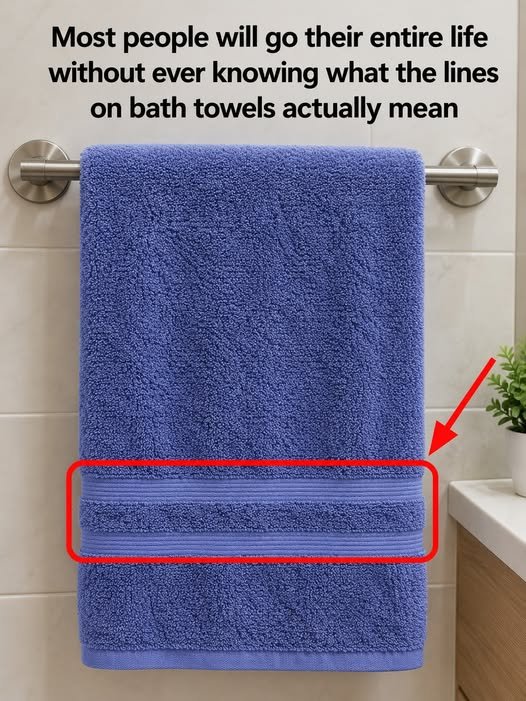
Many people have noticed the woven strip near the edge of their bath towels but never stopped to consider its purpose. A recent social media post claims that most people will go their entire lives without knowing what these lines mean.
The lines are called a “dobby border,” named after the dobby loom used to create them . While they add a decorative touch, they serve several practical functions.
Key Functions of the Dobby Border
The dobby border is more than just a design feature. Here are its main purposes:
Preventing Fraying and Adding Durability: The tighter, denser weave reinforces the towel’s edges, which helps prevent threads from unraveling and extends the towel’s lifespan. This is especially important for towels that are washed frequently, such as those used in hotels or gyms .
Maintaining Shape: The dobby border provides more structure than the terrycloth body of the towel. This helps the towel hold its shape and resist shrinking or curling at the edges during washing .
Improving Hanging and Folding: Because the border is flatter and less bulky, it can make it easier to hang the towel neatly on a rack or clothesline and to fold it uniformly for storage .
A Note on Absorbency
The dobby border is generally less absorbent than the main body of the towel because of its tighter weave. Some manufacturers claim it can help improve the towel’s overall drying speed by allowing moisture to distribute more evenly, though the main absorbency comes from the terrycloth .
Why It’s Worth Knowing
Understanding the purpose of the dobby border can help you make more informed decisions when shopping for towels. While a towel without this feature will still absorb water, it may not be as durable or hold its shape as well over time .