The Real Meaning Behind the Stripes on Bath Towels (It’s Not Just Decoration!)
🛁 The Real Meaning Behind the Stripes on Bath Towels
We use bath towels every single day, but have you ever stopped to wonder why so many of them have those distinct woven stripes near the ends? Most people assume they are just a decorative design choice to make the towel look nice.
The truth is, those stripes actually serve a very practical purpose — and once you know it, you’ll never look at your towels the same way again. 👇
🧵 What Are Those Stripes Actually For?
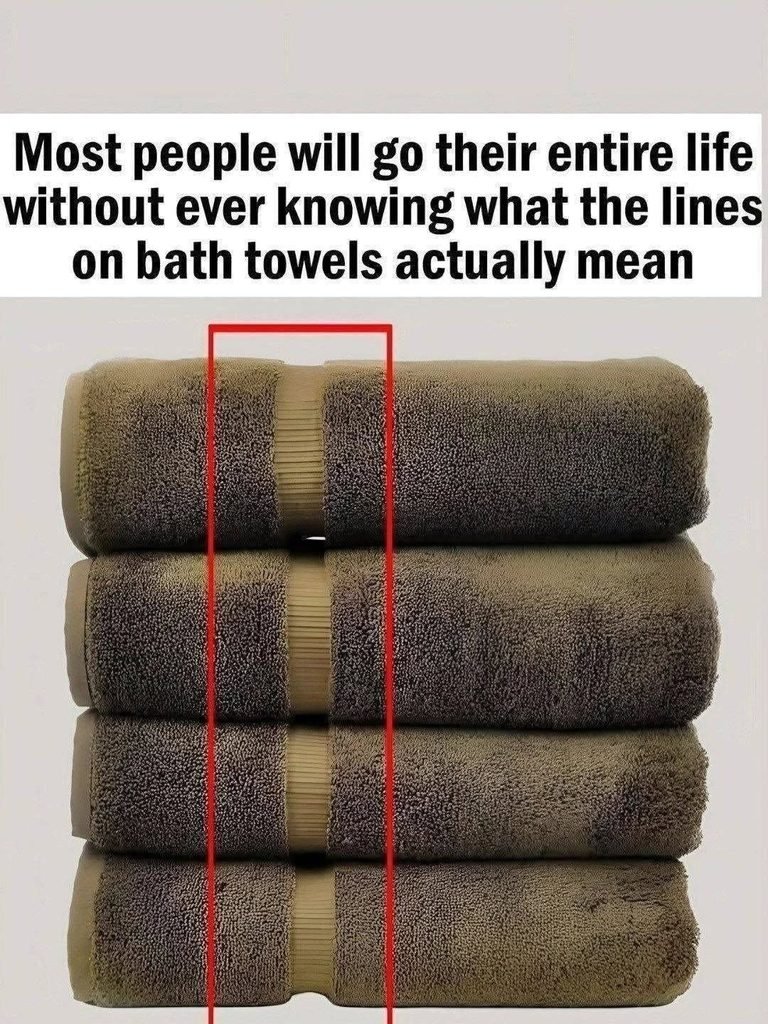
Those decorative bands, often called dobby borders (or sometimes “true selvage”), are woven directly into the fabric. While they do add aesthetic appeal, their original purpose is entirely functional:
1. They prevent unraveling (Structural Integrity) In cheaper or mass-produced towels, the ends might just be folded over and stitched. But in higher-quality towels, the dobby border is a tightly woven section that locks the weft threads in place. This prevents the towel from fraying, unraveling, or falling apart after multiple washes. It acts as a structural “anchor” for the terry cloth loops.
2. They indicate the “Head” and “Foot” of the towel In the textile industry, the decorative stripe often indicates the top and bottom of the towel. This helps manufacturers, retailers, and even you at home know exactly how to fold the towel properly for a neat, uniform display. The striped band is designed to face outward when folded.
3. They mark the “Wrong Side” In some higher-end towels, the dobby border is woven slightly differently on the front and back. This can help you quickly identify the “right” side of the towel to face outward when hanging it up.
🧺 Why Do Some Towels Have Different Stripe Patterns?
The style and number of stripes often signify the quality or brand of the towel:
Single thin stripe: Often a basic, everyday towel.
Wide band with multiple stripes: Typically indicates a higher-quality towel with a denser weave.
Jacquard patterns: Sometimes the stripes are actually a woven-in brand logo or a specific design pattern.
No stripes (plain border): Often found on very cheap towels that are simply hemmed, or on luxury towels where the entire towel is woven with equal density.
❓ Frequently Asked Questions
Do the stripes mean anything about the towel’s quality? They can be a good indicator! A tightly woven dobby border usually means the towel was made with more care and will last longer than a cheaply hemmed towel.
Are the stripes always at the ends of the towel? Yes, traditionally they are woven horizontally near both ends of the towel, running parallel to the short edges.
Why do some towels have stripes and others don’t? It comes down to manufacturing choices. Cheaper towels might skip the dobby border to save costs, while luxury towels might use a different finishing technique that doesn’t require a visible stripe.
Can I remove the stripes? No, they are woven into the fabric itself. Cutting them off would cause the towel to unravel immediately.
Do the stripes have a specific name? Yes, they are commonly called dobby borders in the textile industry. “Dobby” refers to a specific weaving technique that creates small, geometric patterns.
Do the colors of the stripes mean anything? Not usually. The color is typically chosen to match or complement the color of the towel. However, some high-end brands use specific stripe patterns as a signature mark of their brand.
Why do hotel towels often have stripes? Hotels often use towels with dobby borders because they are more durable and can withstand frequent industrial washing. The stripes also make it easy for staff to fold them uniformly for a clean, professional look.
Does the stripe help with drying? No, the stripe itself doesn’t affect absorbency. The absorbency comes from the terry cloth loops that cover the rest of the towel.