Think You’re Buying Real Honey? Here’s How to Tell (The “Flip Test” Revealed)
Is your honey actually just sugar syrup? Discover the viral “Flip Test” and 3 other simple kitchen tricks to tell if your honey is 100% pure and real.
Introduction
Honey is liquid gold. We put it in our tea, drizzle it over yogurt, and use it to soothe sore throats. But here is a scary statistic: Up to 30% of the honey sold in supermarkets is fake.
Manufacturers often cut pure honey with cheap corn syrup, sugar water, or molasses to increase profits. You might think you are eating a superfood, but you’re actually just eating expensive sugar.
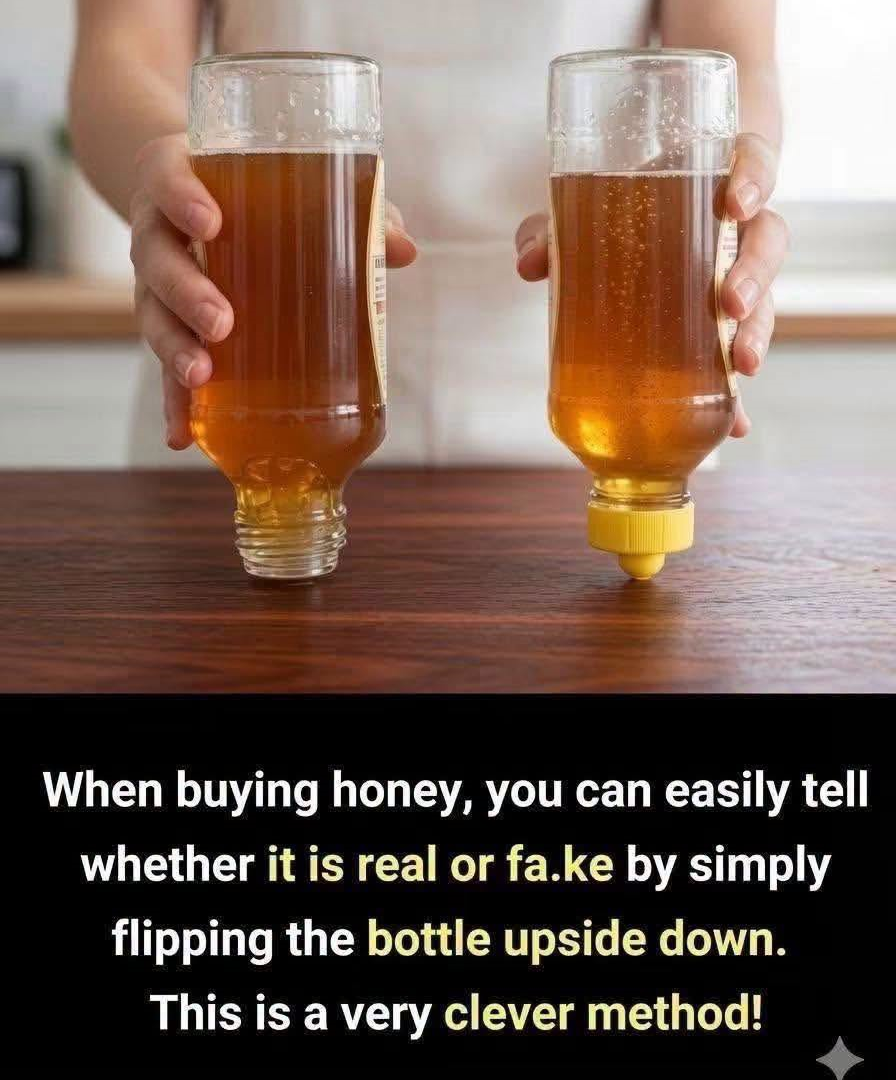
As the image above suggests, there is a “very clever method” to spot the fakes right in the grocery store aisle without opening the jar. It’s called the Flip Test, and it relies on simple physics.
Here is how to perform the Flip Test, plus three other easy ways to verify your honey at home.
1. The “Flip Test” (The Grocery Store Hack)
This is the trick shown in the viral image. It tests the viscosity (thickness) of the honey. Pure honey is dense and heavy; fake honey (mixed with water) is thin and runny.
How to do it:
Pick up a bottle of honey.
Turn it completely upside down (as shown in the photo).
Watch the air bubble inside the jar.
The Result:
Real Honey: The air bubble will rise to the bottom (now the top) very slowly. It might take several seconds to move an inch. This shows the honey is thick and viscous.
Fake Honey: The air bubble will shoot up to the top quickly, almost like it does in a bottle of water or oil. This indicates the liquid is thin and likely watered down.
2. The Water Test (The Solubility Check)
Once you get the honey home, you can try the water test. Pure honey is dense and doesn’t dissolve easily in cold water.
How to do it:
Fill a glass with water.
Drop a tablespoon of honey into the glass.
Do not stir immediately.
The Result:
Real Honey: It will sink to the bottom and stay in a solid lump. You will have to stir it vigorously to get it to dissolve.
Fake Honey: It will start dissolving immediately as it hits the water, turning the water cloudy or sweet right away.
3. The Thumb Test (The Stickiness Check)
Real honey is incredibly sticky and thick. Fake honey is often just syrup, which runs easily.
How to do it:
Put a small drop of honey on your thumb.
The Result:
Real Honey: It will stay in a perfect round bead and stay exactly where you put it. It feels thick and tacky.
Fake Honey: It will spill over your thumb and drip down your hand like water or oil.
4. The Bread Test (The Hardening Check)
This is a fun one to try at breakfast. Real honey contains enzymes that actually harden bread, while fake honey (sugar syrup) just makes it wet.
How to do it:
Spread honey on a slice of bread.
Wait a few minutes.
The Result:
Real Honey: The bread underneath the honey will become hard and crunchy.
Fake Honey: The bread will just get soggy and wet, like you spilled water on it.
Why Does It Matter?
You might think, “Sugar is sugar, who cares?”
Real raw honey is packed with antioxidants, enzymes, and antibacterial properties. It can help with allergies and heal wounds. Fake honey (high fructose corn syrup) has none of these benefits. It spikes your blood sugar just like soda does, without the nutritional payoff.
Conclusion
Next time you are at the store, don’t just look at the label (labels can be misleading!). Grab that bottle, flip it upside down, and watch that bubble. If it shoots up like a rocket, put it back on the shelf.