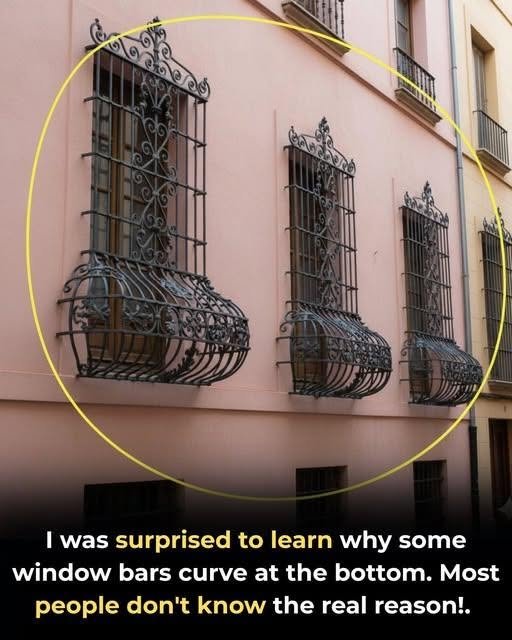
The Secret History Behind Curved Window Bars: Why They Aren’t Just for Decoration
Introduction: The Mystery of the Bulging Window
If you have ever traveled through Spain, Portugal, or many parts of Latin America, you have undoubtedly noticed them. As you walk down the narrow, sun-drenched streets of Madrid or Seville, your eyes are drawn to the facades of the buildings, adorned with ornate wrought-iron window grilles. Unlike the flat, purely protective bars you might see on a ground-floor apartment in New York or London, these bars often feature a distinct, architectural bulge. They curve outward at the bottom, creating a small, cage-like extension that hangs over the street.
A recent viral image highlights this exact feature. The photo shows a beautiful pink building with three identical windows. The heavy, black iron bars are perfectly flat at the top, but at the bottom, they swoop outward in an elegant, basket-like curve. The text overlaid on the image reads: “I was surprised to learn why some window bars curve at the bottom. Most people don’t know the real reason! Many people think it’s for decoration!”
It is a fascinating observation. To the modern eye, accustomed to viewing historical architecture through an aesthetic lens, this curved ironwork appears to be purely decorative. It adds a touch of flair, a romantic, old-world charm to the building’s facade. However, as with many elements of historical architecture, form follows function. That outward curve is not merely a stylistic choice; it is a brilliant design solution born out of a time when windows were not just portals for light and air, but critical points of vulnerability, social interaction, and domestic life.
This comprehensive two-part guide will explore the hidden history of the curved window bar. We will delve into the architectural evolution of the reja, the fascinating defensive tactics of medieval and early modern Europe, and the practical, everyday reasons why expanding the window outward became a necessity in urban living.