The Secret Meaning Behind the Lines on Bath Towels: It’s Not Just Decoration
We use them every single day, rubbing them against our wet skin, throwing them over a rack to dry, and tossing them in the washing machine without a second thought. The humble bath towel is one of the most ubiquitous objects in the modern home, a silent workhorse of our daily hygiene routine. Yet, despite its constant presence in our lives, there is a specific design feature on almost every towel that leaves people utterly baffled.
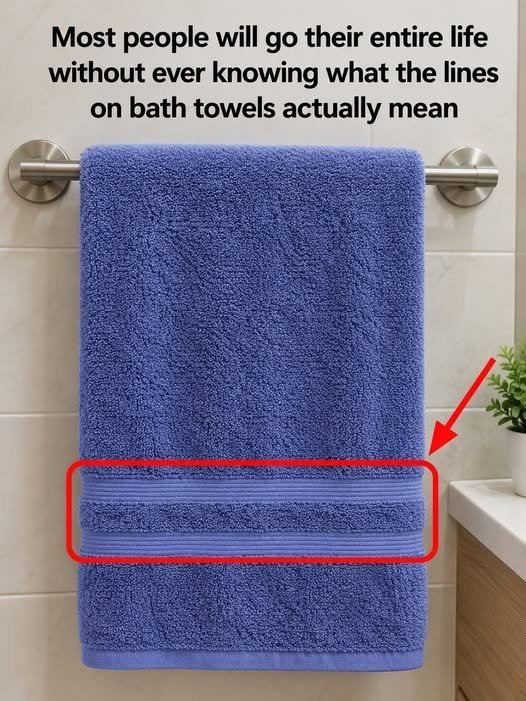
A viral social media post recently highlighted this mystery. It featured an image of a plush blue towel hanging over a rack, with a red arrow pointing directly to the horizontal, woven bands located near the bottom edge. The text read: “Most people will go their entire life without ever knowing what the lines on bath towels actually mean.”
The post sparked thousands of comments, with speculations ranging from the mundane to the bizarre. Some argued that the bands indicate the “foot end” of the towel, meant to keep your face clean. Others believed they are a hidden signal for hotel housekeeping, or simply a decorative flourish to break up the solid color.
The truth, as is often the case with well-engineered everyday objects, is far more practical. Those horizontal bands are called dobby borders, and they serve a crucial combination of structural, functional, and aesthetic purposes. They are not just decorative lines; they are a hallmark of textile engineering that ensures your towel remains durable, hangs properly, and looks good doing it.
This comprehensive guide will unravel the mystery of the towel band. We will explore the fascinating history of the terry cloth towel, explain the mechanical process of how these bands are woven, break down their primary functions, debunk the most common myths, and explain why this small design detail is actually a major indicator of quality.
The Anatomy of a Bath Towel
To understand why the horizontal bands exist, it is first necessary to understand how a towel is constructed. A towel is not just a flat piece of fabric; it is a complex textile composed of several distinct elements woven together.
The Ground Warp and Weft
Every woven fabric consists of two sets of threads. The warp threads run vertically (lengthwise) and are held under tension on a loom. The weft threads run horizontally (widthwise) and are woven over and under the warp threads. In a towel, these threads form the base fabric, known as the ground cloth.
The Terry Pile
What makes a towel different from a bedsheet is the terry pile. During the weaving process, extra warp threads are woven in small loops on both sides of the fabric. These loops are the fluffy, absorbent part of the towel. They increase the surface area of the fabric, allowing it to soak up massive amounts of water. The length and density of these loops (often measured in grams per square meter, or GSM) determine how plush and absorbent the towel will be.
The Hem
The top and bottom edges of a towel are folded over and stitched to prevent the fabric from unraveling. This is called the hem.
The Dobby Border (The Lines)
The dobby border is the specific area near the hem where the terry loops are interrupted. Instead of the fluffy, textured loops, the weaver switches to a flat, tightly woven pattern. This flat section usually consists of several distinct bands or stripes.
The name “dobby” comes from a specific type of weaving machine called a Dobby Loom. Unlike a plain loom that weaves simple, repeating patterns, a dobby loom uses a mechanical chain or a computer to lift specific warp threads in sequence, allowing the weaver to create small, intricate geometric patterns—like the horizontal bands seen on towels.
The Primary Purpose: Structural Reinforcement
The most important reason for the dobby border is structural. It is the architectural anchor of the towel.
Preventing Unraveling
Towels are woven in long, continuous bolts, often hundreds of feet long. When the towel is cut to its finished size, the raw edges are exposed. If a towel were made entirely of terry loops, cutting it would be a disaster. The loops would immediately begin to pull out, and the entire towel would unravel into a pile of loose threads in the washing machine.
The dobby border solves this problem. By weaving a flat, tight band near the ends of the towel, the manufacturer creates a dense, stable foundation. When the towel is cut, the edge is secured, preventing the terry loops from pulling apart. This is why cheap towels often fray after a few washes—their dobby borders are poorly constructed or too narrow to effectively anchor the fabric.
Anchoring the Hem
The dobby border also provides a stable base for the hem. Because the dobby area is flat and tightly woven, it folds over easily without the bulk of the terry loops. This allows for a clean, flat stitched hem that secures the towel’s edge without distorting the overall shape of the fabric.
The Functional Purpose: Draping and Hanging
While the structural purpose is vital, the dobby band also serves a highly practical, everyday function related to how we hang our towels.
The “Hanging Straight” Principle
Have you ever noticed that a towel hangs better on a rack when it is folded at the band? The dobby border is denser and heavier than the rest of the fluffy towel. When you drape a towel over a towel bar, folding it exactly at the dobby border creates a perfect, straight-hanging drape. The weight of the band acts as a counterbalance, preventing the towel from sliding off the rack and ensuring it dries evenly.
A Visual Cue
For towel designers, the band provides a visual cue to indicate the top and bottom of the towel. This is especially important when the towel is hung on a rack or folded on a shelf. If a towel has a distinct band, it is instantly recognizable as the “end” of the towel, helping to create a neat, uniform look in a bathroom. It guides you on how to fold it properly to look tidy.
The Aesthetic Purpose: Design and Branding
Beyond its functional and structural roles, the dobby border is a crucial element of design.
Adding Contrast and Elegance
For centuries, towel manufacturers have used the dobby border to add contrast to solid-colored towels. A white towel with a navy blue dobby border, or a gray towel with a crisp white border, adds a touch of tailored elegance to a bathroom. The flat, smooth texture of the band provides a pleasing visual and tactile contrast to the fluffy, nubby terry loops of the main body.
A Canvas for Branding
The flat surface of the dobby border is the perfect place for embroidery. This is why high-end hotels often feature towels with their logos embroidered directly onto the band. The tight weave holds the embroidery threads securely, and the flat surface prevents the logo from getting distorted by the terry loops.
Debunking the Myths: What the Lines Do NOT Mean
Because the dobby border is so prominent, several enduring myths have sprung up around its purpose. It is time to put them to rest.
Myth 1: The Lines Mark the “Foot End”
This is perhaps the most popular myth. Many people believe the banded end is the designated area for drying your feet, to keep the rest of the towel hygienic for your face. While this is a nice idea for personal organization, there is no historical or manufacturing basis for it. The band is simply where the towel was structurally finished, not a hygiene indicator.
Myth 2: The Lines Indicate Higher Absorbency
Some people believe the flat band is more absorbent than the fluffy loops. In reality, the terry loops are far more absorbent. The flat dobby band actually absorbs less water because it lacks the surface area of the loops.
Myth 3: The Lines are a Hotel Housekeeping Signal
There is a rumor that in hotels, the band indicates which part of the towel should be used for the face versus the body, or that a specific number of lines indicates the grade of the hotel. This is entirely false. The number of lines is simply a stylistic choice made by the manufacturer.
How to Use the Dobby Border to Judge Towel Quality
Now that you know what the band is, you can use it as a practical tool for shopping. When you are buying a new towel, inspect the dobby border closely. Here is what to look for:
Width: A wider dobby border usually indicates a higher-quality towel. It provides more structural support and is less likely to fray.
Density: Run your fingers over the band. It should feel tight, flat, and substantial. If it feels flimsy, loose, or scratchy, the towel is likely of lower quality.
Stitching: The hem at the end of the band should be neatly stitched with no loose threads. A poorly stitched hem is a sign of a towel that will fall apart quickly.
Consistency: The band should be perfectly straight and symmetrical. If it is crooked, the towel was poorly manufactured.
The History of the Terry Cloth Towel
To fully appreciate the design of the modern towel, it helps to look at its history.
From Linen to Terry Cloth
For centuries, people dried themselves with plain linen cloths or rough cotton fabrics that had very little absorbency. They were scratchy and had to be replaced frequently. In the mid-19th century, a British manufacturer named Samuel Holt patented a new type of fabric called terry cloth. It featured loops of thread on both sides, which increased its absorbency significantly.
By the early 20th century, terry cloth towels had become the standard in Western households. As manufacturing technology improved, the dobby loom allowed weavers to create patterns within the towel itself, leading to the decorative borders we see today.
The Evolution of Design
Over the decades, the dobby border evolved from a purely functional necessity into a major design element. In the mid-20th century, towel sets often featured elaborate floral or geometric bands in bold colors. Today, the trend is often toward minimalism, with simple, elegant bands in complementary colors.
Caring for Your Towel Bands: Maintenance Tips
To ensure your towels last for years, you need to care for the dobby bands properly.
Wash Separately: Wash new towels separately from other clothing for the first few washes, as they shed a lot of lint and dye.
Avoid Fabric Softener: Fabric softener coats the terry loops and the dobby band with a waxy layer, reducing absorbency over time.
Tumble Dry Low: High heat can damage the cotton fibers in the band, causing it to shrink or fray. Tumble dry on low or medium heat.
Don’t Overload the Machine: Towels need room to agitate in the wash to get clean. Overloading the machine can cause the dobby bands to snag and tear.
Conclusion: A Small Band with a Big Job
The horizontal lines on your bath towel are far more than just a decorative detail. They are the structural backbone of the towel, the anchor that prevents it from unraveling into a mess of threads. They provide a stable base for the hem, help the towel hang neatly on the rack, and serve as a canvas for elegant design and hotel branding.
The next time you reach for a towel, take a moment to look at the dobby border. It is a testament to the ingenuity of textile engineering—a small, flat band that silently does its job, ensuring that your towel remains fluffy, absorbent, and durable for years to come.
Frequently Asked Questions
What are the horizontal lines on a bath towel called?
They are called dobby borders or dobby bands. The name comes from the Dobby Loom, a type of weaving machine used to create small, intricate patterns in fabric.
Why do towels have those bands?
The bands serve three main purposes: they structurally reinforce the ends of the towel to prevent unraveling, they anchor the hem, and they provide a visually appealing design element. They also help the towel hang straight on a rack.
Do the lines mean the towel is higher quality?
Yes, generally. A wide, tightly woven, and neatly stitched dobby border is a strong indicator of a high-quality towel. It shows that the manufacturer took care to secure the edges, meaning the towel will last longer without fraying.
Is the banded end supposed to be for your feet?
No, this is a common myth. The banded end is simply the structural finish of the towel. It does not indicate which part of the towel should be used for your face or your feet.
Are the lines more absorbent than the rest of the towel?
No. The fluffy terry loops are far more absorbent than the flat dobby band, because the loops have a much larger surface area to soak up water.
How can I tell if a towel is good quality by looking at the band?
Look for a wide, dense band that feels smooth and substantial. The stitching on the hem should be tight and neat. Avoid towels with narrow, flimsy bands or loose threads, as these are likely to fray quickly.
What is a Dobby Loom?
A Dobby Loom is a weaving machine that uses a mechanical or computerized system to lift individual warp threads, allowing the weaver to create small geometric patterns, like the bands on towels, without the complexity of a full Jacquard loom.
Do all towels have a dobby border?
Most high-quality terry cloth towels do. However, some very cheap or novelty towels may have a simple hemmed edge without a dobby band. These towels are much more prone to fraying and unraveling over time.