The Mystery of the Viral Grandpa Sticker: Unraveling the Mushroom Face Illusion
The Psychology of Ambiguous Images: Why Our Brains Flip
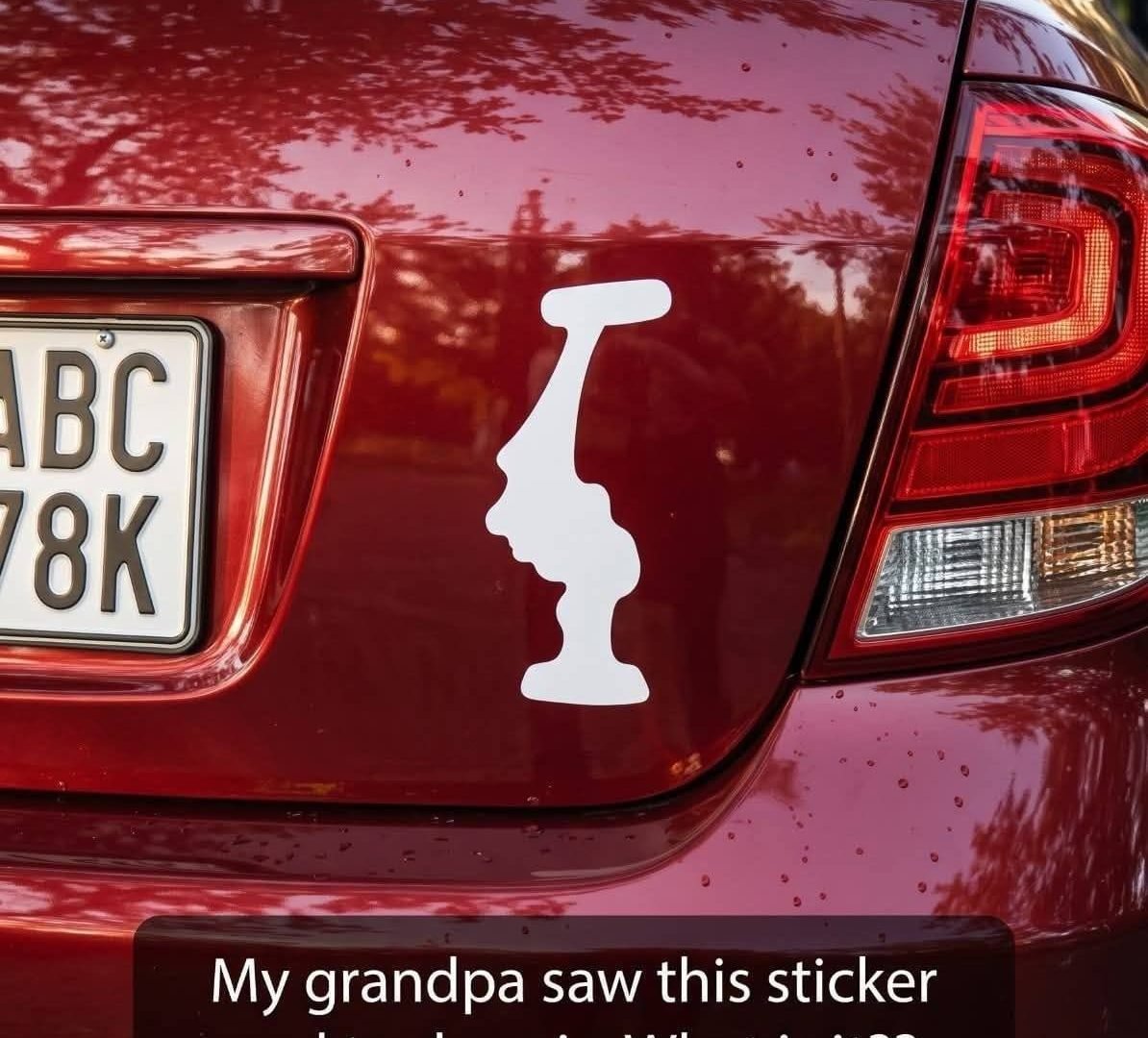
The grandfather’s confusion is a completely natural human reaction to an ambiguous image. When presented with a visual stimulus that can be interpreted in more than one way, the human brain does not simply process both images simultaneously. Instead, it alternates between them.
Figure-Ground Organization
This phenomenon is rooted in the Gestalt principles of psychology, specifically figure-ground organization. According to this principle, the human mind organizes visual information into a “figure” (the object of focus) and a “ground” (the background).
In the case of the bumper sticker, the brain struggles to decide which part of the image is the figure. When you see the mushroom, the white sticker is the figure, and the red car is the ground. When you see the face, the white shape is still the figure, but the internal contours are interpreted differently. This is known as bistable perception—the brain cycles back and forth between two stable interpretations of the same visual data.
Pareidolia: The Evolutionary Advantage of Seeing Faces
The ability to see the human profile in the sticker is a specific example of a broader psychological phenomenon known as pareidolia. This is the tendency for the human mind to perceive a specific, often meaningful image in a random or ambiguous visual pattern. Seeing faces in inanimate objects is the most common form of pareidolia.
Why Are We Wired This Way?
Evolutionary psychologists believe that this tendency is deeply ingrained in human biology. For our distant ancestors, the ability to quickly recognize a human face—whether friend, family, or foe—was a critical survival skill. The brain is thus heavily optimized to detect facial patterns, sometimes even when they are not actually there. The bumper sticker triggers this ancient survival mechanism, which is why the face interpretation is so compelling and immediate for many viewers once they spot it.