The Mystery of the “Universal Scar”: Why Millions of People Have the Exact Same Mark on Their Arm
Have you noticed a small, round scar on your upper arm? You aren’t alone. Discover the history behind the “universal scar” that millions of people share, and find out if yours is from the Smallpox or Tuberculosis vaccine.
Introduction
If you look closely at your upper arm, specifically on the outside of your shoulder, you might notice a small, round scar. It might be slightly raised, flat, or pitted. If you’ve ever compared arms with friends or family, you may have realized you share the exact same mark.
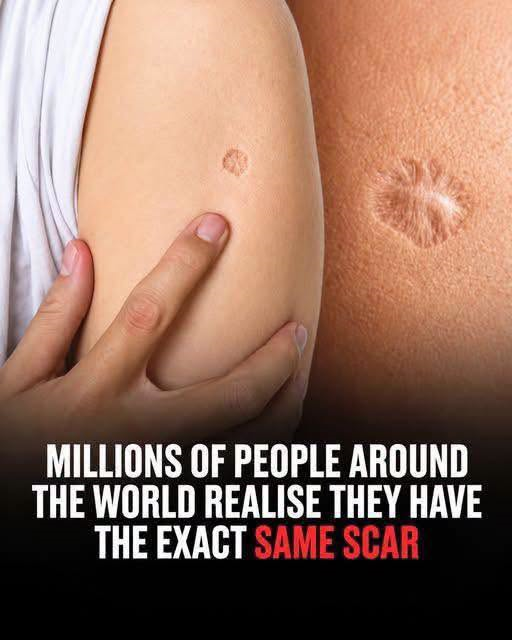
As the viral image above suggests, millions of people around the world have this exact same scar. But what is it? Is it a birthmark? An old injury?
The answer is a badge of medical history. This scar is almost certainly the result of a vaccination. Depending on your age and where you were born, it is likely one of two things: the BCG vaccine scar (for Tuberculosis) or the Smallpox vaccine scar.
Here is the story behind the mark on your arm.
Possibility #1: The BCG Vaccine Scar (Tuberculosis)
Most likely if you were born after 1980 or outside the United States.
For a vast portion of the global population, this scar comes from the BCG (Bacillus Calmette-Guérin) vaccine, which protects against Tuberculosis (TB).
Who has it?
Global Reach: The BCG vaccine is the most widely administered vaccine in the world. It is routinely given to infants in countries with high rates of TB, including the UK (until 2005), India, Brazil, China, and most of Africa and Eastern Europe.
The US Exception: The United States does not routinely give the BCG vaccine because TB rates are low, so most Americans do not have this scar.
How the scar forms:
The BCG vaccine is unique because it is injected intradermally (just under the top layer of skin), rather than into the muscle like most shots.
The Reaction: A few weeks after the shot, a small red bump appears.
The Blister: This bump turns into a small blister or pustule (sometimes oozing slightly).
The Scab: It crusts over and forms a scab.
The Scar: When the scab falls off, it leaves a small, round scar—usually about 3 to 5 millimeters wide. This is the mark seen in the image.
Possibility #2: The Smallpox Vaccine Scar
Most likely if you were born before 1980.
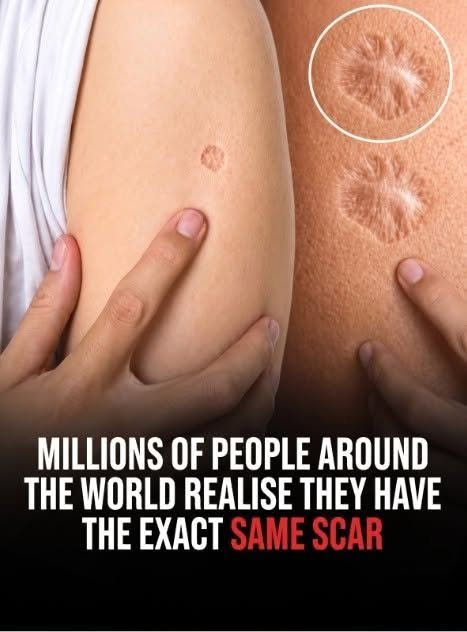
If you are older, or if your scar has a very distinct “starburst” or pitted pattern (like the zoomed-in image above), it is likely from the Smallpox vaccine.
Who has it?
The Timeline: Routine smallpox vaccination ended in the United States in 1972 and globally in 1980 after the disease was eradicated. Anyone born before the early 1980s likely has this scar.
The Visual: The smallpox scar is often larger and more textured than the BCG scar. It frequently has a “rosette” or radial pattern (like a tiny flower or sunburst) because of the way it was administered.
How the scar forms:
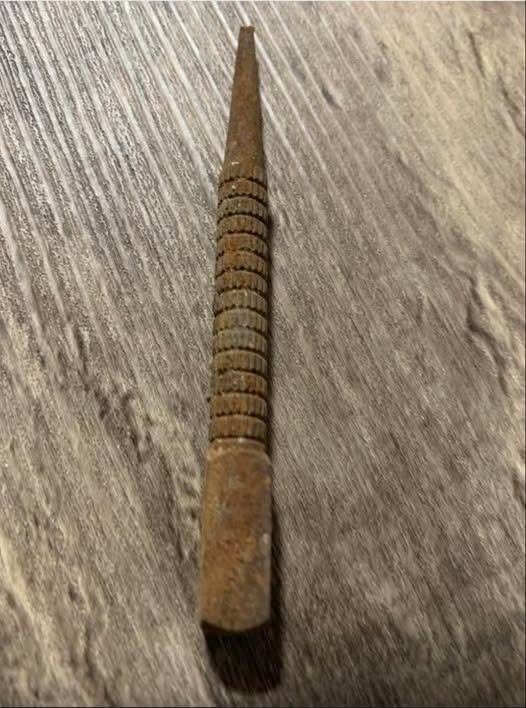
The Bifurcated Needle: The smallpox vaccine wasn’t given with a standard needle. It used a two-pronged (bifurcated) needle that was dipped into the vaccine solution.
The Punctures: The doctor would prick the skin rapidly about 15 times in a small area. This created multiple tiny wounds.
The “Take”: A successful vaccination (called a “take”) would result in a red, itchy bump that turned into a large blister, then a scab. When the scab fell off after a few weeks, it left the characteristic round, pitted scar.
Why Do These Scars Look So Similar?
Both vaccines share a few key characteristics that lead to this specific type of scarring:
Location: Both are traditionally administered on the upper left arm (the deltoid muscle area). This standardization makes it easy to spot.
Live Viruses/Bacteria: Both vaccines use live, weakened viruses (Smallpox) or bacteria (BCG). This creates a stronger local immune response on the skin compared to modern inactivated vaccines, leading to the blistering and subsequent scarring.
Intradermal/Surface Administration: Because the vaccine is delivered into the skin layers rather than deep muscle, the healing process happens on the surface, leaving a visible mark.
How to Tell the Difference
If you are trying to figure out which scar you have, here is a quick guide:
Feature
BCG Scar (Tuberculosis)
Smallpox Scar
Age Group
Common in anyone born in endemic countries (often children/young adults).
Common in people born before ~1980.
Shape
Usually a smooth, small round disc. Can be flat or slightly raised (keloid).
Often pitted (indented). May have a “starburst” or radial line pattern.
Size
Smaller (3-5mm).
Often larger (4-8mm).
Location
Almost always the left upper arm.
Almost always the left upper arm.
Conclusion
That small mark on your arm isn’t a mystery; it’s a historical record. It represents a moment where your immune system was trained to fight off a deadly disease.
Whether it’s the BCG scar protecting you from Tuberculosis or the Smallpox scar linking you to the generation that eradicated a global plague, it is a shared human experience. You are part of the millions who carry this tiny badge of medical history.
Check your arm today—do you have the scar?
Disclaimer: This article is for informational purposes only. If you are concerned about a scar or your vaccination history, please consult a medical professional.