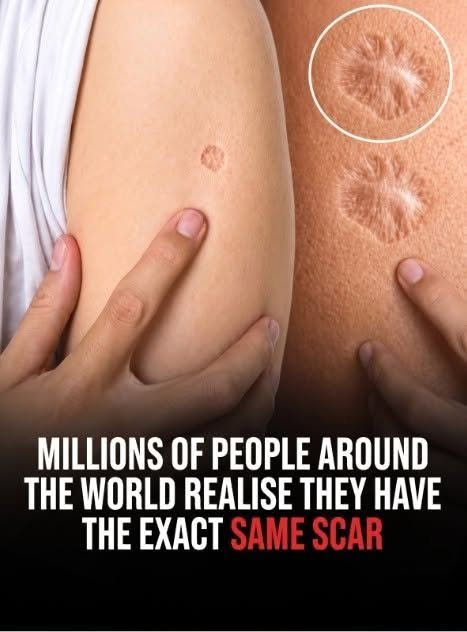
Why Do So Many People Have the Same Small Scar? The Mystery Behind a Global Mark
If you look closely at the upper arm of almost anyone born before the early 1980s, you will likely spot it: a small, round, slightly raised or pitted scar on the deltoid muscle. It is a mark shared by hundreds of millions of people across Europe, Asia, Africa, and South America.
For decades, this mysterious badge has sparked curiosity. Is it from a childhood accident? A cultural ritual? Or something medical?
The answer lies in one of the most successful public health campaigns in human history: the fight against Smallpox.
The Culprit: The Smallpox Vaccine
That distinctive scar is the permanent souvenir of the smallpox vaccine. Unlike modern vaccines that are injected with a fine needle into the muscle, the smallpox vaccine was administered using a unique technique designed to create a localized infection that would trigger immunity.
The “Multiple Puncture” Technique
The vaccine wasn’t a liquid shot; it was a live virus called Vaccinia. Doctors used a special bifurcated (two-pronged) needle. They would dip the needle into the vaccine solution and then rapidly poke the skin 10 to 15 times in a small area (about 5mm wide) on the upper arm.
This process, known as scarification, broke the skin’s surface just enough to deposit the virus into the superficial layers of the dermis.
Why Did It Leave a Scar?
The scar is actually evidence that the vaccine worked. Here is the biological process that created the mark:
The Reaction: Within a few days of the vaccination, a red, itchy bump would appear at the site.
The Blister: This bump would turn into a blister (a vesicle), then a pustule filled with fluid. This was the body’s immune system reacting to the live virus.
The Scab: The pustule would dry out and form a thick scab.
The Healing: After about two to three weeks, the scab would fall off, leaving behind the characteristic round scar.
If the scar looks distinct and textured (like the close-up in the image), it usually means the person had a “take”—meaning their immune system successfully responded to the vaccine. If there is no scar, it sometimes indicated the vaccination didn’t “take,” and the person might need to be revaccinated.
A Global Phenomenon
The reason this scar is so ubiquitous is that smallpox was a global killer. For centuries, the variola virus devastated populations with a mortality rate of up to 30%.
Mandatory Vaccination: In the mid-20th century, many countries made the vaccine mandatory for school entry, military service, or travel.
The Eradication Campaign: In 1967, the World Health Organization (WHO) launched an intensified global eradication program. Teams of health workers traveled to remote villages, administering millions of doses.
The Last Case: The campaign was wildly successful. The last natural case of smallpox was diagnosed in 1977. In 1980, the WHO declared smallpox eradicated—the only human disease to be completely wiped out.
Why Don’t Younger People Have It?
Because smallpox was eradicated, routine vaccination stopped worldwide in the early 1980s.
Born after ~1980: If you were born after the early 80s (depending on the country), you likely do not have this scar because you never received the vaccine.
Military Personnel: Some military personnel still receive the vaccine today due to bioterrorism concerns, so you may still see the scar on active-duty soldiers.
Not Just Smallpox: The BCG Vaccine
While the upper arm scar is most famously associated with smallpox, there is another vaccine that leaves a similar mark: the BCG vaccine for Tuberculosis (TB).
Location: The BCG scar is also usually on the upper arm but can sometimes be found on the thigh or buttock depending on local medical protocols.
Geography: The BCG vaccine is still widely used today in countries with high rates of TB (such as in parts of Asia, Africa, and South America).
Appearance: The BCG scar tends to be smaller and flatter than the smallpox scar, but they can look very similar to the untrained eye.
Conclusion
That small circle on your arm is more than just a blemish; it is a historical document. It represents a time when humanity united to defeat a deadly plague. It is a symbol of scientific achievement and a reminder of the power of vaccination.
So, the next time you see that familiar mark on a friend’s shoulder, you’ll know: it’s the badge of a survivor of the smallpox era.
Disclaimer: This article is for informational purposes only. If you have concerns about a scar or your vaccination history, please consult a medical professional.