The Most Potent Herb That Destroys Parasites, UTIs, Herpes, and More: The Truth About Thyme
Introduction: The Kitchen Spice Making Bold Promises
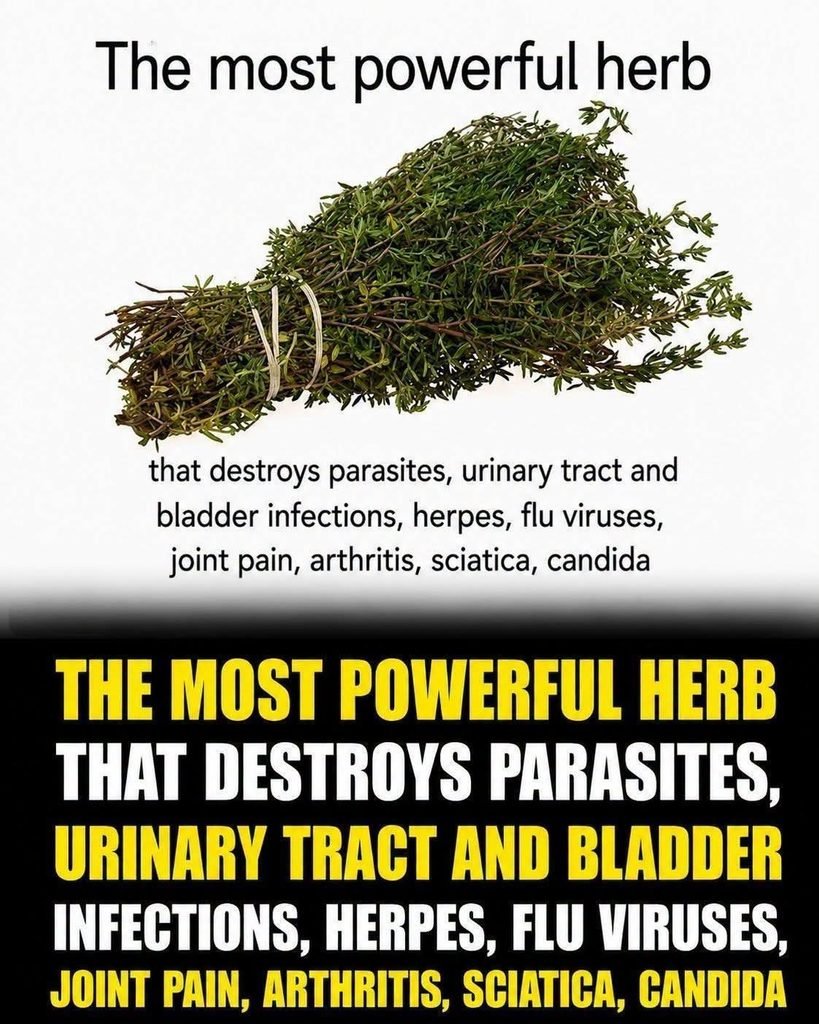
A striking image has been making the rounds on social media, featuring a bundle of dried green herbs tied with a white string. The text above it declares, “The most powerful herb,” while the text below makes a staggering series of claims: this single herb “destroys parasites, urinary tract and bladder infections, herpes, flu viruses, joint pain, arthritis, sciatica, candida.” It is a bold assertion, the kind that promises a natural panacea for a wide array of chronic and infectious ailments. For anyone who has struggled with recurrent UTIs, stubborn candida overgrowth, or the nagging pain of arthritis, such a claim is undeniably compelling.
The herb in the image is thyme (Thymus vulgaris), a staple of kitchens around the world, prized for its earthy, savory flavor in soups, roasts, and stuffings. But behind its culinary ubiquity lies a long history of medicinal use. Ancient Greeks used thyme as a symbol of elegance, Roman soldiers bathed in thyme-infused water for vigor, and Egyptian embalmers relied on its preservative properties. During World War I, thyme oil was even used as an antiseptic. Traditional medicine has long employed thyme tea for coughs, colds, and digestive complaints, and poultices of the herb for skin infections and rheumatic pain.
This comprehensive two-part article will dissect the viral claims surrounding thyme with the scientific scrutiny they deserve. We will separate the proven biological activities from the exaggerated marketing hype, exploring what modern research actually says about thyme’s ability to combat parasites, urinary tract infections, viruses, inflammation, and fungal overgrowth. By the end, you will have a clear, evidence-based understanding of what this remarkable herb can and cannot do.
Identifying the Herb: Thyme and Its Active Compounds
Thyme is a perennial evergreen herb belonging to the mint family, Lamiaceae. While there are many species within the Thymus genus, Thymus vulgaris is the most common variety used for both culinary and medicinal purposes. The plant’s therapeutic power is concentrated in its essential oil, which is rich in a class of volatile compounds known as phenols, terpenoids, and flavonoids.
The two most critical bioactive constituents are thymol and carvacrol. These phenolic compounds are responsible for much of thyme’s antimicrobial, antifungal, and anti-inflammatory activity. In a chemical analysis of thyme essential oil, thymol was found to be the dominant component, comprising over 57% of the oil, followed by γ-terpinene and p-cymene. These compounds work synergistically, disrupting microbial cell membranes and interfering with essential cellular functions. It is this potent chemical arsenal that forms the basis for the long list of health claims.
The Antimicrobial and Antiparasitic Claims: Separating Fact from Fiction
The viral post begins with the bold claim that thyme “destroys parasites.” This assertion has roots in both traditional practice and modern laboratory research, though the context and limitations of that research are crucial to understand.
Thyme’s Antiparasitic Activity
Traditional medicine has long used thyme to treat intestinal worms in children, and modern studies have begun to validate this use. Research has demonstrated that Thymus vulgaris extracts possess anti-parasitic and anti-helminthic properties, attributed to the presence of monoterpenes and phenolic compounds like thymol. A specific study on Trichinella spiralis, a parasitic roundworm that can infect humans, found that thyme extract led to a significant reduction in adult worms, with efficacy rates approaching 80% in animal models.
Other laboratory studies have shown that thyme essential oil exhibits promising activity against Cryptosporidium parvum, a parasite that causes severe diarrheal disease, and Entamoeba histolytica, a protozoan that can cause dysentery. Research on thymol, thyme’s primary active compound, has also confirmed its anti-Toxocara activity and ovicidal (egg-killing) properties.
The Important Caveat: It is essential to note that the vast majority of this research has been conducted in vitro (in test tubes or petri dishes) or in animal models, not in humans. While these results are scientifically intriguing and support thyme’s traditional use, they do not mean that eating thyme or drinking thyme tea will cure a human parasitic infection. The concentrations of active compounds used in laboratory studies are often far higher than what can be achieved through normal dietary consumption.
Urinary Tract and Bladder Infections
The claim that thyme can combat urinary tract infections (UTIs) and cystitis (bladder inflammation) is supported by a growing body of research. Aqueous extracts of Thymus vulgaris have demonstrated significant antibacterial activity against common UTI pathogens, including Staphylococcus aureus and Escherichia coli (E. coli). One study noted that the extract showed a dose-dependent inhibition of these bacteria, suggesting it could be a promising natural alternative for combating antibiotic-resistant UTIs.
More recent research has delved into the molecular mechanisms by which thyme, along with oregano and cinnamon oils, exerts its antibacterial effects against bacteria that cause cystitis. The essential oils were shown to disrupt bacterial cell membranes and interfere with the pathogens’ ability to establish infection. Traditional use also supports this application, with thyme flower shoots historically used to treat cystitis and other urinary tract issues.
Again, the distinction between laboratory evidence and clinical application is vital. While thyme shows clear antibacterial properties against UTI-causing bacteria in vitro, there is a lack of clinical trials demonstrating that consuming thyme can effectively treat an active UTI in humans. It should not be used as a replacement for prescribed antibiotics when medically necessary.
Thyme as an Antiviral Agent: Herpes, Influenza, and Beyond
The claim that thyme destroys “herpes” and “flu viruses” is perhaps the most dramatic, but it is grounded in a surprising amount of scientific investigation. Thyme’s antiviral properties have been the subject of numerous studies, particularly against herpes simplex virus (HSV) and influenza.
Herpes Simplex Virus (HSV-1 and HSV-2)
Research has shown that aqueous extracts of thyme can inhibit both HSV-1 and HSV-2 in cell cultures. The extract appears to work by directly inactivating the virus particles before they can attach to and enter host cells, a mechanism that suggests potential for topical therapeutic applications against recurrent herpes infections. Further studies have confirmed that thyme ethanol extract has strong antiviral activity by directly inactivating extracellular HSV-2 virions, reducing the virus’s ability to spread to new cells. Some research indicates that thyme oil can reduce viral load by over 96% in laboratory settings.
Influenza and Other Respiratory Viruses
Thyme’s traditional use as a remedy for coughs, colds, and respiratory infections is well-documented. Modern research has begun to explain why. In studies involving influenza virus, thyme extract showed antiviral activity by reducing the virus’s cytopathic effect in a dose-dependent manner. While it did not show activity against rhinoviruses (a common cause of the cold), its specific efficacy against influenza is notable.
The active compounds in thyme, particularly carvacrol, are thought to interfere with viral entry into host cells and inhibit viral replication. Thymol has even been placed on the U.S. Environmental Protection Agency’s list of disinfectants with evidence for use against SARS-CoV-2, the virus that causes COVID-19, for external surfaces.
Crucial Context: The antiviral effects observed in these studies are primarily the result of direct contact between thyme extracts and virus particles in a laboratory setting. This does not mean that drinking thyme tea will cure a herpes outbreak or prevent the flu. The concentrations required and the method of delivery for a systemic antiviral effect in humans have not been established through clinical trials.