If You See Someone with a Three-Point Tattoo, Should You Really Run? The Truth Behind the Viral Warning
Religious and Spiritual Meanings
Beyond crime and medicine, the three dots have been used in various cultures and spiritual practices for centuries, often representing something entirely positive.
The Holy Trinity
In Christian symbolism, three dots in a triangle represent the Holy Trinity (the Father, the Son, and the Holy Spirit). It is a common, devout tattoo for deeply religious individuals.
Eastern Philosophy
In Hindu and Buddhist traditions, the three dots can represent the three jewels of Buddhism (the Buddha, the Dharma, and the Sangha) or the three gunas in Hinduism.
The Semicolon Connection
While the semicolon (;) is the most famous mental health tattoo (representing that the author of a sentence could have stopped, but chose to continue), some people use three dots to represent an ellipsis (…). An ellipsis indicates a pause, a continuation, or an unfinished story. It has been adopted by some mental health communities to symbolize that their story is not over, even in the darkest times.
The Dermatological Reality: They Might Just Be Moles
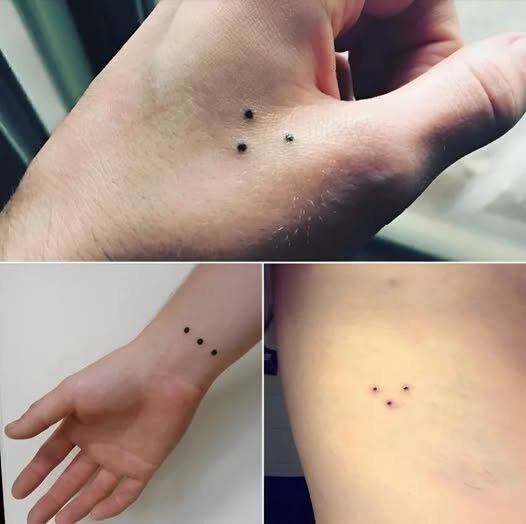
Take a close look at the top panel of the image. The three dots look slightly raised and textured, almost like scabs. It is entirely possible that these are not tattoos at all, but rather freckles or moles.
The “Dangerous” Melanoma
In dermatology, the “ABCDE” rule is used to detect melanoma (skin cancer):
Asymmetry
Border irregularity
Color changes
Diameter (larger than a pencil eraser)
Evolving
While three moles in a row are usually just a coincidence of genetics and sun exposure, they should be monitored by a doctor. Assuming a person with three moles is a dangerous criminal is a massive and unwarranted leap.
Why the “Run Away” Advice is Harmful
The viral instruction to “run as far as you can” is not just inaccurate; it is actively harmful.
It Promotes Paranoia and Stigma
Living in constant fear of arbitrary symbols breeds a toxic culture of paranoia. It encourages people to judge others based on a superficial mark rather than their behavior. This type of profiling can lead to discrimination against people who are completely innocent.
It Undermines Real Safety
When internet culture creates fake “secret codes” for danger, it distracts from the actual signs of danger. If you are so focused on scanning people’s hands for three dots, you might miss the actual behavioral red flags of a person who poses a genuine threat.
The Power of Context
A tattoo is never just a symbol; it is a piece of a much larger puzzle. A man with three dots on his face in a maximum-security prison means one thing. A teenager with three dots on her ankle means she likely got a matching tattoo with her best friends at a sleepover. To treat them the same is illogical.
What Should You Actually Do?
If you see someone with a three-point tattoo, how should you react?
Do Nothing: Your default reaction should be no reaction at all. A tattoo on a stranger’s body is none of your business.
Assess the Context: Look at the whole picture. If you are in a high-crime area and someone is acting aggressively while displaying heavy gang tattoos, you should remove yourself from the situation—not because of the three dots, but because of the behavior.
Be Kind: If you are curious, and the situation is safe and appropriate, you can ask the person what their tattoo means. You might hear a moving story about their faith, a tribute to a lost loved one, or a funny story about a teenage mistake.
Conclusion: Don’t Let the Internet Dictate Your Fear
The viral image claiming that a three-point tattoo is a reason to “run as far as you can” is a masterclass in internet fear-mongering. It takes a symbol that does have specific meanings in certain subcultures (like Hispanic gangs) and applies it universally to everyone, including cancer patients and devout Christians.
The truth is that the three-dot tattoo is just a pattern. It is the person wearing it, their behavior, and the context of the situation that matter. We should not live our lives in fear of shapes on skin. By rejecting these blanket warnings and choosing to see the individual behind the ink, we build a safer, more compassionate world.
Frequently Asked Questions
What does a three-dot tattoo mean?
It depends entirely on the context. It can mean “Mi Vida Loca” (My Crazy Life) in Hispanic gang culture, the Holy Trinity in Christianity, an unfinished story (ellipsis) in mental health awareness, or it could simply be a radiation therapy alignment marker for cancer treatment.
Is it true that you should run away from someone with three dots?
No. That is internet exaggeration and fear-mongering. A tattoo alone is not a reliable indicator of danger. You should assess a person’s behavior and the context of the situation, not just a small mark on their skin.
Are three dots a sign of human trafficking?
Organizations that combat human trafficking, like Polaris, have repeatedly debunked the myth that traffickers use specific secret symbols or tattoos to mark victims. Traffickers rely on psychological control, not secret codes.
What is the “Mi Vida Loca” tattoo?
“Mi Vida Loca” translates to “My Crazy Life.” It is a three-dot tattoo (usually on the hand or face) used by some Hispanic gang members to symbolize their commitment to gang life, representing the past, present, and future, or prison, hospital, and death.
Why do cancer patients get three dots tattooed on them?
During radiation therapy, doctors place tiny ink dots (fiducial markers) on the patient’s skin. These dots act as precise alignment guides for the radiation machines, ensuring the treatment targets the exact same spot every time.
Can three moles be a sign of skin cancer?
Three moles are usually just a coincidence. However, if you have multiple moles, you should monitor them using the ABCDE rule (Asymmetry, Border, Color, Diameter, Evolving) and have them checked annually by a dermatologist.
Is there a religious meaning to the three dots?
Yes. In Christianity, three dots in a triangle often represent the Holy Trinity. In Buddhism, they can represent the three jewels (Buddha, Dharma, and Sangha).
Why do these internet warnings go viral?
They go viral because they trigger primal fear and curiosity. People want to feel like they have “insider knowledge” that will keep them safe, and sharing a warning makes them feel like they are helping others. Unfortunately, these warnings are often based on misinformation.