Is It Mold? The Truth About Those Green Spots on Your Bread
Meta Description: Found green spots on your bread? Learn why you should never eat it, why cutting off the moldy part isn’t safe, and how to properly handle moldy food.
The Verdict: It Is Mold
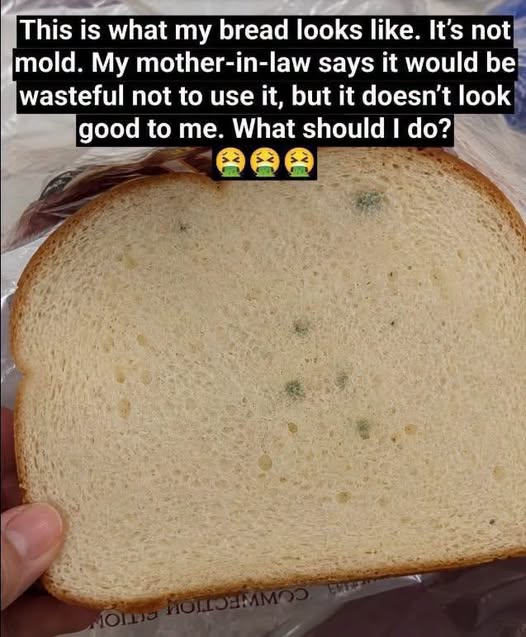
The image shows a slice of white bread with small, distinct green and blue-grey spots. Despite the caption claiming “It’s not mold,” these spots are absolutely mold.
Specifically, they appear to be early colonies of Penicillium or Aspergillus, common fungi that thrive on starchy foods. The green color comes from the spores the mold produces to reproduce.
Why You Should Not Eat It
The mother-in-law in the scenario suggests that it is wasteful to throw the bread away. However, food safety experts (like the USDA) strongly advise against eating moldy bread for two main reasons:
1. The “Roots” of the Mold
What you see on the surface (the green spots) is only the reproductive part of the mold. Mold is a fungus, and like a plant, it has roots called hyphae.
Soft Foods: Bread is a soft, porous food. The hyphae can penetrate deep into the bread, far beyond what you can see with the naked eye.
Invisible Danger: Even if you cut off the green spot, the rest of the slice is likely contaminated with mold roots and potentially mycotoxins (toxic substances produced by mold).
2. Bacterial Growth
Moldy food often harbors invisible bacteria growing alongside the fungus. Consuming it can lead to food poisoning, allergic reactions, or respiratory issues, especially for those with compromised immune systems.
The “Wasteful” Argument
It is natural to want to avoid food waste. However, the risk to your health outweighs the cost of a slice of bread.
Do not toast it: Heat does not necessarily destroy all mycotoxins.
Do not cut it off: As mentioned, the roots go deep.
Check the whole loaf: If one slice has visible mold, the spores have likely spread throughout the bag. It is safest to discard the entire loaf to prevent cross-contamination in your pantry.
How to Prevent Bread Mold
To avoid this situation in the future:
Freeze it: If you don’t eat bread quickly, freeze it. Mold cannot grow at freezing temperatures.
Keep it dry: Moisture accelerates mold growth. Keep bread in a cool, dry place, not the refrigerator (which can actually make bread stale faster, though it slows mold).
Check expiration dates: Buy only what you can consume within a few days.
Conclusion
The person in the image is correct to be suspicious. Those green spots are mold. While it feels wasteful to throw food away, eating moldy bread poses a genuine health risk. The safest and only recommended course of action is to throw the bread in the trash.