7 Signs of Arthritis You Shouldn’t Ignore: A Comprehensive Guide to Joint Health
Introduction: The Warning Signal of the Red Shoulder
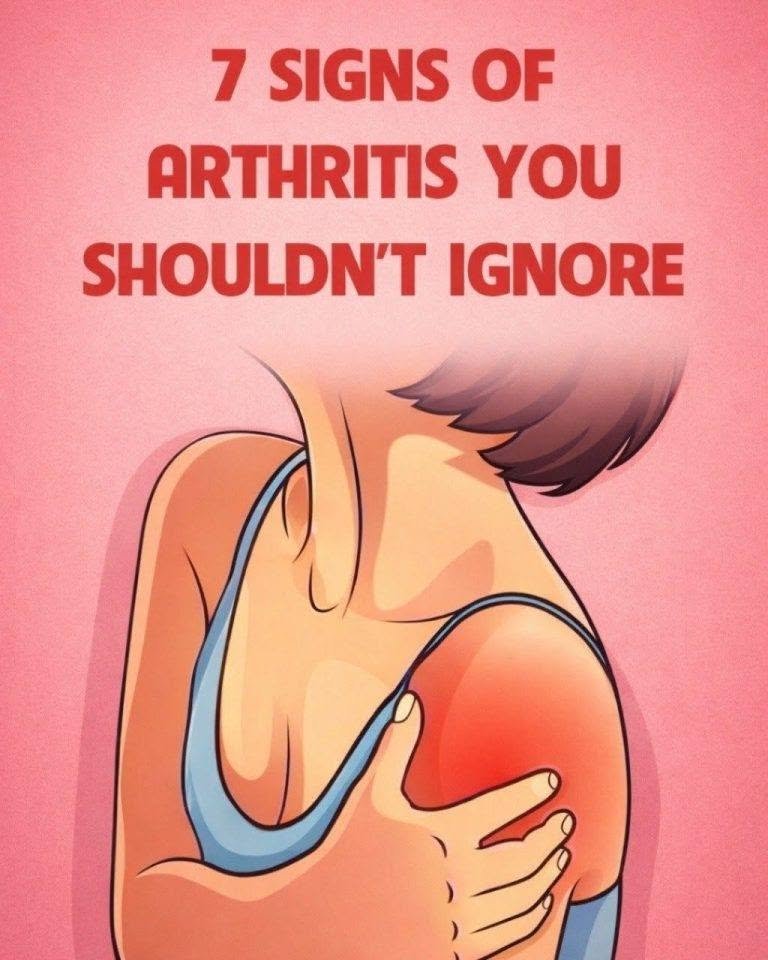
The image is simple but arresting. A person is clutching their shoulder, their face turned away in obvious discomfort. The shoulder joint itself is depicted as a glowing, angry red, radiating heat and pain. Above this illustration, the bold text issues a clear directive: “7 Signs of Arthritis You Shouldn’t Ignore.” For millions of people around the world, this image is not just an illustration; it is a daily reality.
Arthritis is a condition that is often mistakenly dismissed as a mere consequence of aging—a few aches and pains that are simply a part of getting older. This misconception is dangerous. Arthritis is not a single disease; it is an umbrella term for more than 100 different types of joint disease and related conditions. It is a leading cause of disability worldwide, affecting people of all ages, genders, and backgrounds. While it is more common in older adults, it can strike children, teenagers, and young adults in the prime of their lives.
The danger of ignoring the early signs of arthritis cannot be overstated. Whether the condition is the common “wear and tear” of osteoarthritis or the autoimmune assault of rheumatoid arthritis, early intervention is critical. The joint damage caused by many forms of arthritis is irreversible. Once the cartilage is worn away or the joint is deformed, it cannot be regrown. However, the trajectory of the disease can be altered. Early diagnosis and appropriate treatment can slow the progression, manage the pain, and preserve your mobility and quality of life for decades to come.
This comprehensive two-part guide will explore the seven critical signs of arthritis that should never be ignored. We will delve into the science behind joint pain, differentiate between the most common types of arthritis, and provide you with a detailed roadmap for what to do if you recognize these symptoms in yourself or a loved one. By the end of this article, you will have a deep understanding of why that glowing red shoulder is a warning signal you must heed.
Understanding Arthritis: The Anatomy of the Joint
To truly grasp the significance of the seven signs, it is essential to understand what is happening inside the joint. A joint is the connection between two bones. In a healthy joint, the ends of the bones are covered with a smooth, slippery tissue called cartilage. This cartilage acts as a shock absorber, allowing the bones to glide over each other without friction.
The joint is encapsulated in a fibrous capsule, the inside of which is lined with a membrane called the synovium. This membrane produces a small amount of thick fluid, known as synovial fluid, which lubricates the joint and provides nutrients to the cartilage. Ligaments connect the bones to each other, providing stability, while tendons connect muscles to bones, allowing for movement.
When arthritis develops, this delicate, smoothly functioning system breaks down. The specific mechanism of destruction depends on the type of arthritis, but the results are often similar: inflammation, pain, stiffness, and eventual structural damage.
The Two Major Categories: Osteoarthritis and Rheumatoid Arthritis
While there are over 100 types of arthritis, they generally fall into two major categories, and understanding the difference is crucial for recognizing the signs.
Osteoarthritis (OA): Often referred to as “wear and tear” arthritis, OA is the most common form. It occurs when the protective cartilage that cushions the ends of the bones gradually wears down over time. While it can affect any joint, it most commonly affects the hands, knees, hips, and spine. OA is primarily a disease of the cartilage, though it can affect the entire joint structure, including the bone and the synovial lining.
Rheumatoid Arthritis (RA): This is an autoimmune disease. In RA, the body’s immune system mistakenly attacks the synovium (the lining of the membranes that surround the joints). This attack causes painful swelling that can eventually result in bone erosion and joint deformity. RA is a systemic disease, meaning it affects the whole body, and it typically presents symmetrically (e.g., both hands or both knees at the same time).
The First Four Signs: Pain, Stiffness, Swelling, and Loss of Motion
The seven signs of arthritis encompass a range of physical symptoms that interfere with daily life. The first four signs are the most common and immediate indicators that something is wrong.
Sign 1: Persistent Joint Pain
Pain is the hallmark symptom of almost all forms of arthritis. However, the nature of the pain can vary significantly depending on the type and the stage of the disease.
What to Watch For:
The Quality of the Pain: It may be a dull, aching sensation that never fully goes away, or it may be a sharp, stabbing pain that occurs with movement.
The Location: For OA, pain is usually localized to the affected joint (e.g., pain on the inner side of the knee). For RA, pain often affects joints on both sides of the body. The shoulders, hips, fingers, and wrists are common sites.
The Timing: In OA, pain tends to worsen with activity and improve with rest. In RA, the pain may be worse after periods of inactivity, such as upon waking in the morning, and may lessen as you move around.
Persistence: The most critical factor is persistence. If you have joint pain that lasts for more than a few days, or if it comes and goes over weeks or months, it is a sign that should not be ignored.
Sign 2: Morning Stiffness
Stiffness is a feeling of tightness, resistance, or difficulty moving a joint. It is a very common symptom of arthritis, but its duration is a key diagnostic clue.
What to Watch For:
The “Morning Gell” Phenomenon: This is the sensation that a joint is “stuck” or hard to move after a period of rest. It is particularly noticeable in the morning after sleeping.
Duration Matters: The length of time the stiffness lasts is crucial. In Osteoarthritis, morning stiffness typically lasts for less than 30 minutes and improves quickly with movement. In Rheumatoid Arthritis, morning stiffness is often prolonged, frequently lasting for an hour or more, and may not fully resolve until you have been active for a significant period.
General Stiffness: If you find yourself needing to “warm up” your joints to get going, or if you struggle to get out of bed due to joint tightness, this is a clear warning sign.
Sign 3: Swelling and Inflammation
Swelling is a direct visual indicator that something is wrong inside the joint. The image accompanying this article, depicting the red shoulder, perfectly illustrates the concept of an inflamed, swollen joint.
What to Watch For:
Puffiness: The joint may appear noticeably larger, puffy, or distorted compared to the opposite side.
The Cause: In OA, swelling is often caused by excess fluid accumulating in the joint space (effusion) due to the irritation of the cartilage. In RA, the swelling is primarily due to the thickening and inflammation of the synovial membrane.
Warning: Swelling that is persistent, or accompanied by warmth and redness (as seen in the red shoulder graphic), indicates active inflammation. This is a major red flag, especially in RA, where uncontrolled inflammation can lead to rapid joint destruction. Do not dismiss a chronically swollen joint as a minor sprain.
Sign 4: Decreased Range of Motion
As pain, stiffness, and swelling increase, you will naturally begin to move the affected joint less. Over time, the joint capsule can tighten and the muscles around it can weaken, leading to a loss of mobility.
What to Watch For:
Inability to Fully Extend or Flex: You may find that you cannot fully straighten your knee, or you cannot bend your elbow as far as you used to.
Difficulty with Daily Tasks: It may become difficult to reach overhead to grab a plate from the top shelf, turn a doorknob, or fasten a button.
The Cycle of Decline: The less you move a joint, the stiffer it becomes, which leads to less movement—a vicious cycle. Loss of range of motion is a critical sign that arthritis is beginning to impact your functional independence.