What to Do If You Start Seeing Eye Floaters: An Eye Doctor’s Helpful Guide
Introduction: The Ghosts in Your Vision
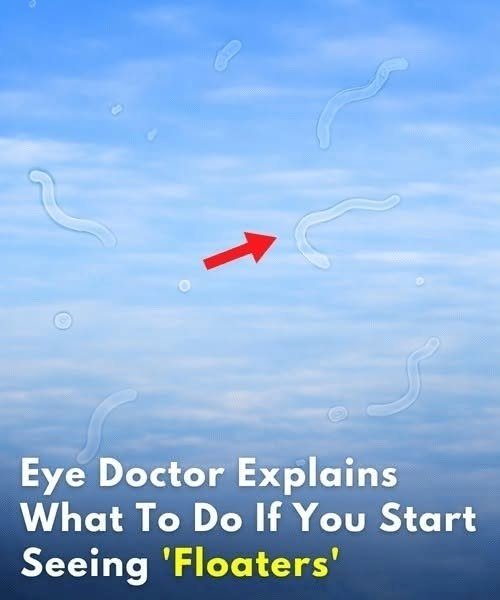
Imagine looking up at a bright, cloudless blue sky, much like the image that accompanies this article. Instead of a pristine expanse of azure, you see faint, translucent squiggles, tiny dots, or cobweb-like threads drifting aimlessly across your field of vision. When you try to look directly at them, they dart away, always remaining just at the edge of your focus. These are eye floaters, and for millions of people around the world, they are a daily—and often highly frustrating—reality.
A viral social media post featuring a red arrow pointing to a ghostly, worm-like shape against a blue sky has sparked widespread conversation about this common visual phenomenon. The text reads, “Eye Doctor Explains What To Do If You Start Seeing ‘Floaters’.” For anyone who has experienced the sudden appearance of these visual interruptions, the question of what to do is paramount. Are they a sign of a serious medical emergency? Are they simply a harmless nuisance? Can they be treated or removed?
This comprehensive two-part guide will provide an in-depth, medically grounded explanation of eye floaters. We will explore the anatomy of the eye, explain exactly what those squiggly lines are, and detail the circumstances under which you should seek immediate medical attention. We will also discuss the various treatment options available, from simple coping strategies to advanced surgical procedures, and provide practical advice on how to protect your long-term eye health. By the end of this article, you will have a clear, eye-doctor-approved roadmap for navigating the world of floaters, ensuring you can distinguish between a harmless aging quirk and a vision-threatening emergency.
The Anatomy of the Eye: Understanding the Vitreous Humor
To understand what floaters are, it is essential to understand the internal structure of the eye, specifically a jelly-like substance called the vitreous humor. The vitreous is a clear, gel-like substance that fills the large space in the center of the eye, between the lens at the front and the retina at the back. It is composed primarily of water (about 99%), but it also contains collagen fibers and hyaluronic acid, which give it a firm, gelatinous consistency.
The vitreous serves several critical functions. It helps maintain the spherical shape of the eye, absorbs shock to protect the delicate structures within, and allows light to pass through to the retina, where images are formed and sent to the brain. When we are young, the vitreous is typically quite uniform and transparent. However, as we age, the proteins within the vitreous can begin to clump together. These clumps cast shadows onto the retina, and it is these shadows that we perceive as floaters.
The Biology of a Floater
When the collagen fibers in the vitreous clump together, they form small, opaque structures. Because they are floating in the gel, they move as your eye moves. If you try to look directly at a floater, it will often drift out of your central line of sight. The shape of the floater depends on the nature of the clump. They are commonly described as:
Cobwebs: Thin, thread-like structures.
Squiggly lines: Often resembling tiny worms or commas.
Spots or dots: Small, circular opacities.
Rings: Occasionally, a floater may appear as a ring or a circle (this is often a sign of a posterior vitreous detachment).
Why Do Floaters Happen? The Causes and Risk Factors
While the most common cause of floaters is simple aging, there are several other factors that can contribute to their development. Understanding these causes can help you assess your personal risk level.
As we age, the vitreous humor gradually begins to shrink and liquefy (a process called vitreous syneresis). As the vitreous shrinks, it can pull away from the retina. This separation is known as Posterior Vitreous Detachment (PVD). PVD is extremely common, affecting more than half of people by the time they reach age 80. When the vitreous pulls away, it can create a sudden shower of floaters, often accompanied by flashes of light. While PVD itself is usually harmless, it is the leading cause of age-related floaters.
2. Nearsightedness (Myopia)
People who are nearsighted (myopic) are at a higher risk of developing floaters at an earlier age. This is because the elongated shape of a nearsighted eye places more stress on the vitreous and the retina. The vitreous in these eyes is more likely to liquefy and clump sooner than in a normal eye.
3. Eye Trauma or Inflammation
Injury to the eye, such as a blow to the head or a penetrating wound, can cause bleeding into the vitreous (vitreous hemorrhage), which appears as a sudden shower of dark floaters. Similarly, inflammation within the eye (uveitis) can cause white blood cells to enter the vitreous, creating floaters.
4. Diabetes and Other Systemic Conditions
Conditions like diabetic retinopathy can cause abnormal blood vessels to grow in the retina. If these vessels leak or bleed, blood can enter the vitreous, resulting in floaters. Other systemic conditions, such as high blood pressure or autoimmune diseases, can also contribute to eye inflammation or bleeding.
5. Cataract Surgery
Some patients report experiencing floaters after cataract surgery. While the surgery itself does not cause floaters, it can sometimes make them more noticeable because the replacement lens is clearer than the cloudy natural lens.
When Floaters Are Harmless: Coping Strategies and Neuroadaptation
For the vast majority of people, floaters are a benign nuisance rather than a sign of a serious medical condition. Once an eye doctor has examined your eyes and confirmed that the floaters are not caused by a retinal tear or other serious issue, the primary challenge is learning to live with them.
The Brain’s Filter: Neuroadaptation
The human brain is remarkably adaptable. Over time, it learns to ignore the constant, predictable shadows cast by floaters. This process is called neuroadaptation. The floaters do not physically disappear, but your brain stops paying attention to them. However, this process takes time and can be frustrating. Stress, fatigue, and focusing on a plain background (like a blue sky or a white computer screen) can make them more noticeable.
Practical Strategies to Minimize Disruption
While you cannot control the floaters themselves, you can control how you react to them. Here are a few tips from eye doctors to help you cope:
Look Up and Down: Because floaters are suspended in the vitreous gel, moving your eyes vertically (up and down) rather than horizontally can help shift the gel and move the floater out of your central line of sight.
Reduce Eye Strain: Prolonged screen time can make you more aware of your floaters. Take regular breaks using the 20-20-20 rule (every 20 minutes, look at something 20 feet away for 20 seconds).
Use Good Lighting: Bright, harsh lighting can make floaters more visible. Using softer, diffused lighting can help reduce their perceived presence.
Manage Stress: Anxiety and stress can amplify your perception of floaters. Practicing relaxation techniques can help reduce the mental distraction they cause.