Small White Spots on Arms and Legs You Need To Know: What They Are and How to Treat Them
The Most Likely Culprit: Idiopathic Guttate Hypomelanosis (IGH)
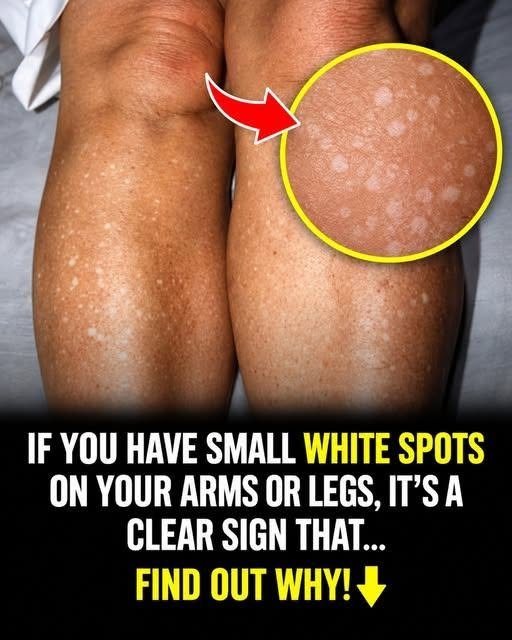
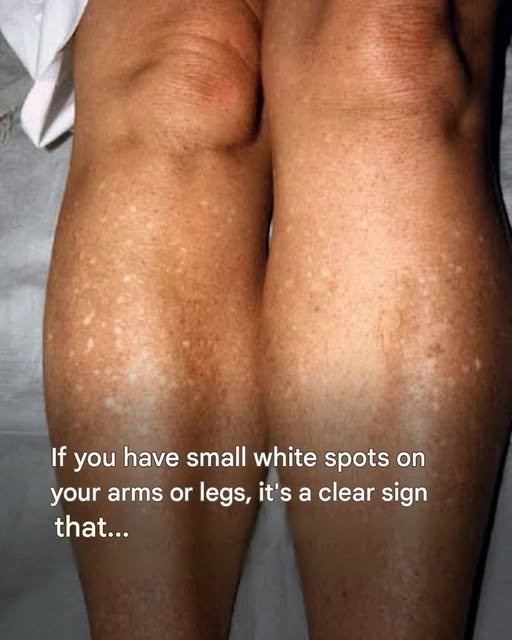
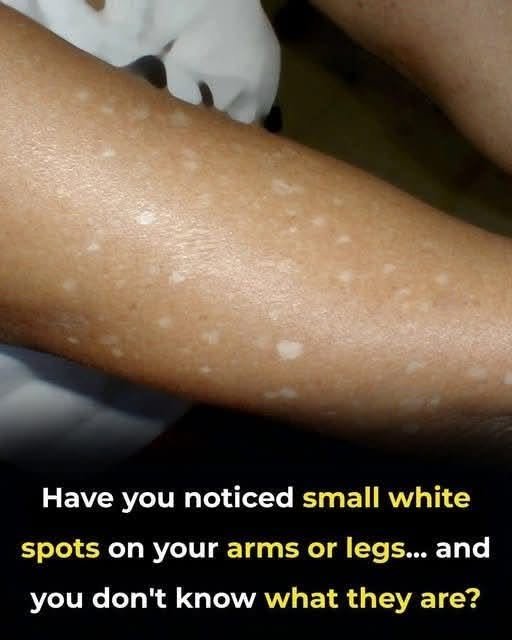
If you are an adult and the spots look exactly like the ones in the image—small, sharply defined, flat white spots scattered across sun-exposed areas like the shins, forearms, and shoulders—the most likely diagnosis is Idiopathic Guttate Hypomelanosis (IGH).
What Does the Name Mean?
Idiopathic: The exact cause is unknown.
Guttate: Resembling drops (like a drop of rain).
Hypomelanosis: A reduction in melanin, the pigment that gives your skin its color.
What is Your Body Telling You?
If you have IGH, your body is telling you two primary things:
You have a history of sun exposure: These spots are essentially a localized loss of pigment caused by chronic, cumulative exposure to ultraviolet (UV) radiation. The sun damages the melanocytes (the pigment-producing cells), and in certain areas, these cells simply “burn out” and stop producing color.
You are getting older: IGH is incredibly common in people over the age of 40. It is considered a normal, harmless part of the skin’s aging process.
What do they look like? They are usually 1 to 5 millimeters in diameter. They have a distinct, sharply defined border and are often described as looking like “white confetti” or “porcelain spots.” They do not have scales, crusts, or a raised texture. They are completely flat and asymptomatic (they don’t itch or hurt).
The Second Most Common Cause: Pityriasis Alba (The Dryness Signal)
While IGH is the most common cause in older adults, Pityriasis Alba is the most common cause of white spots in children, teenagers, and young adults, though it can occur at any age.
What is Pityriasis Alba?
Pityriasis alba is a mild form of eczema that presents as round or oval patches of skin that lose their pigment, usually on the face, upper arms, and neck.
What is Your Body Telling You?
If you have Pityriasis alba, the body is signaling that the skin is extremely dry and mildly inflamed. The exact cause is unknown, but it is strongly associated with atopic dermatitis (eczema) and a lack of moisture in the skin barrier.
What does it look like? Unlike the sharp, porcelain-white spots of IGH, the spots of Pityriasis alba are usually slightly pink or pale. They often have a very fine, subtle white scale over them. They are more noticeable in the summer because the surrounding skin tans, making the untanned, dry patches stand out.
The Fungal Connection: Tinea Versicolor
If your white spots are accompanied by mild itching and are located primarily on your chest, back, or upper arms, your body might be hosting a common, harmless yeast.
What is Tinea Versicolor?
This is a fungal infection caused by an overgrowth of Malassezia, a yeast that naturally lives on everyone’s skin. In hot, humid weather, or if you sweat a lot, the yeast can multiply rapidly.
What is Your Body Telling You?
Your body is signaling an overgrowth of natural skin flora. The fungus produces an acid that bleaches the skin, preventing it from tanning.
What does it look like? The spots can be white, pink, or brown. They often have a slightly scaly texture and can merge together to form larger patches. The defining characteristic is that they do not tan in the sun, leaving a “versicolor” (multicolored) appearance.