Sleeping on Your Left Side vs. Right: What the Anatomy of Your Stomach Reveals About Reflux, Digestion, and Whole-Body Health
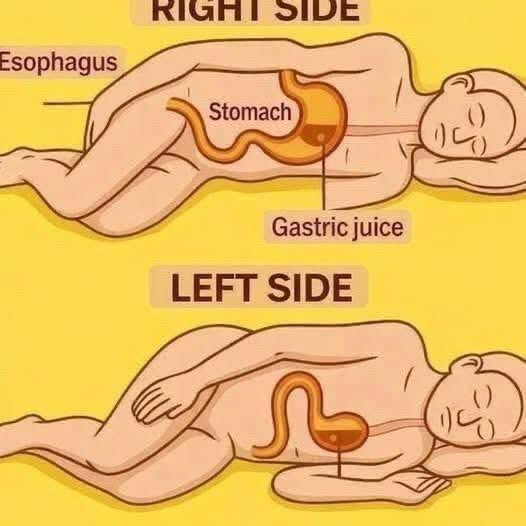
The diagram is deceptively simple: two sleeping figures, one curled on the right side and one on the left, with a translucent stomach and esophagus superimposed on each. In the top image—the right-side sleeper—the stomach sits pooled with gastric juice, the acidic contents resting heavily against the junction where the esophagus meets the stomach. In the bottom image—the left-side sleeper—the stomach hangs below the esophagus, the acid settled away from the opening, held in place by the quiet, constant pull of gravity. The caption reads: “CAUTION if you sleep on your right side.”
It is the kind of image that stops a scroll. Millions of people sleep on their right side every night without giving it a second thought. And for many of them, nothing terrible happens. But for a significant portion of the population—those who wake with a sour taste in their mouth, a burning in the chest, a cough that will not quit, or a throat that feels raw by morning—the position in which they sleep may be quietly sabotaging their rest and their digestive health. The anatomy is not a metaphor. It is a mechanical reality. The stomach is an asymmetrical organ, curved and anchored toward the left side of the upper abdomen, and the angle at which the esophagus enters it changes depending on which side of the body bears the weight of the night. Understanding this geometry is the first step toward understanding why a simple shift in sleeping position has become one of the most studied—and most misunderstood—interventions in sleep medicine.
The Geometry of Reflux: Why Position Changes Everything