How Many Triangles Can You See? Your Answer May Surprise You
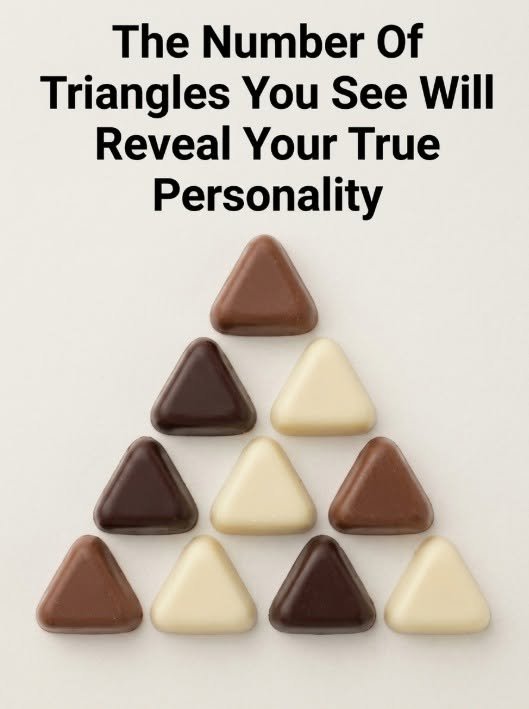
The image above presents a deceptively simple visual puzzle: a pyramid made of chocolate triangles. At the top, the text claims that the number of triangles you see will reveal your true personality. Below, the caption asks, “How many triangles can you see? Your answer may surprise you!”
At first glance, the answer seems obvious. You can count the individual chocolate pieces. But this type of puzzle is designed to test whether you look beyond the surface and spot the hidden shapes formed by the arrangement of the smaller pieces. It is a classic example of a visual reasoning challenge that has circulated online for years in various forms.
Understanding the Puzzle
The image displays ten small chocolate triangles arranged in a pyramid formation. There are four rows:
Top row: 1 triangle
Second row: 2 triangles
Third row: 3 triangles
Bottom row: 4 triangles
This adds up to 10 individual triangles. But the puzzle asks how many triangles you can see, not how many pieces there are. This is where the challenge lies.
Counting the Larger Triangles
Beyond the individual pieces, the arrangement itself creates larger triangular shapes when smaller triangles are grouped together. These are the “hidden” triangles that many people miss on their first look.
To find them, you need to look for combinations of the small triangles that form a larger triangle. For example:
The top three rows together form a larger triangle.
The bottom three rows together form another larger triangle.
The entire pyramid itself is a large triangle made up of all 10 pieces.
Depending on how you group the pieces, you can identify several additional triangles beyond the original 10. The exact number can vary depending on the interpretation, which is part of what makes the puzzle so engaging and debatable.
What Your Answer Might Reveal
While this is not a scientifically validated personality test, the puzzle is often used as a fun way to reflect on how you approach problems. The number you see first may say something about your thinking style.
If you counted only the individual triangles: You may be a practical, detail-oriented thinker who focuses on what is immediately visible. You prefer clear, straightforward answers and tend to take things at face value.
If you spotted the larger triangles: You may have a more holistic or creative thinking style. You tend to look at the bigger picture and see connections that others might miss. You are comfortable with ambiguity and enjoy exploring different possibilities.
If you counted both: You likely have a balanced approach, combining attention to detail with an ability to see the broader context. You are both analytical and creative in your thinking.
The Value of Visual Puzzles
Puzzles like this are more than just a fun distraction. They offer several cognitive benefits:
They improve observation skills: You learn to look more carefully and systematically at what is in front of you.
They encourage flexible thinking: You practice shifting between different perspectives and interpretations.
They enhance problem-solving abilities: You develop strategies for breaking down complex problems into smaller parts.
They provide a sense of accomplishment: Finding a hidden shape or solving a puzzle gives a satisfying “aha” moment.
These types of challenges are suitable for people of all ages and can be a pleasant way to pass the time, either alone or with friends and family.
Why These Puzzles Go Viral
Visual puzzles like this one are popular on social media because they are simple, accessible, and invite discussion. Everyone can participate, and disagreements about the correct answer often lead to lively debates in the comments. They also tap into our natural curiosity and our desire to test our own perception.
The “personality reveal” aspect adds an extra layer of interest. Even though the results are not scientifically meaningful, they offer a lighthearted way to think about how we think.
Conclusion
Whether you counted 10 triangles or more, the important thing is to have fun with the challenge. The next time you see a puzzle like this, take a moment to look beyond the obvious—you might be surprised by what you find. And if you did not spot the larger triangles on your first try, do not worry. Visual perception is a skill that can be practiced and improved with time.