Optical illusions and visual puzzles are a fantastic way to test your brain’s processing speed, attention to detail, and perception. They force you to look beyond the obvious and think creatively.
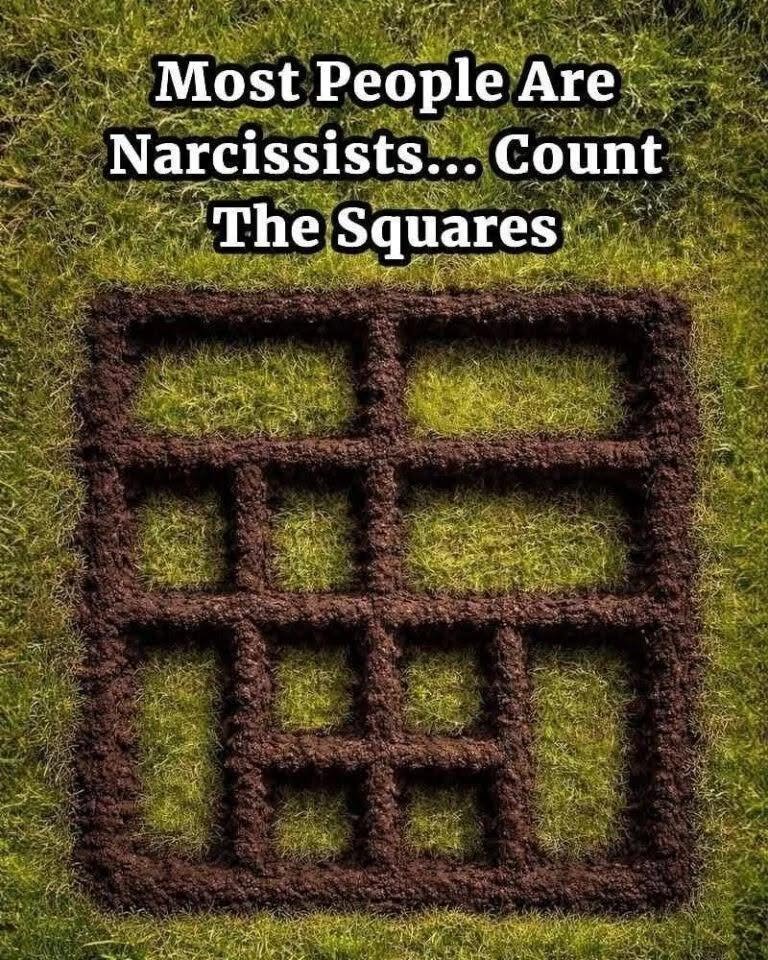
Take a close look at the image above. It shows a grid drawn in dirt on a patch of grass. The caption reads: “Most People Are Narcissists… Count The Squares.”
So, how many squares do you see?
If you’re struggling, don’t worry — it’s a tricky one. Here’s the answer. 👇
Disclaimer: This post is for entertainment purposes only. The “narcissist” claim is a viral hook, not a scientific test.
🔍 The Answer: 14 Squares
Most people count the obvious ones and stop at 9 or 10. But if you look carefully, there are 14 squares in total.
Here’s the breakdown:
9 small squares (the individual squares)
4 medium squares (made by combining 4 small squares each)
1 large square (the entire outer boundary)
Total: 9 + 4 + 1 = 14 squares.
Why this puzzle works: Your brain is wired to quickly scan and count the most obvious shapes. It takes a slower, more focused look to see the larger squares formed by the grid lines. This is called perceptual restructuring — the ability to see the same image in a new way.
What the “narcissist” claim means: The viral post claims that “most people are narcissists” based on how many squares they count. This is not scientifically accurate. It’s a clickbait hook designed to make you engage with the post.
❓ Frequently Asked Questions
How many squares are in the picture? There are 14 squares in total: 9 small, 4 medium, and 1 large.
Why do most people only count 9 or 10? Because the larger squares are formed by the grid lines, and our brains tend to focus on the individual small squares first.
Does counting squares reveal if I’m a narcissist? No — the “narcissist” claim is a viral hook. There is no scientific evidence that counting squares reveals your personality.
What does this puzzle actually test? It tests your attention to detail, visual perception, and ability to see patterns.
Are these puzzles good for your brain? Yes — visual puzzles and optical illusions are a form of mental exercise. They challenge your brain to process information in new ways.
Can these puzzles help prevent cognitive decline? While no single puzzle can prevent cognitive decline, regularly challenging your brain with new and varied tasks is associated with better cognitive health as you age.
What is an optical illusion? An optical illusion is an image that tricks your brain into perceiving something differently from reality.
Why do people see different things? Because our brains prioritize different visual cues. Some people focus on the overall shape, while others notice fine details first.
💬 How many squares did you count? Let us know in the comments! 🧠