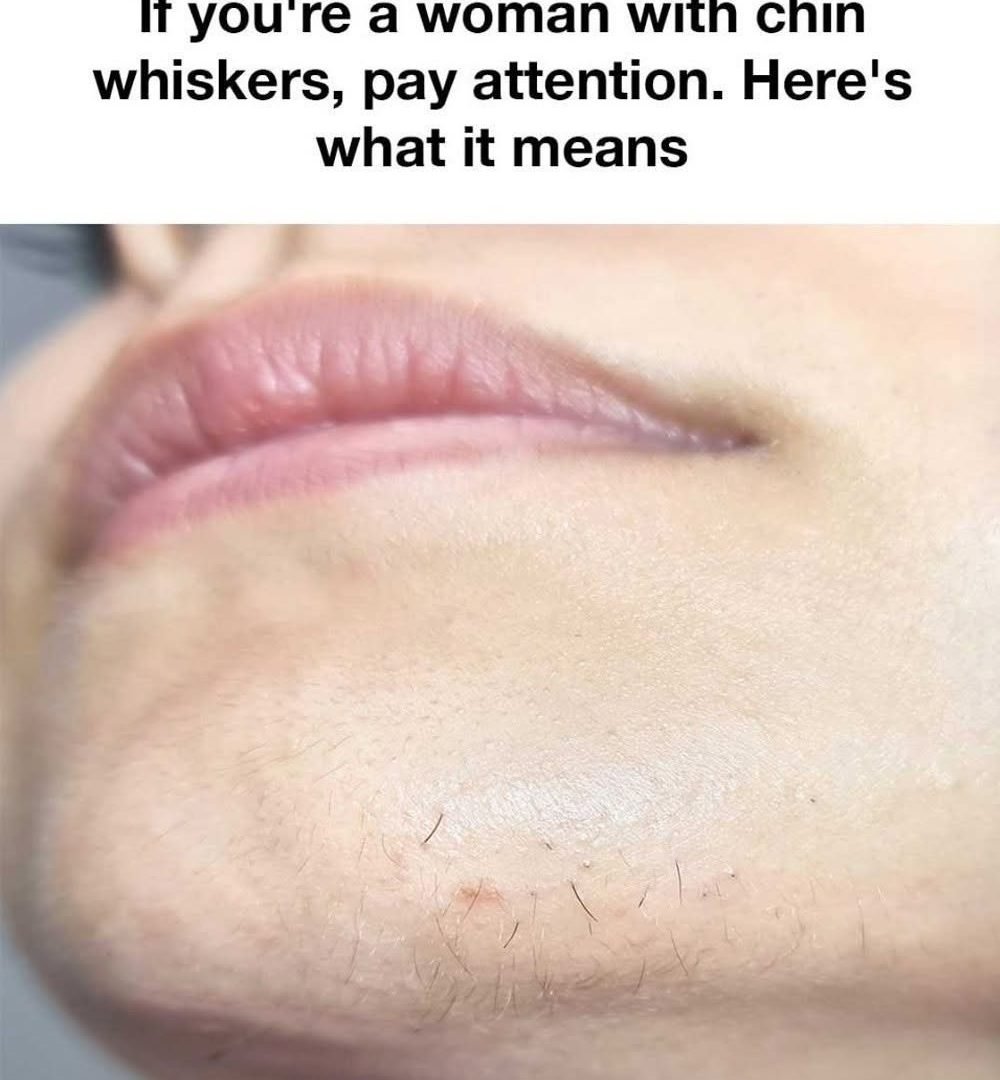
Chin Hair in Women: What It May Reveal About Hormones, PCOS, and Other Health Conditions
1. Is Chin Hair in Women Normal?
Yes. Chin hair is a normal feature of human body hair growth, and having a few visible hairs does not automatically indicate a health problem.
Women naturally produce small amounts of androgens, a group of hormones that includes testosterone. These hormones influence hair growth, skin activity, and several other bodily functions.
Hair follicles also differ in their sensitivity to hormones. This means two people with similar hormone levels can have noticeably different hair growth patterns.
Some women naturally develop a few darker hairs around the chin, while others have mostly fine, light-colored facial hair.
Genetics, age, ethnicity, and individual hormone sensitivity can all influence these differences.
It is useful to distinguish between two types of facial hair:
Vellus hair: Fine, soft, usually lightly colored hair that covers much of the body.
Terminal hair: Thicker, longer, and more pigmented hair that develops in response to genetic and hormonal influences.
A few isolated terminal hairs around the chin are not necessarily a sign of an underlying medical condition.
The important consideration is whether the growth is new, increasing, widespread, or accompanied by other symptoms.
Hirsutism is the medical term for excessive growth of coarse, dark hair in areas where androgen hormones typically promote hair growth.
In women, these areas can include:
Chin and jawline.
Upper lip.
Chest.
Upper and lower abdomen.
Back.
Upper thighs.
Hirsutism is different from simply having visible facial hair.
For example, someone with two or three isolated chin hairs may have normal hair growth rather than clinical hirsutism.
A person with more extensive, coarse hair growth across several androgen-sensitive areas may warrant medical evaluation.
The condition is often associated with increased androgen activity, although not every case involves elevated hormone levels.
According to the Endocrine Society, hirsutism is commonly associated with hormonal conditions, particularly polycystic ovary syndrome (PCOS). endocrine.org+1
3. The Connection Between Chin Hair and Hormones
Hormones are chemical messengers that help regulate many processes throughout the body.
Androgens are particularly relevant to facial hair growth because they influence the activity of hair follicles.
Although androgens are commonly described as male hormones, everyone produces them.
In women, these hormones are normally present in smaller amounts and contribute to several important functions.
Testosterone is one of the best-known androgens.
When androgen levels become elevated, or when hair follicles become more sensitive to their effects, certain fine hairs may gradually become thicker, darker, and more noticeable.
This process does not happen overnight.
Hair follicles move through different growth stages, so changes in hormonal activity may take time to become visible.
This explains why some women notice increasing facial hair gradually rather than experiencing an immediate change.
However, visible chin hair alone cannot establish whether testosterone levels are elevated.
A medical assessment is necessary when the pattern suggests a possible hormonal problem.
4. Why Polycystic Ovary Syndrome (PCOS) Is an Important Possible Cause
One of the most frequently discussed causes of excessive facial hair in women is polycystic ovary syndrome, commonly known as PCOS.
PCOS is a hormonal and metabolic condition that can affect ovarian function, menstrual cycles, and androgen activity.
In some individuals, the ovaries produce higher amounts of androgens than expected.
This can contribute to excessive hair growth on the chin, upper lip, chest, or abdomen.
However, facial hair is only one possible feature of PCOS.
Other signs can include:
Irregular menstrual periods.
Infrequent or absent periods.
Persistent acne.
Increased androgen-related hair growth.
Difficulty with ovulation.
Changes associated with insulin resistance.
Not everyone with PCOS experiences all these symptoms.
Some individuals have relatively regular periods, while others notice changes in their menstrual cycles before developing other symptoms.
The American College of Obstetricians and Gynecologists identifies excess facial or body hair and irregular menstrual cycles among the possible features of PCOS. ACOG+1
An important distinction: Having chin hair does not mean someone automatically has PCOS. Diagnosis requires consideration of several clinical factors, and other possible explanations must be considered.
5. Other Possible Causes of Chin Hair in Women
PCOS receives considerable attention, but it is not the only possible explanation for unwanted facial hair.
Several other factors can influence hair growth.
Genetics and family history
Some families naturally have more noticeable facial hair.
If close relatives experience similar hair growth, genetics may contribute to the pattern.
This can occur without an identifiable hormonal disorder.
Natural hormonal changes
Hormone levels change throughout life.
Puberty, adulthood, and menopause can all influence the distribution and appearance of body hair.
During puberty, androgen activity increases as part of normal development. This can cause changes in skin oil production and hair growth.
Increased sensitivity of hair follicles
Sometimes androgen levels are within the normal range, but hair follicles respond more strongly to these hormones.
This can contribute to unwanted facial hair without a clearly identifiable hormonal abnormality.
Certain medications
Some medications can influence hair growth.
Examples include certain steroid medications and some treatments that affect hormonal activity.
Anyone who notices new hair growth after starting medication should discuss the timing with a healthcare professional rather than stopping the medication independently.
Other endocrine conditions
Less commonly, conditions involving the adrenal glands or other hormone-producing organs can contribute to excessive hair growth.
These possibilities are more important to investigate when hair growth develops rapidly or occurs alongside other significant hormonal changes.NHS+2
Chin Hair in Women: What It May Reveal About Hormones, PCOS, and Other Health Conditions
Finding a few unexpected hairs on the chin can raise questions, especially when they appear suddenly or become more noticeable over time. Although facial hair is completely normal, changes in its growth pattern can sometimes provide clues about hormonal activity and other aspects of health.
Chin hair in women is a common concern, particularly during periods of hormonal change. Some women notice one or two coarse hairs that they occasionally remove, while others experience more noticeable hair growth around the chin, upper lip, jawline, neck, or chest.
In many cases, this is simply a normal variation influenced by genetics, age, and individual hormone levels. However, excessive or progressively increasing facial hair can sometimes be associated with a condition called hirsutism, which refers to unwanted growth of coarse, dark hair in areas where androgen hormones typically promote hair growth.
One possible underlying cause is polycystic ovary syndrome (PCOS), a hormonal condition that can affect menstrual cycles, ovulation, and androgen levels. Other possibilities include certain medications, changes associated with menopause, and less common hormonal or adrenal conditions.
But does every woman with chin hair have a hormonal imbalance? Absolutely not.
Understanding the difference between ordinary facial hair and medically significant changes is important. This article explores why chin hair develops, how hormones influence hair growth, when it may be worth seeking medical advice, and what treatment options are available.
Part 1 of 5
1. Is Chin Hair in Women Normal?
Yes. Chin hair is a normal feature of human body hair growth, and having a few visible hairs does not automatically indicate a health problem.
Women naturally produce small amounts of androgens, a group of hormones that includes testosterone. These hormones influence hair growth, skin activity, and several other bodily functions.
Hair follicles also differ in their sensitivity to hormones. This means two people with similar hormone levels can have noticeably different hair growth patterns.
Some women naturally develop a few darker hairs around the chin, while others have mostly fine, light-colored facial hair.
Genetics, age, ethnicity, and individual hormone sensitivity can all influence these differences.
It is useful to distinguish between two types of facial hair:
Vellus hair: Fine, soft, usually lightly colored hair that covers much of the body.
Terminal hair: Thicker, longer, and more pigmented hair that develops in response to genetic and hormonal influences.
A few isolated terminal hairs around the chin are not necessarily a sign of an underlying medical condition.
The important consideration is whether the growth is new, increasing, widespread, or accompanied by other symptoms.
Hirsutism is the medical term for excessive growth of coarse, dark hair in areas where androgen hormones typically promote hair growth.
In women, these areas can include:
Chin and jawline.
Upper lip.
Chest.
Upper and lower abdomen.
Back.
Upper thighs.
Hirsutism is different from simply having visible facial hair.
For example, someone with two or three isolated chin hairs may have normal hair growth rather than clinical hirsutism.
A person with more extensive, coarse hair growth across several androgen-sensitive areas may warrant medical evaluation.
The condition is often associated with increased androgen activity, although not every case involves elevated hormone levels.
According to the Endocrine Society, hirsutism is commonly associated with hormonal conditions, particularly polycystic ovary syndrome (PCOS). endocrine.org+1
3. The Connection Between Chin Hair and Hormones
Hormones are chemical messengers that help regulate many processes throughout the body.
Androgens are particularly relevant to facial hair growth because they influence the activity of hair follicles.
Although androgens are commonly described as male hormones, everyone produces them.
In women, these hormones are normally present in smaller amounts and contribute to several important functions.
Testosterone is one of the best-known androgens.
When androgen levels become elevated, or when hair follicles become more sensitive to their effects, certain fine hairs may gradually become thicker, darker, and more noticeable.
This process does not happen overnight.
Hair follicles move through different growth stages, so changes in hormonal activity may take time to become visible.
This explains why some women notice increasing facial hair gradually rather than experiencing an immediate change.
However, visible chin hair alone cannot establish whether testosterone levels are elevated.
A medical assessment is necessary when the pattern suggests a possible hormonal problem.
4. Why Polycystic Ovary Syndrome (PCOS) Is an Important Possible Cause
One of the most frequently discussed causes of excessive facial hair in women is polycystic ovary syndrome, commonly known as PCOS.
PCOS is a hormonal and metabolic condition that can affect ovarian function, menstrual cycles, and androgen activity.
In some individuals, the ovaries produce higher amounts of androgens than expected.
This can contribute to excessive hair growth on the chin, upper lip, chest, or abdomen.
However, facial hair is only one possible feature of PCOS.
Other signs can include:
Irregular menstrual periods.
Infrequent or absent periods.
Persistent acne.
Increased androgen-related hair growth.
Difficulty with ovulation.
Changes associated with insulin resistance.
Not everyone with PCOS experiences all these symptoms.
Some individuals have relatively regular periods, while others notice changes in their menstrual cycles before developing other symptoms.
The American College of Obstetricians and Gynecologists identifies excess facial or body hair and irregular menstrual cycles among the possible features of PCOS. ACOG+1
An important distinction: Having chin hair does not mean someone automatically has PCOS. Diagnosis requires consideration of several clinical factors, and other possible explanations must be considered.
5. Other Possible Causes of Chin Hair in Women
PCOS receives considerable attention, but it is not the only possible explanation for unwanted facial hair.
Several other factors can influence hair growth.
Genetics and family history
Some families naturally have more noticeable facial hair.
If close relatives experience similar hair growth, genetics may contribute to the pattern.
This can occur without an identifiable hormonal disorder.
Natural hormonal changes
Hormone levels change throughout life.
Puberty, adulthood, and menopause can all influence the distribution and appearance of body hair.
During puberty, androgen activity increases as part of normal development. This can cause changes in skin oil production and hair growth.
Increased sensitivity of hair follicles
Sometimes androgen levels are within the normal range, but hair follicles respond more strongly to these hormones.
This can contribute to unwanted facial hair without a clearly identifiable hormonal abnormality.
Certain medications
Some medications can influence hair growth.
Examples include certain steroid medications and some treatments that affect hormonal activity.
Anyone who notices new hair growth after starting medication should discuss the timing with a healthcare professional rather than stopping the medication independently.
Other endocrine conditions
Less commonly, conditions involving the adrenal glands or other hormone-producing organs can contribute to excessive hair growth.
These possibilities are more important to investigate when hair growth develops rapidly or occurs alongside other significant hormonal changes.NHS+2
Part 2 of 5
6. Can Chin Hair Be a Sign of Insulin Resistance?
Insulin resistance is another health issue sometimes associated with excessive facial hair, particularly in people with PCOS.
Insulin is a hormone produced by the pancreas. Its main function is to help cells absorb glucose from the bloodstream and use it for energy.
When the body’s cells become less responsive to insulin, the pancreas may produce more insulin to compensate.
This can lead to elevated insulin levels, which may influence androgen production in some individuals.
In PCOS, insulin resistance and increased androgen activity can interact, contributing to several symptoms.
These may include:
Irregular menstrual cycles.
Increased facial or body hair.
Persistent acne.
Changes in skin pigmentation.
Increased risk of developing type 2 diabetes.
One possible skin-related sign is a condition called acanthosis nigricans.
It appears as darker, thicker, velvety-looking skin, commonly around the neck, underarms, or other skin folds.
However, having chin hair does not establish that someone has insulin resistance.
If several symptoms occur together, a healthcare professional can determine whether blood glucose testing or other investigations are appropriate.
7. Does Menopause Cause Chin Hair?
Yes. Hormonal changes associated with menopause can contribute to more noticeable facial hair in some women.
During the menopausal transition, estrogen levels decline. Androgen production also changes with age, but the balance between different hormones can shift.
As a result, some women notice thicker hairs appearing around the chin, upper lip, and jawline.
This is a relatively common experience during later adulthood.
The changes can be gradual, and individual experiences vary considerably.
Some women notice only a few isolated hairs, while others experience more noticeable changes in facial hair distribution.
It is important to distinguish ordinary age-related changes from sudden or rapidly progressive hair growth.
New, extensive, or unusually rapid hair growth should be evaluated by a healthcare professional rather than automatically attributed to menopause.
8. Can Irregular Periods and Chin Hair Be Connected?
Yes. When increased facial hair occurs alongside irregular menstrual periods, it may suggest an underlying hormonal condition.
The menstrual cycle is regulated by a complex interaction between hormones produced by the brain, ovaries, and other endocrine organs.
When this hormonal system is disrupted, ovulation may become irregular.
In PCOS, for example, elevated androgen activity can interfere with normal ovarian function and contribute to unpredictable menstrual cycles.
Some people experience:
Periods that occur infrequently.
Missed periods.
Unpredictable menstrual cycles.
Acne that persists beyond puberty.
Increased coarse facial hair.
However, menstrual irregularity can have several other causes, including normal changes during puberty, thyroid conditions, stress, and other medical factors.
In adolescents, PCOS should be diagnosed particularly carefully because menstrual irregularity and acne can occur naturally during the early years after periods begin.
The American College of Obstetricians and Gynecologists recommends caution when evaluating possible PCOS in adolescents, especially within two years of the first menstrual period. ACOG+1
9. When Should Chin Hair Become a Medical Concern?
A few isolated chin hairs generally do not require an extensive medical investigation.
However, certain changes make it worthwhile to arrange a medical appointment.
Consider seeking medical advice if:
Coarse facial hair is becoming increasingly noticeable.
Hair growth begins suddenly and progresses rapidly.
Important warning signs
Sudden development of substantial coarse facial or body hair, particularly when accompanied by a noticeably deeper voice or increased muscle development, requires prompt medical assessment.
These changes can occasionally indicate a condition involving unusually high androgen production.
Although serious causes are uncommon, they should not be overlooked.
The NHS specifically recommends medical evaluation for new, thick, dark facial hair and urgent assessment when it develops suddenly alongside other signs of androgen excess. NHS+1
Part 3 of 5
10. How Doctors Investigate Unwanted Chin Hair
A medical evaluation usually begins with a discussion of symptoms, personal health history, and the pattern of hair growth.
The purpose is not simply to count facial hairs. It is to understand whether the changes could be related to hormones or another underlying condition.
A healthcare professional may ask:
When did the facial hair first appear?
Has the amount increased over time?
Are menstrual periods regular?
Is there a history of persistent acne?
Have any medications recently changed?
Do other family members experience similar hair growth?
Are there other noticeable hormonal changes?
The doctor may also assess other areas of the skin and look for signs associated with hormonal conditions.
The exact evaluation depends on age, symptoms, medical history, and examination findings.
11. Which Hormone Tests May Be Recommended?
When excessive hair growth suggests a possible hormonal condition, a doctor may recommend blood tests.
These tests help investigate whether androgen levels are elevated and whether other hormonal abnormalities may be present.
Possible investigations include:
Test
What it helps investigate
Total testosterone
Androgen levels
DHEAS
Possible adrenal androgen production
17-hydroxyprogesterone
Certain adrenal hormone conditions
TSH
Thyroid function
Prolactin
Possible prolactin-related menstrual disturbances
Blood glucose or HbA1c
Blood sugar regulation
Not everyone needs every test.
For example, isolated mild facial hair with otherwise normal menstrual cycles and no additional symptoms may not require extensive hormonal testing.
The Endocrine Society recommends a more focused investigation when hair growth is moderate or severe, develops rapidly, or occurs alongside other signs of hormonal disturbance. OUP Academic+1
12. Does Chin Hair Automatically Mean High Testosterone?
No.
This is one of the most important misconceptions about facial hair.
Although elevated testosterone can contribute to hirsutism, hair growth is influenced by more than the amount of testosterone circulating in the bloodstream.
Hair follicles have different levels of sensitivity to androgen hormones.
Some people naturally develop darker, thicker hairs even when their hormone measurements are within expected ranges.
Genetics and individual differences in follicle activity can help explain these variations.
There is also a condition sometimes called idiopathic hirsutism, in which unwanted hair growth occurs without an obvious underlying hormonal disorder.
Therefore, facial hair alone cannot be used to diagnose high testosterone.
A proper assessment considers the overall pattern of symptoms and, when appropriate, laboratory results.
13. Can Chin Hair Be Related to Thyroid Problems?
Thyroid hormones influence metabolism and several important processes throughout the body.
When thyroid function becomes abnormal, some people experience changes in skin condition, hair texture, and menstrual cycles.
However, isolated chin hair is not a typical or reliable indicator of thyroid disease.
Increased facial hair may occasionally occur alongside other hormonal abnormalities, but it should not be assumed to originate from the thyroid.
Other possible symptoms of thyroid dysfunction include:
Unusual tiredness.
Changes in temperature sensitivity.
Changes in bowel habits.
Menstrual irregularities.
Changes in hair texture or overall hair shedding.
If several symptoms occur together, a healthcare professional may recommend thyroid function testing.
It is important to investigate the actual cause instead of assuming that every change in facial hair reflects a thyroid problem.
Part 4 of 5
14. What Are the Available Treatment Options for Unwanted Chin Hair?
Treatment depends on the cause, the extent of hair growth, and whether the individual wants treatment.
It is important to understand that facial hair itself is not automatically a medical problem.
Some people prefer to leave it alone, while others choose cosmetic hair removal.
Both choices are valid.
For individuals experiencing medically significant hirsutism, treatment may involve addressing underlying hormonal activity as well as managing the visible hair.
Common approaches include:
Treating an underlying hormonal condition
If excessive hair growth is associated with PCOS or another endocrine condition, a healthcare professional can recommend appropriate treatment.
Addressing the underlying condition may help reduce further hair growth over time.
Cosmetic hair removal
Temporary methods can remove existing hair without changing hormone levels.
These may include shaving, trimming, threading, or other professionally recommended methods.
Medical treatment
Depending on age, diagnosis, and medical circumstances, a clinician may consider prescription treatments that influence androgen activity or slow facial hair growth.
These treatments require professional assessment because they may have side effects and are not suitable for everyone.
The most appropriate approach depends on the individual rather than the appearance of the hair alone.
15. Can Laser Hair Removal Help With Chin Hair?
Laser hair removal is one option for people who want longer-lasting reduction in unwanted facial hair.
It works by directing light energy toward pigment in the hair follicle.
The resulting heat damages the follicle and reduces its ability to produce hair.
Multiple sessions are generally needed because hair follicles grow in different stages.
Laser treatment tends to work best on darker hairs because the treatment targets pigment.
However, effectiveness varies according to hair color, skin tone, equipment, and the experience of the professional performing the treatment.
Potential side effects include temporary redness, irritation, pigment changes, and, less commonly, burns or scarring.
A qualified dermatologist or appropriately trained professional can determine whether the treatment is suitable.
Importantly, laser hair removal reduces existing hair growth but does not correct an underlying hormonal condition.
New hair may continue to develop if androgen activity remains elevated.
16. What Is the Difference Between Laser Treatment and Electrolysis?
Laser hair removal and electrolysis are two different methods used to reduce unwanted hair.
Uses a fine probe and electrical current to treat individual hair follicles. It can work on different hair colors.
Laser treatment generally covers larger areas more quickly, while electrolysis treats individual follicles.
Electrolysis may be particularly useful for lighter-colored hairs that do not respond well to laser treatment.
Both methods require trained professionals and may involve multiple appointments.
Neither treatment should be considered a cure for hormonal conditions that continue stimulating new hair growth.
17. Can Medication Reduce Hormone-Related Facial Hair?
Yes. Certain prescription medications can reduce androgen-related hair growth.
For some women with PCOS or other causes of androgen excess, doctors may consider hormonal treatments.
Combined hormonal contraceptives are sometimes prescribed to help regulate menstrual cycles and reduce androgen activity.
Other medications, including antiandrogens, may be considered in selected circumstances.
A prescription cream containing eflornithine may also be used in some countries to slow facial hair growth.
However, these treatments are not suitable for everyone.
Some medications have important safety considerations, including pregnancy-related risks and other potential side effects.
They must only be used under appropriate medical supervision.
It is also important to understand that medication does not remove existing coarse hairs immediately.
Because hair follicles have natural growth cycles, visible improvement can take several months.
The Endocrine Society notes that medical treatment for hirsutism generally requires at least six months before its effectiveness can be properly assessed. OUP Academic+1
Part 5 of 5
18. Does Removing Chin Hair Make It Grow Back Thicker?
One of the most common misconceptions about facial hair is that removing it causes the hair to grow back thicker, darker, or faster.
This is not generally true.
Shaving cuts the hair at the surface of the skin. It does not change the hair follicle or increase hormone production.
When the hair grows back, its blunt tip can make it feel slightly rougher than an uncut hair.
This can create the impression that it has become thicker.
Similarly, removing hair with tweezers or threading does not automatically cause additional hair follicles to develop.
However, repeated removal can sometimes irritate the skin, particularly when aggressive techniques are used.
The method chosen should depend on personal comfort, skin sensitivity, and individual preferences.
19. Five Important Facts Every Woman Should Know About Chin Hair
Before assuming that chin hair indicates a health problem, it helps to remember these five important points.
1. A few chin hairs are normal.
Individual differences in genetics and hair follicle sensitivity mean that some women naturally develop visible facial hair.
2. PCOS is one possible cause, not the only cause.
Excessive facial hair can be associated with several hormonal conditions, but it can also occur without an identifiable hormonal abnormality.
3. Menstrual changes provide useful information.
When increased facial hair occurs alongside irregular periods or persistent acne, a medical assessment may help identify a possible hormonal condition.
4. Sudden changes deserve attention.
Rapidly increasing facial hair, particularly alongside other signs of androgen excess, should be evaluated promptly.
5. Treatment is available.
People who want to manage unwanted facial hair have several options, including cosmetic removal and medically supervised treatments.
Most importantly, having facial hair does not make someone unhealthy, and it is not something that everyone needs to remove.
20. Conclusion: What Does Chin Hair Really Mean for Women’s Health?
Chin hair in women can have several explanations, ranging from normal genetic variation to changes in hormone activity.
For many women, a few isolated hairs are simply part of their natural biology. However, increasingly coarse or widespread facial hair can sometimes indicate hirsutism, a condition frequently associated with androgen activity and, in some cases, PCOS.
The most important distinction is the overall pattern.
Facial hair accompanied by irregular menstrual cycles, persistent acne, or other hormonal changes may deserve medical investigation. Sudden and rapidly progressive hair growth should receive particular attention.
Fortunately, effective options are available. Depending on the cause, treatment may include addressing an underlying hormonal condition, cosmetic hair removal, laser treatment, electrolysis, or prescribed medication.
There is no reason to feel embarrassed about asking questions or discussing facial hair with a healthcare professional.
The bottom line: Chin hair is not automatically a warning sign of disease. Understanding your body’s natural changes, recognizing symptoms that deserve attention, and seeking reliable medical advice when necessary are the best ways to protect your health.
Frequently Asked Questions
1. What does chin hair mean in women?
Chin hair can be a normal result of genetics, age, and individual hormone sensitivity. However, excessive coarse facial hair may indicate hirsutism, which is sometimes associated with increased androgen activity or PCOS. A few isolated hairs alone are not enough to diagnose a medical condition.
2. Is chin hair a sign of PCOS?
It can be one possible sign of PCOS, particularly when accompanied by irregular menstrual periods, persistent acne, or other symptoms of androgen excess. However, many women have chin hair without PCOS. Diagnosis requires a broader medical assessment.
3. Does chin hair mean a woman has too much testosterone?
Not necessarily. Hair follicles differ in their sensitivity to testosterone and other androgens. Some women develop coarse facial hair despite having hormone levels within the expected range. Blood testing may be appropriate when additional symptoms suggest a hormonal condition.
4. Why am I suddenly growing thick hairs on my chin?
Sudden changes in facial hair can be associated with hormonal changes, medication effects, or other medical conditions. Rapidly developing coarse facial hair deserves medical evaluation, particularly if accompanied by menstrual changes, a deeper voice, or other signs of increased androgen activity.
5. Can irregular periods and chin hair indicate a hormonal imbalance?
Yes. When these symptoms occur together, PCOS is one possible explanation. However, thyroid conditions, normal pubertal development, and other factors can also affect menstrual cycles. A healthcare professional can determine whether hormonal testing is appropriate.
6. Does shaving chin hair make it grow back thicker?
No. Shaving does not increase the number of hair follicles or change hormone levels. Regrowing hair may temporarily feel rougher because shaving creates a blunt tip, but it does not actually become thicker because of shaving.
7. Can menopause cause chin hair in women?
Yes. Changes in the balance of reproductive hormones during and after menopause can make facial hair more noticeable in some women. A few additional chin hairs can be part of normal aging, although sudden or substantial changes should be medically evaluated.
8. Which medical tests can identify the cause of excessive chin hair?
Depending on the symptoms, doctors may recommend testosterone, DHEAS, 17-hydroxyprogesterone, thyroid function, or other tests. Blood glucose testing may also be considered when PCOS or insulin resistance is suspected. Not everyone needs all these investigations.
9. Can PCOS-related chin hair disappear naturally?
Hair growth may change as hormone activity changes, but established coarse hairs do not necessarily disappear on their own. Treating an underlying hormonal condition may help reduce additional growth, while cosmetic or dermatological treatments can address existing hair.
10. When should a woman see a doctor about chin hair?
Medical advice is particularly important when facial hair becomes increasingly coarse, spreads to other areas, or occurs alongside irregular periods, persistent acne, or other hormonal symptoms. Sudden, rapidly progressive hair growth accompanied by a deeper voice or other significant physical changes warrants prompt assessment.
Medical References and Further Reading
The following reputable medical organizations provide additional information about hirsutism, PCOS, and hormonal health.
Medical disclaimer: This article is intended for educational purposes and does not replace professional medical advice, diagnosis, or treatment. Facial hair alone cannot establish a hormonal diagnosis. Anyone experiencing concerning or rapidly changing symptoms should consult a qualified healthcare professional.
6. Can Chin Hair Be a Sign of Insulin Resistance?
Insulin resistance is another health issue sometimes associated with excessive facial hair, particularly in people with PCOS.
Insulin is a hormone produced by the pancreas. Its main function is to help cells absorb glucose from the bloodstream and use it for energy.
When the body’s cells become less responsive to insulin, the pancreas may produce more insulin to compensate.
This can lead to elevated insulin levels, which may influence androgen production in some individuals.
In PCOS, insulin resistance and increased androgen activity can interact, contributing to several symptoms.
These may include:
Irregular menstrual cycles.
Increased facial or body hair.
Persistent acne.
Changes in skin pigmentation.
Increased risk of developing type 2 diabetes.
One possible skin-related sign is a condition called acanthosis nigricans.
It appears as darker, thicker, velvety-looking skin, commonly around the neck, underarms, or other skin folds.
However, having chin hair does not establish that someone has insulin resistance.
If several symptoms occur together, a healthcare professional can determine whether blood glucose testing or other investigations are appropriate.
7. Does Menopause Cause Chin Hair?
Yes. Hormonal changes associated with menopause can contribute to more noticeable facial hair in some women.
During the menopausal transition, estrogen levels decline. Androgen production also changes with age, but the balance between different hormones can shift.
As a result, some women notice thicker hairs appearing around the chin, upper lip, and jawline.
This is a relatively common experience during later adulthood.
The changes can be gradual, and individual experiences vary considerably.
Some women notice only a few isolated hairs, while others experience more noticeable changes in facial hair distribution.
It is important to distinguish ordinary age-related changes from sudden or rapidly progressive hair growth.
New, extensive, or unusually rapid hair growth should be evaluated by a healthcare professional rather than automatically attributed to menopause.
8. Can Irregular Periods and Chin Hair Be Connected?
Yes. When increased facial hair occurs alongside irregular menstrual periods, it may suggest an underlying hormonal condition.
The menstrual cycle is regulated by a complex interaction between hormones produced by the brain, ovaries, and other endocrine organs.
When this hormonal system is disrupted, ovulation may become irregular.
In PCOS, for example, elevated androgen activity can interfere with normal ovarian function and contribute to unpredictable menstrual cycles.
Some people experience:
Periods that occur infrequently.
Missed periods.
Unpredictable menstrual cycles.
Acne that persists beyond puberty.
Increased coarse facial hair.
However, menstrual irregularity can have several other causes, including normal changes during puberty, thyroid conditions, stress, and other medical factors.
In adolescents, PCOS should be diagnosed particularly carefully because menstrual irregularity and acne can occur naturally during the early years after periods begin.
The American College of Obstetricians and Gynecologists recommends caution when evaluating possible PCOS in adolescents, especially within two years of the first menstrual period. ACOG+1
9. When Should Chin Hair Become a Medical Concern?
A few isolated chin hairs generally do not require an extensive medical investigation.
However, certain changes make it worthwhile to arrange a medical appointment.
Consider seeking medical advice if:
Coarse facial hair is becoming increasingly noticeable.
Hair growth begins suddenly and progresses rapidly.
Important warning signs
Sudden development of substantial coarse facial or body hair, particularly when accompanied by a noticeably deeper voice or increased muscle development, requires prompt medical assessment.
These changes can occasionally indicate a condition involving unusually high androgen production.
Although serious causes are uncommon, they should not be overlooked.
The NHS specifically recommends medical evaluation for new, thick, dark facial hair and urgent assessment when it develops suddenly alongside other signs of androgen excess. NHS+1
Chin Hair in Women: What It May Reveal About Hormones, PCOS, and Other Health Conditions
Finding a few unexpected hairs on the chin can raise questions, especially when they appear suddenly or become more noticeable over time. Although facial hair is completely normal, changes in its growth pattern can sometimes provide clues about hormonal activity and other aspects of health.
Chin hair in women is a common concern, particularly during periods of hormonal change. Some women notice one or two coarse hairs that they occasionally remove, while others experience more noticeable hair growth around the chin, upper lip, jawline, neck, or chest.
In many cases, this is simply a normal variation influenced by genetics, age, and individual hormone levels. However, excessive or progressively increasing facial hair can sometimes be associated with a condition called hirsutism, which refers to unwanted growth of coarse, dark hair in areas where androgen hormones typically promote hair growth.
One possible underlying cause is polycystic ovary syndrome (PCOS), a hormonal condition that can affect menstrual cycles, ovulation, and androgen levels. Other possibilities include certain medications, changes associated with menopause, and less common hormonal or adrenal conditions.
But does every woman with chin hair have a hormonal imbalance? Absolutely not.
Understanding the difference between ordinary facial hair and medically significant changes is important. This article explores why chin hair develops, how hormones influence hair growth, when it may be worth seeking medical advice, and what treatment options are available.
Part 1 of 5
1. Is Chin Hair in Women Normal?
Yes. Chin hair is a normal feature of human body hair growth, and having a few visible hairs does not automatically indicate a health problem.
Women naturally produce small amounts of androgens, a group of hormones that includes testosterone. These hormones influence hair growth, skin activity, and several other bodily functions.
Hair follicles also differ in their sensitivity to hormones. This means two people with similar hormone levels can have noticeably different hair growth patterns.
Some women naturally develop a few darker hairs around the chin, while others have mostly fine, light-colored facial hair.
Genetics, age, ethnicity, and individual hormone sensitivity can all influence these differences.
It is useful to distinguish between two types of facial hair:
Vellus hair: Fine, soft, usually lightly colored hair that covers much of the body.
Terminal hair: Thicker, longer, and more pigmented hair that develops in response to genetic and hormonal influences.
A few isolated terminal hairs around the chin are not necessarily a sign of an underlying medical condition.
The important consideration is whether the growth is new, increasing, widespread, or accompanied by other symptoms.
Hirsutism is the medical term for excessive growth of coarse, dark hair in areas where androgen hormones typically promote hair growth.
In women, these areas can include:
Chin and jawline.
Upper lip.
Chest.
Upper and lower abdomen.
Back.
Upper thighs.
Hirsutism is different from simply having visible facial hair.
For example, someone with two or three isolated chin hairs may have normal hair growth rather than clinical hirsutism.
A person with more extensive, coarse hair growth across several androgen-sensitive areas may warrant medical evaluation.
The condition is often associated with increased androgen activity, although not every case involves elevated hormone levels.
According to the Endocrine Society, hirsutism is commonly associated with hormonal conditions, particularly polycystic ovary syndrome (PCOS). endocrine.org+1
3. The Connection Between Chin Hair and Hormones
Hormones are chemical messengers that help regulate many processes throughout the body.
Androgens are particularly relevant to facial hair growth because they influence the activity of hair follicles.
Although androgens are commonly described as male hormones, everyone produces them.
In women, these hormones are normally present in smaller amounts and contribute to several important functions.
Testosterone is one of the best-known androgens.
When androgen levels become elevated, or when hair follicles become more sensitive to their effects, certain fine hairs may gradually become thicker, darker, and more noticeable.
This process does not happen overnight.
Hair follicles move through different growth stages, so changes in hormonal activity may take time to become visible.
This explains why some women notice increasing facial hair gradually rather than experiencing an immediate change.
However, visible chin hair alone cannot establish whether testosterone levels are elevated.
A medical assessment is necessary when the pattern suggests a possible hormonal problem.
4. Why Polycystic Ovary Syndrome (PCOS) Is an Important Possible Cause
One of the most frequently discussed causes of excessive facial hair in women is polycystic ovary syndrome, commonly known as PCOS.
PCOS is a hormonal and metabolic condition that can affect ovarian function, menstrual cycles, and androgen activity.
In some individuals, the ovaries produce higher amounts of androgens than expected.
This can contribute to excessive hair growth on the chin, upper lip, chest, or abdomen.
However, facial hair is only one possible feature of PCOS.
Other signs can include:
Irregular menstrual periods.
Infrequent or absent periods.
Persistent acne.
Increased androgen-related hair growth.
Difficulty with ovulation.
Changes associated with insulin resistance.
Not everyone with PCOS experiences all these symptoms.
Some individuals have relatively regular periods, while others notice changes in their menstrual cycles before developing other symptoms.
The American College of Obstetricians and Gynecologists identifies excess facial or body hair and irregular menstrual cycles among the possible features of PCOS. ACOG+1
An important distinction: Having chin hair does not mean someone automatically has PCOS. Diagnosis requires consideration of several clinical factors, and other possible explanations must be considered.
5. Other Possible Causes of Chin Hair in Women
PCOS receives considerable attention, but it is not the only possible explanation for unwanted facial hair.
Several other factors can influence hair growth.
Genetics and family history
Some families naturally have more noticeable facial hair.
If close relatives experience similar hair growth, genetics may contribute to the pattern.
This can occur without an identifiable hormonal disorder.
Natural hormonal changes
Hormone levels change throughout life.
Puberty, adulthood, and menopause can all influence the distribution and appearance of body hair.
During puberty, androgen activity increases as part of normal development. This can cause changes in skin oil production and hair growth.
Increased sensitivity of hair follicles
Sometimes androgen levels are within the normal range, but hair follicles respond more strongly to these hormones.
This can contribute to unwanted facial hair without a clearly identifiable hormonal abnormality.
Certain medications
Some medications can influence hair growth.
Examples include certain steroid medications and some treatments that affect hormonal activity.
Anyone who notices new hair growth after starting medication should discuss the timing with a healthcare professional rather than stopping the medication independently.
Other endocrine conditions
Less commonly, conditions involving the adrenal glands or other hormone-producing organs can contribute to excessive hair growth.
These possibilities are more important to investigate when hair growth develops rapidly or occurs alongside other significant hormonal changes.NHS+2
Part 2 of 5
6. Can Chin Hair Be a Sign of Insulin Resistance?
Insulin resistance is another health issue sometimes associated with excessive facial hair, particularly in people with PCOS.
Insulin is a hormone produced by the pancreas. Its main function is to help cells absorb glucose from the bloodstream and use it for energy.
When the body’s cells become less responsive to insulin, the pancreas may produce more insulin to compensate.
This can lead to elevated insulin levels, which may influence androgen production in some individuals.
In PCOS, insulin resistance and increased androgen activity can interact, contributing to several symptoms.
These may include:
Irregular menstrual cycles.
Increased facial or body hair.
Persistent acne.
Changes in skin pigmentation.
Increased risk of developing type 2 diabetes.
One possible skin-related sign is a condition called acanthosis nigricans.
It appears as darker, thicker, velvety-looking skin, commonly around the neck, underarms, or other skin folds.
However, having chin hair does not establish that someone has insulin resistance.
If several symptoms occur together, a healthcare professional can determine whether blood glucose testing or other investigations are appropriate.
7. Does Menopause Cause Chin Hair?
Yes. Hormonal changes associated with menopause can contribute to more noticeable facial hair in some women.
During the menopausal transition, estrogen levels decline. Androgen production also changes with age, but the balance between different hormones can shift.
As a result, some women notice thicker hairs appearing around the chin, upper lip, and jawline.
This is a relatively common experience during later adulthood.
The changes can be gradual, and individual experiences vary considerably.
Some women notice only a few isolated hairs, while others experience more noticeable changes in facial hair distribution.
It is important to distinguish ordinary age-related changes from sudden or rapidly progressive hair growth.
New, extensive, or unusually rapid hair growth should be evaluated by a healthcare professional rather than automatically attributed to menopause.
8. Can Irregular Periods and Chin Hair Be Connected?
Yes. When increased facial hair occurs alongside irregular menstrual periods, it may suggest an underlying hormonal condition.
The menstrual cycle is regulated by a complex interaction between hormones produced by the brain, ovaries, and other endocrine organs.
When this hormonal system is disrupted, ovulation may become irregular.
In PCOS, for example, elevated androgen activity can interfere with normal ovarian function and contribute to unpredictable menstrual cycles.
Some people experience:
Periods that occur infrequently.
Missed periods.
Unpredictable menstrual cycles.
Acne that persists beyond puberty.
Increased coarse facial hair.
However, menstrual irregularity can have several other causes, including normal changes during puberty, thyroid conditions, stress, and other medical factors.
In adolescents, PCOS should be diagnosed particularly carefully because menstrual irregularity and acne can occur naturally during the early years after periods begin.
The American College of Obstetricians and Gynecologists recommends caution when evaluating possible PCOS in adolescents, especially within two years of the first menstrual period. ACOG+1
9. When Should Chin Hair Become a Medical Concern?
A few isolated chin hairs generally do not require an extensive medical investigation.
However, certain changes make it worthwhile to arrange a medical appointment.
Consider seeking medical advice if:
Coarse facial hair is becoming increasingly noticeable.
Hair growth begins suddenly and progresses rapidly.
Important warning signs
Sudden development of substantial coarse facial or body hair, particularly when accompanied by a noticeably deeper voice or increased muscle development, requires prompt medical assessment.
These changes can occasionally indicate a condition involving unusually high androgen production.
Although serious causes are uncommon, they should not be overlooked.
The NHS specifically recommends medical evaluation for new, thick, dark facial hair and urgent assessment when it develops suddenly alongside other signs of androgen excess. NHS+1
Part 3 of 5
10. How Doctors Investigate Unwanted Chin Hair
A medical evaluation usually begins with a discussion of symptoms, personal health history, and the pattern of hair growth.
The purpose is not simply to count facial hairs. It is to understand whether the changes could be related to hormones or another underlying condition.
A healthcare professional may ask:
When did the facial hair first appear?
Has the amount increased over time?
Are menstrual periods regular?
Is there a history of persistent acne?
Have any medications recently changed?
Do other family members experience similar hair growth?
Are there other noticeable hormonal changes?
The doctor may also assess other areas of the skin and look for signs associated with hormonal conditions.
The exact evaluation depends on age, symptoms, medical history, and examination findings.
11. Which Hormone Tests May Be Recommended?
When excessive hair growth suggests a possible hormonal condition, a doctor may recommend blood tests.
These tests help investigate whether androgen levels are elevated and whether other hormonal abnormalities may be present.
Possible investigations include:
Test
What it helps investigate
Total testosterone
Androgen levels
DHEAS
Possible adrenal androgen production
17-hydroxyprogesterone
Certain adrenal hormone conditions
TSH
Thyroid function
Prolactin
Possible prolactin-related menstrual disturbances
Blood glucose or HbA1c
Blood sugar regulation
Not everyone needs every test.
For example, isolated mild facial hair with otherwise normal menstrual cycles and no additional symptoms may not require extensive hormonal testing.
The Endocrine Society recommends a more focused investigation when hair growth is moderate or severe, develops rapidly, or occurs alongside other signs of hormonal disturbance. OUP Academic+1
12. Does Chin Hair Automatically Mean High Testosterone?
No.
This is one of the most important misconceptions about facial hair.
Although elevated testosterone can contribute to hirsutism, hair growth is influenced by more than the amount of testosterone circulating in the bloodstream.
Hair follicles have different levels of sensitivity to androgen hormones.
Some people naturally develop darker, thicker hairs even when their hormone measurements are within expected ranges.
Genetics and individual differences in follicle activity can help explain these variations.
There is also a condition sometimes called idiopathic hirsutism, in which unwanted hair growth occurs without an obvious underlying hormonal disorder.
Therefore, facial hair alone cannot be used to diagnose high testosterone.
A proper assessment considers the overall pattern of symptoms and, when appropriate, laboratory results.
13. Can Chin Hair Be Related to Thyroid Problems?
Thyroid hormones influence metabolism and several important processes throughout the body.
When thyroid function becomes abnormal, some people experience changes in skin condition, hair texture, and menstrual cycles.
However, isolated chin hair is not a typical or reliable indicator of thyroid disease.
Increased facial hair may occasionally occur alongside other hormonal abnormalities, but it should not be assumed to originate from the thyroid.
Other possible symptoms of thyroid dysfunction include:
Unusual tiredness.
Changes in temperature sensitivity.
Changes in bowel habits.
Menstrual irregularities.
Changes in hair texture or overall hair shedding.
If several symptoms occur together, a healthcare professional may recommend thyroid function testing.
It is important to investigate the actual cause instead of assuming that every change in facial hair reflects a thyroid problem.
Part 4 of 5
14. What Are the Available Treatment Options for Unwanted Chin Hair?
Treatment depends on the cause, the extent of hair growth, and whether the individual wants treatment.
It is important to understand that facial hair itself is not automatically a medical problem.
Some people prefer to leave it alone, while others choose cosmetic hair removal.
Both choices are valid.
For individuals experiencing medically significant hirsutism, treatment may involve addressing underlying hormonal activity as well as managing the visible hair.
Common approaches include:
Treating an underlying hormonal condition
If excessive hair growth is associated with PCOS or another endocrine condition, a healthcare professional can recommend appropriate treatment.
Addressing the underlying condition may help reduce further hair growth over time.
Cosmetic hair removal
Temporary methods can remove existing hair without changing hormone levels.
These may include shaving, trimming, threading, or other professionally recommended methods.
Medical treatment
Depending on age, diagnosis, and medical circumstances, a clinician may consider prescription treatments that influence androgen activity or slow facial hair growth.
These treatments require professional assessment because they may have side effects and are not suitable for everyone.
The most appropriate approach depends on the individual rather than the appearance of the hair alone.
15. Can Laser Hair Removal Help With Chin Hair?
Laser hair removal is one option for people who want longer-lasting reduction in unwanted facial hair.
It works by directing light energy toward pigment in the hair follicle.
The resulting heat damages the follicle and reduces its ability to produce hair.
Multiple sessions are generally needed because hair follicles grow in different stages.
Laser treatment tends to work best on darker hairs because the treatment targets pigment.
However, effectiveness varies according to hair color, skin tone, equipment, and the experience of the professional performing the treatment.
Potential side effects include temporary redness, irritation, pigment changes, and, less commonly, burns or scarring.
A qualified dermatologist or appropriately trained professional can determine whether the treatment is suitable.
Importantly, laser hair removal reduces existing hair growth but does not correct an underlying hormonal condition.
New hair may continue to develop if androgen activity remains elevated.
16. What Is the Difference Between Laser Treatment and Electrolysis?
Laser hair removal and electrolysis are two different methods used to reduce unwanted hair.
Uses a fine probe and electrical current to treat individual hair follicles. It can work on different hair colors.
Laser treatment generally covers larger areas more quickly, while electrolysis treats individual follicles.
Electrolysis may be particularly useful for lighter-colored hairs that do not respond well to laser treatment.
Both methods require trained professionals and may involve multiple appointments.
Neither treatment should be considered a cure for hormonal conditions that continue stimulating new hair growth.
17. Can Medication Reduce Hormone-Related Facial Hair?
Yes. Certain prescription medications can reduce androgen-related hair growth.
For some women with PCOS or other causes of androgen excess, doctors may consider hormonal treatments.
Combined hormonal contraceptives are sometimes prescribed to help regulate menstrual cycles and reduce androgen activity.
Other medications, including antiandrogens, may be considered in selected circumstances.
A prescription cream containing eflornithine may also be used in some countries to slow facial hair growth.
However, these treatments are not suitable for everyone.
Some medications have important safety considerations, including pregnancy-related risks and other potential side effects.
They must only be used under appropriate medical supervision.
It is also important to understand that medication does not remove existing coarse hairs immediately.
Because hair follicles have natural growth cycles, visible improvement can take several months.
The Endocrine Society notes that medical treatment for hirsutism generally requires at least six months before its effectiveness can be properly assessed. OUP Academic+1
Part 5 of 5
18. Does Removing Chin Hair Make It Grow Back Thicker?
One of the most common misconceptions about facial hair is that removing it causes the hair to grow back thicker, darker, or faster.
This is not generally true.
Shaving cuts the hair at the surface of the skin. It does not change the hair follicle or increase hormone production.
When the hair grows back, its blunt tip can make it feel slightly rougher than an uncut hair.
This can create the impression that it has become thicker.
Similarly, removing hair with tweezers or threading does not automatically cause additional hair follicles to develop.
However, repeated removal can sometimes irritate the skin, particularly when aggressive techniques are used.
The method chosen should depend on personal comfort, skin sensitivity, and individual preferences.
19. Five Important Facts Every Woman Should Know About Chin Hair
Before assuming that chin hair indicates a health problem, it helps to remember these five important points.
1. A few chin hairs are normal.
Individual differences in genetics and hair follicle sensitivity mean that some women naturally develop visible facial hair.
2. PCOS is one possible cause, not the only cause.
Excessive facial hair can be associated with several hormonal conditions, but it can also occur without an identifiable hormonal abnormality.
3. Menstrual changes provide useful information.
When increased facial hair occurs alongside irregular periods or persistent acne, a medical assessment may help identify a possible hormonal condition.
4. Sudden changes deserve attention.
Rapidly increasing facial hair, particularly alongside other signs of androgen excess, should be evaluated promptly.
5. Treatment is available.
People who want to manage unwanted facial hair have several options, including cosmetic removal and medically supervised treatments.
Most importantly, having facial hair does not make someone unhealthy, and it is not something that everyone needs to remove.
20. Conclusion: What Does Chin Hair Really Mean for Women’s Health?
Chin hair in women can have several explanations, ranging from normal genetic variation to changes in hormone activity.
For many women, a few isolated hairs are simply part of their natural biology. However, increasingly coarse or widespread facial hair can sometimes indicate hirsutism, a condition frequently associated with androgen activity and, in some cases, PCOS.
The most important distinction is the overall pattern.
Facial hair accompanied by irregular menstrual cycles, persistent acne, or other hormonal changes may deserve medical investigation. Sudden and rapidly progressive hair growth should receive particular attention.
Fortunately, effective options are available. Depending on the cause, treatment may include addressing an underlying hormonal condition, cosmetic hair removal, laser treatment, electrolysis, or prescribed medication.
There is no reason to feel embarrassed about asking questions or discussing facial hair with a healthcare professional.
The bottom line: Chin hair is not automatically a warning sign of disease. Understanding your body’s natural changes, recognizing symptoms that deserve attention, and seeking reliable medical advice when necessary are the best ways to protect your health.
Frequently Asked Questions
1. What does chin hair mean in women?
Chin hair can be a normal result of genetics, age, and individual hormone sensitivity. However, excessive coarse facial hair may indicate hirsutism, which is sometimes associated with increased androgen activity or PCOS. A few isolated hairs alone are not enough to diagnose a medical condition.
2. Is chin hair a sign of PCOS?
It can be one possible sign of PCOS, particularly when accompanied by irregular menstrual periods, persistent acne, or other symptoms of androgen excess. However, many women have chin hair without PCOS. Diagnosis requires a broader medical assessment.
3. Does chin hair mean a woman has too much testosterone?
Not necessarily. Hair follicles differ in their sensitivity to testosterone and other androgens. Some women develop coarse facial hair despite having hormone levels within the expected range. Blood testing may be appropriate when additional symptoms suggest a hormonal condition.
4. Why am I suddenly growing thick hairs on my chin?
Sudden changes in facial hair can be associated with hormonal changes, medication effects, or other medical conditions. Rapidly developing coarse facial hair deserves medical evaluation, particularly if accompanied by menstrual changes, a deeper voice, or other signs of increased androgen activity.
5. Can irregular periods and chin hair indicate a hormonal imbalance?
Yes. When these symptoms occur together, PCOS is one possible explanation. However, thyroid conditions, normal pubertal development, and other factors can also affect menstrual cycles. A healthcare professional can determine whether hormonal testing is appropriate.
6. Does shaving chin hair make it grow back thicker?
No. Shaving does not increase the number of hair follicles or change hormone levels. Regrowing hair may temporarily feel rougher because shaving creates a blunt tip, but it does not actually become thicker because of shaving.
7. Can menopause cause chin hair in women?
Yes. Changes in the balance of reproductive hormones during and after menopause can make facial hair more noticeable in some women. A few additional chin hairs can be part of normal aging, although sudden or substantial changes should be medically evaluated.
8. Which medical tests can identify the cause of excessive chin hair?
Depending on the symptoms, doctors may recommend testosterone, DHEAS, 17-hydroxyprogesterone, thyroid function, or other tests. Blood glucose testing may also be considered when PCOS or insulin resistance is suspected. Not everyone needs all these investigations.
9. Can PCOS-related chin hair disappear naturally?
Hair growth may change as hormone activity changes, but established coarse hairs do not necessarily disappear on their own. Treating an underlying hormonal condition may help reduce additional growth, while cosmetic or dermatological treatments can address existing hair.
10. When should a woman see a doctor about chin hair?
Medical advice is particularly important when facial hair becomes increasingly coarse, spreads to other areas, or occurs alongside irregular periods, persistent acne, or other hormonal symptoms. Sudden, rapidly progressive hair growth accompanied by a deeper voice or other significant physical changes warrants prompt assessment.
Medical References and Further Reading
The following reputable medical organizations provide additional information about hirsutism, PCOS, and hormonal health.
Medical disclaimer: This article is intended for educational purposes and does not replace professional medical advice, diagnosis, or treatment. Facial hair alone cannot establish a hormonal diagnosis. Anyone experiencing concerning or rapidly changing symptoms should consult a qualified healthcare professional.
10. How Doctors Investigate Unwanted Chin Hair
A medical evaluation usually begins with a discussion of symptoms, personal health history, and the pattern of hair growth.
The purpose is not simply to count facial hairs. It is to understand whether the changes could be related to hormones or another underlying condition.
A healthcare professional may ask:
When did the facial hair first appear?
Has the amount increased over time?
Are menstrual periods regular?
Is there a history of persistent acne?
Have any medications recently changed?
Do other family members experience similar hair growth?
Are there other noticeable hormonal changes?
The doctor may also assess other areas of the skin and look for signs associated with hormonal conditions.
The exact evaluation depends on age, symptoms, medical history, and examination findings.
11. Which Hormone Tests May Be Recommended?
When excessive hair growth suggests a possible hormonal condition, a doctor may recommend blood tests.
These tests help investigate whether androgen levels are elevated and whether other hormonal abnormalities may be present.
Possible investigations include:
Test
What it helps investigate
Total testosterone
Androgen levels
DHEAS
Possible adrenal androgen production
17-hydroxyprogesterone
Certain adrenal hormone conditions
TSH
Thyroid function
Prolactin
Possible prolactin-related menstrual disturbances
Blood glucose or HbA1c
Blood sugar regulation
Not everyone needs every test.
For example, isolated mild facial hair with otherwise normal menstrual cycles and no additional symptoms may not require extensive hormonal testing.
The Endocrine Society recommends a more focused investigation when hair growth is moderate or severe, develops rapidly, or occurs alongside other signs of hormonal disturbance. OUP Academic+1
12. Does Chin Hair Automatically Mean High Testosterone?
No.
This is one of the most important misconceptions about facial hair.
Although elevated testosterone can contribute to hirsutism, hair growth is influenced by more than the amount of testosterone circulating in the bloodstream.
Hair follicles have different levels of sensitivity to androgen hormones.
Some people naturally develop darker, thicker hairs even when their hormone measurements are within expected ranges.
Genetics and individual differences in follicle activity can help explain these variations.
There is also a condition sometimes called idiopathic hirsutism, in which unwanted hair growth occurs without an obvious underlying hormonal disorder.
Therefore, facial hair alone cannot be used to diagnose high testosterone.
A proper assessment considers the overall pattern of symptoms and, when appropriate, laboratory results.
13. Can Chin Hair Be Related to Thyroid Problems?
Thyroid hormones influence metabolism and several important processes throughout the body.
When thyroid function becomes abnormal, some people experience changes in skin condition, hair texture, and menstrual cycles.
However, isolated chin hair is not a typical or reliable indicator of thyroid disease.
Increased facial hair may occasionally occur alongside other hormonal abnormalities, but it should not be assumed to originate from the thyroid.
Other possible symptoms of thyroid dysfunction include:
Unusual tiredness.
Changes in temperature sensitivity.
Changes in bowel habits.
Menstrual irregularities.
Changes in hair texture or overall hair shedding.
If several symptoms occur together, a healthcare professional may recommend thyroid function testing.
It is important to investigate the actual cause instead of assuming that every change in facial hair reflects a thyroid problem.
Chin Hair in Women: What It May Reveal About Hormones, PCOS, and Other Health Conditions
Finding a few unexpected hairs on the chin can raise questions, especially when they appear suddenly or become more noticeable over time. Although facial hair is completely normal, changes in its growth pattern can sometimes provide clues about hormonal activity and other aspects of health.
Chin hair in women is a common concern, particularly during periods of hormonal change. Some women notice one or two coarse hairs that they occasionally remove, while others experience more noticeable hair growth around the chin, upper lip, jawline, neck, or chest.
In many cases, this is simply a normal variation influenced by genetics, age, and individual hormone levels. However, excessive or progressively increasing facial hair can sometimes be associated with a condition called hirsutism, which refers to unwanted growth of coarse, dark hair in areas where androgen hormones typically promote hair growth.
One possible underlying cause is polycystic ovary syndrome (PCOS), a hormonal condition that can affect menstrual cycles, ovulation, and androgen levels. Other possibilities include certain medications, changes associated with menopause, and less common hormonal or adrenal conditions.
But does every woman with chin hair have a hormonal imbalance? Absolutely not.
Understanding the difference between ordinary facial hair and medically significant changes is important. This article explores why chin hair develops, how hormones influence hair growth, when it may be worth seeking medical advice, and what treatment options are available.
Part 1 of 5
1. Is Chin Hair in Women Normal?
Yes. Chin hair is a normal feature of human body hair growth, and having a few visible hairs does not automatically indicate a health problem.
Women naturally produce small amounts of androgens, a group of hormones that includes testosterone. These hormones influence hair growth, skin activity, and several other bodily functions.
Hair follicles also differ in their sensitivity to hormones. This means two people with similar hormone levels can have noticeably different hair growth patterns.
Some women naturally develop a few darker hairs around the chin, while others have mostly fine, light-colored facial hair.
Genetics, age, ethnicity, and individual hormone sensitivity can all influence these differences.
It is useful to distinguish between two types of facial hair:
Vellus hair: Fine, soft, usually lightly colored hair that covers much of the body.
Terminal hair: Thicker, longer, and more pigmented hair that develops in response to genetic and hormonal influences.
A few isolated terminal hairs around the chin are not necessarily a sign of an underlying medical condition.
The important consideration is whether the growth is new, increasing, widespread, or accompanied by other symptoms.
Hirsutism is the medical term for excessive growth of coarse, dark hair in areas where androgen hormones typically promote hair growth.
In women, these areas can include:
Chin and jawline.
Upper lip.
Chest.
Upper and lower abdomen.
Back.
Upper thighs.
Hirsutism is different from simply having visible facial hair.
For example, someone with two or three isolated chin hairs may have normal hair growth rather than clinical hirsutism.
A person with more extensive, coarse hair growth across several androgen-sensitive areas may warrant medical evaluation.
The condition is often associated with increased androgen activity, although not every case involves elevated hormone levels.
According to the Endocrine Society, hirsutism is commonly associated with hormonal conditions, particularly polycystic ovary syndrome (PCOS). endocrine.org+1
3. The Connection Between Chin Hair and Hormones
Hormones are chemical messengers that help regulate many processes throughout the body.
Androgens are particularly relevant to facial hair growth because they influence the activity of hair follicles.
Although androgens are commonly described as male hormones, everyone produces them.
In women, these hormones are normally present in smaller amounts and contribute to several important functions.
Testosterone is one of the best-known androgens.
When androgen levels become elevated, or when hair follicles become more sensitive to their effects, certain fine hairs may gradually become thicker, darker, and more noticeable.
This process does not happen overnight.
Hair follicles move through different growth stages, so changes in hormonal activity may take time to become visible.
This explains why some women notice increasing facial hair gradually rather than experiencing an immediate change.
However, visible chin hair alone cannot establish whether testosterone levels are elevated.
A medical assessment is necessary when the pattern suggests a possible hormonal problem.
4. Why Polycystic Ovary Syndrome (PCOS) Is an Important Possible Cause
One of the most frequently discussed causes of excessive facial hair in women is polycystic ovary syndrome, commonly known as PCOS.
PCOS is a hormonal and metabolic condition that can affect ovarian function, menstrual cycles, and androgen activity.
In some individuals, the ovaries produce higher amounts of androgens than expected.
This can contribute to excessive hair growth on the chin, upper lip, chest, or abdomen.
However, facial hair is only one possible feature of PCOS.
Other signs can include:
Irregular menstrual periods.
Infrequent or absent periods.
Persistent acne.
Increased androgen-related hair growth.
Difficulty with ovulation.
Changes associated with insulin resistance.
Not everyone with PCOS experiences all these symptoms.
Some individuals have relatively regular periods, while others notice changes in their menstrual cycles before developing other symptoms.
The American College of Obstetricians and Gynecologists identifies excess facial or body hair and irregular menstrual cycles among the possible features of PCOS. ACOG+1
An important distinction: Having chin hair does not mean someone automatically has PCOS. Diagnosis requires consideration of several clinical factors, and other possible explanations must be considered.
5. Other Possible Causes of Chin Hair in Women
PCOS receives considerable attention, but it is not the only possible explanation for unwanted facial hair.
Several other factors can influence hair growth.
Genetics and family history
Some families naturally have more noticeable facial hair.
If close relatives experience similar hair growth, genetics may contribute to the pattern.
This can occur without an identifiable hormonal disorder.
Natural hormonal changes
Hormone levels change throughout life.
Puberty, adulthood, and menopause can all influence the distribution and appearance of body hair.
During puberty, androgen activity increases as part of normal development. This can cause changes in skin oil production and hair growth.
Increased sensitivity of hair follicles
Sometimes androgen levels are within the normal range, but hair follicles respond more strongly to these hormones.
This can contribute to unwanted facial hair without a clearly identifiable hormonal abnormality.
Certain medications
Some medications can influence hair growth.
Examples include certain steroid medications and some treatments that affect hormonal activity.
Anyone who notices new hair growth after starting medication should discuss the timing with a healthcare professional rather than stopping the medication independently.
Other endocrine conditions
Less commonly, conditions involving the adrenal glands or other hormone-producing organs can contribute to excessive hair growth.
These possibilities are more important to investigate when hair growth develops rapidly or occurs alongside other significant hormonal changes.NHS+2
Part 2 of 5
6. Can Chin Hair Be a Sign of Insulin Resistance?
Insulin resistance is another health issue sometimes associated with excessive facial hair, particularly in people with PCOS.
Insulin is a hormone produced by the pancreas. Its main function is to help cells absorb glucose from the bloodstream and use it for energy.
When the body’s cells become less responsive to insulin, the pancreas may produce more insulin to compensate.
This can lead to elevated insulin levels, which may influence androgen production in some individuals.
In PCOS, insulin resistance and increased androgen activity can interact, contributing to several symptoms.
These may include:
Irregular menstrual cycles.
Increased facial or body hair.
Persistent acne.
Changes in skin pigmentation.
Increased risk of developing type 2 diabetes.
One possible skin-related sign is a condition called acanthosis nigricans.
It appears as darker, thicker, velvety-looking skin, commonly around the neck, underarms, or other skin folds.
However, having chin hair does not establish that someone has insulin resistance.
If several symptoms occur together, a healthcare professional can determine whether blood glucose testing or other investigations are appropriate.
7. Does Menopause Cause Chin Hair?
Yes. Hormonal changes associated with menopause can contribute to more noticeable facial hair in some women.
During the menopausal transition, estrogen levels decline. Androgen production also changes with age, but the balance between different hormones can shift.
As a result, some women notice thicker hairs appearing around the chin, upper lip, and jawline.
This is a relatively common experience during later adulthood.
The changes can be gradual, and individual experiences vary considerably.
Some women notice only a few isolated hairs, while others experience more noticeable changes in facial hair distribution.
It is important to distinguish ordinary age-related changes from sudden or rapidly progressive hair growth.
New, extensive, or unusually rapid hair growth should be evaluated by a healthcare professional rather than automatically attributed to menopause.
8. Can Irregular Periods and Chin Hair Be Connected?
Yes. When increased facial hair occurs alongside irregular menstrual periods, it may suggest an underlying hormonal condition.
The menstrual cycle is regulated by a complex interaction between hormones produced by the brain, ovaries, and other endocrine organs.
When this hormonal system is disrupted, ovulation may become irregular.
In PCOS, for example, elevated androgen activity can interfere with normal ovarian function and contribute to unpredictable menstrual cycles.
Some people experience:
Periods that occur infrequently.
Missed periods.
Unpredictable menstrual cycles.
Acne that persists beyond puberty.
Increased coarse facial hair.
However, menstrual irregularity can have several other causes, including normal changes during puberty, thyroid conditions, stress, and other medical factors.
In adolescents, PCOS should be diagnosed particularly carefully because menstrual irregularity and acne can occur naturally during the early years after periods begin.
The American College of Obstetricians and Gynecologists recommends caution when evaluating possible PCOS in adolescents, especially within two years of the first menstrual period. ACOG+1
9. When Should Chin Hair Become a Medical Concern?
A few isolated chin hairs generally do not require an extensive medical investigation.
However, certain changes make it worthwhile to arrange a medical appointment.
Consider seeking medical advice if:
Coarse facial hair is becoming increasingly noticeable.
Hair growth begins suddenly and progresses rapidly.
Important warning signs
Sudden development of substantial coarse facial or body hair, particularly when accompanied by a noticeably deeper voice or increased muscle development, requires prompt medical assessment.
These changes can occasionally indicate a condition involving unusually high androgen production.
Although serious causes are uncommon, they should not be overlooked.
The NHS specifically recommends medical evaluation for new, thick, dark facial hair and urgent assessment when it develops suddenly alongside other signs of androgen excess. NHS+1
Part 3 of 5
10. How Doctors Investigate Unwanted Chin Hair
A medical evaluation usually begins with a discussion of symptoms, personal health history, and the pattern of hair growth.
The purpose is not simply to count facial hairs. It is to understand whether the changes could be related to hormones or another underlying condition.
A healthcare professional may ask:
When did the facial hair first appear?
Has the amount increased over time?
Are menstrual periods regular?
Is there a history of persistent acne?
Have any medications recently changed?
Do other family members experience similar hair growth?
Are there other noticeable hormonal changes?
The doctor may also assess other areas of the skin and look for signs associated with hormonal conditions.
The exact evaluation depends on age, symptoms, medical history, and examination findings.
11. Which Hormone Tests May Be Recommended?
When excessive hair growth suggests a possible hormonal condition, a doctor may recommend blood tests.
These tests help investigate whether androgen levels are elevated and whether other hormonal abnormalities may be present.
Possible investigations include:
Test
What it helps investigate
Total testosterone
Androgen levels
DHEAS
Possible adrenal androgen production
17-hydroxyprogesterone
Certain adrenal hormone conditions
TSH
Thyroid function
Prolactin
Possible prolactin-related menstrual disturbances
Blood glucose or HbA1c
Blood sugar regulation
Not everyone needs every test.
For example, isolated mild facial hair with otherwise normal menstrual cycles and no additional symptoms may not require extensive hormonal testing.
The Endocrine Society recommends a more focused investigation when hair growth is moderate or severe, develops rapidly, or occurs alongside other signs of hormonal disturbance. OUP Academic+1
12. Does Chin Hair Automatically Mean High Testosterone?
No.
This is one of the most important misconceptions about facial hair.
Although elevated testosterone can contribute to hirsutism, hair growth is influenced by more than the amount of testosterone circulating in the bloodstream.
Hair follicles have different levels of sensitivity to androgen hormones.
Some people naturally develop darker, thicker hairs even when their hormone measurements are within expected ranges.
Genetics and individual differences in follicle activity can help explain these variations.
There is also a condition sometimes called idiopathic hirsutism, in which unwanted hair growth occurs without an obvious underlying hormonal disorder.
Therefore, facial hair alone cannot be used to diagnose high testosterone.
A proper assessment considers the overall pattern of symptoms and, when appropriate, laboratory results.
13. Can Chin Hair Be Related to Thyroid Problems?
Thyroid hormones influence metabolism and several important processes throughout the body.
When thyroid function becomes abnormal, some people experience changes in skin condition, hair texture, and menstrual cycles.
However, isolated chin hair is not a typical or reliable indicator of thyroid disease.
Increased facial hair may occasionally occur alongside other hormonal abnormalities, but it should not be assumed to originate from the thyroid.
Other possible symptoms of thyroid dysfunction include:
Unusual tiredness.
Changes in temperature sensitivity.
Changes in bowel habits.
Menstrual irregularities.
Changes in hair texture or overall hair shedding.
If several symptoms occur together, a healthcare professional may recommend thyroid function testing.
It is important to investigate the actual cause instead of assuming that every change in facial hair reflects a thyroid problem.
Part 4 of 5
14. What Are the Available Treatment Options for Unwanted Chin Hair?
Treatment depends on the cause, the extent of hair growth, and whether the individual wants treatment.
It is important to understand that facial hair itself is not automatically a medical problem.
Some people prefer to leave it alone, while others choose cosmetic hair removal.
Both choices are valid.
For individuals experiencing medically significant hirsutism, treatment may involve addressing underlying hormonal activity as well as managing the visible hair.
Common approaches include:
Treating an underlying hormonal condition
If excessive hair growth is associated with PCOS or another endocrine condition, a healthcare professional can recommend appropriate treatment.
Addressing the underlying condition may help reduce further hair growth over time.
Cosmetic hair removal
Temporary methods can remove existing hair without changing hormone levels.
These may include shaving, trimming, threading, or other professionally recommended methods.
Medical treatment
Depending on age, diagnosis, and medical circumstances, a clinician may consider prescription treatments that influence androgen activity or slow facial hair growth.
These treatments require professional assessment because they may have side effects and are not suitable for everyone.
The most appropriate approach depends on the individual rather than the appearance of the hair alone.
15. Can Laser Hair Removal Help With Chin Hair?
Laser hair removal is one option for people who want longer-lasting reduction in unwanted facial hair.
It works by directing light energy toward pigment in the hair follicle.
The resulting heat damages the follicle and reduces its ability to produce hair.
Multiple sessions are generally needed because hair follicles grow in different stages.
Laser treatment tends to work best on darker hairs because the treatment targets pigment.
However, effectiveness varies according to hair color, skin tone, equipment, and the experience of the professional performing the treatment.
Potential side effects include temporary redness, irritation, pigment changes, and, less commonly, burns or scarring.
A qualified dermatologist or appropriately trained professional can determine whether the treatment is suitable.
Importantly, laser hair removal reduces existing hair growth but does not correct an underlying hormonal condition.
New hair may continue to develop if androgen activity remains elevated.
16. What Is the Difference Between Laser Treatment and Electrolysis?
Laser hair removal and electrolysis are two different methods used to reduce unwanted hair.
Uses a fine probe and electrical current to treat individual hair follicles. It can work on different hair colors.
Laser treatment generally covers larger areas more quickly, while electrolysis treats individual follicles.
Electrolysis may be particularly useful for lighter-colored hairs that do not respond well to laser treatment.
Both methods require trained professionals and may involve multiple appointments.
Neither treatment should be considered a cure for hormonal conditions that continue stimulating new hair growth.
17. Can Medication Reduce Hormone-Related Facial Hair?
Yes. Certain prescription medications can reduce androgen-related hair growth.
For some women with PCOS or other causes of androgen excess, doctors may consider hormonal treatments.
Combined hormonal contraceptives are sometimes prescribed to help regulate menstrual cycles and reduce androgen activity.
Other medications, including antiandrogens, may be considered in selected circumstances.
A prescription cream containing eflornithine may also be used in some countries to slow facial hair growth.
However, these treatments are not suitable for everyone.
Some medications have important safety considerations, including pregnancy-related risks and other potential side effects.
They must only be used under appropriate medical supervision.
It is also important to understand that medication does not remove existing coarse hairs immediately.
Because hair follicles have natural growth cycles, visible improvement can take several months.
The Endocrine Society notes that medical treatment for hirsutism generally requires at least six months before its effectiveness can be properly assessed. OUP Academic+1
Part 5 of 5
18. Does Removing Chin Hair Make It Grow Back Thicker?
One of the most common misconceptions about facial hair is that removing it causes the hair to grow back thicker, darker, or faster.
This is not generally true.
Shaving cuts the hair at the surface of the skin. It does not change the hair follicle or increase hormone production.
When the hair grows back, its blunt tip can make it feel slightly rougher than an uncut hair.
This can create the impression that it has become thicker.
Similarly, removing hair with tweezers or threading does not automatically cause additional hair follicles to develop.
However, repeated removal can sometimes irritate the skin, particularly when aggressive techniques are used.
The method chosen should depend on personal comfort, skin sensitivity, and individual preferences.
19. Five Important Facts Every Woman Should Know About Chin Hair
Before assuming that chin hair indicates a health problem, it helps to remember these five important points.
1. A few chin hairs are normal.
Individual differences in genetics and hair follicle sensitivity mean that some women naturally develop visible facial hair.
2. PCOS is one possible cause, not the only cause.
Excessive facial hair can be associated with several hormonal conditions, but it can also occur without an identifiable hormonal abnormality.
3. Menstrual changes provide useful information.
When increased facial hair occurs alongside irregular periods or persistent acne, a medical assessment may help identify a possible hormonal condition.
4. Sudden changes deserve attention.
Rapidly increasing facial hair, particularly alongside other signs of androgen excess, should be evaluated promptly.
5. Treatment is available.
People who want to manage unwanted facial hair have several options, including cosmetic removal and medically supervised treatments.
Most importantly, having facial hair does not make someone unhealthy, and it is not something that everyone needs to remove.
20. Conclusion: What Does Chin Hair Really Mean for Women’s Health?
Chin hair in women can have several explanations, ranging from normal genetic variation to changes in hormone activity.
For many women, a few isolated hairs are simply part of their natural biology. However, increasingly coarse or widespread facial hair can sometimes indicate hirsutism, a condition frequently associated with androgen activity and, in some cases, PCOS.
The most important distinction is the overall pattern.
Facial hair accompanied by irregular menstrual cycles, persistent acne, or other hormonal changes may deserve medical investigation. Sudden and rapidly progressive hair growth should receive particular attention.
Fortunately, effective options are available. Depending on the cause, treatment may include addressing an underlying hormonal condition, cosmetic hair removal, laser treatment, electrolysis, or prescribed medication.
There is no reason to feel embarrassed about asking questions or discussing facial hair with a healthcare professional.
The bottom line: Chin hair is not automatically a warning sign of disease. Understanding your body’s natural changes, recognizing symptoms that deserve attention, and seeking reliable medical advice when necessary are the best ways to protect your health.
Frequently Asked Questions
1. What does chin hair mean in women?
Chin hair can be a normal result of genetics, age, and individual hormone sensitivity. However, excessive coarse facial hair may indicate hirsutism, which is sometimes associated with increased androgen activity or PCOS. A few isolated hairs alone are not enough to diagnose a medical condition.
2. Is chin hair a sign of PCOS?
It can be one possible sign of PCOS, particularly when accompanied by irregular menstrual periods, persistent acne, or other symptoms of androgen excess. However, many women have chin hair without PCOS. Diagnosis requires a broader medical assessment.
3. Does chin hair mean a woman has too much testosterone?
Not necessarily. Hair follicles differ in their sensitivity to testosterone and other androgens. Some women develop coarse facial hair despite having hormone levels within the expected range. Blood testing may be appropriate when additional symptoms suggest a hormonal condition.
4. Why am I suddenly growing thick hairs on my chin?
Sudden changes in facial hair can be associated with hormonal changes, medication effects, or other medical conditions. Rapidly developing coarse facial hair deserves medical evaluation, particularly if accompanied by menstrual changes, a deeper voice, or other signs of increased androgen activity.
5. Can irregular periods and chin hair indicate a hormonal imbalance?
Yes. When these symptoms occur together, PCOS is one possible explanation. However, thyroid conditions, normal pubertal development, and other factors can also affect menstrual cycles. A healthcare professional can determine whether hormonal testing is appropriate.
6. Does shaving chin hair make it grow back thicker?
No. Shaving does not increase the number of hair follicles or change hormone levels. Regrowing hair may temporarily feel rougher because shaving creates a blunt tip, but it does not actually become thicker because of shaving.
7. Can menopause cause chin hair in women?
Yes. Changes in the balance of reproductive hormones during and after menopause can make facial hair more noticeable in some women. A few additional chin hairs can be part of normal aging, although sudden or substantial changes should be medically evaluated.
8. Which medical tests can identify the cause of excessive chin hair?
Depending on the symptoms, doctors may recommend testosterone, DHEAS, 17-hydroxyprogesterone, thyroid function, or other tests. Blood glucose testing may also be considered when PCOS or insulin resistance is suspected. Not everyone needs all these investigations.
9. Can PCOS-related chin hair disappear naturally?
Hair growth may change as hormone activity changes, but established coarse hairs do not necessarily disappear on their own. Treating an underlying hormonal condition may help reduce additional growth, while cosmetic or dermatological treatments can address existing hair.
10. When should a woman see a doctor about chin hair?
Medical advice is particularly important when facial hair becomes increasingly coarse, spreads to other areas, or occurs alongside irregular periods, persistent acne, or other hormonal symptoms. Sudden, rapidly progressive hair growth accompanied by a deeper voice or other significant physical changes warrants prompt assessment.
Medical References and Further Reading
The following reputable medical organizations provide additional information about hirsutism, PCOS, and hormonal health.
Medical disclaimer: This article is intended for educational purposes and does not replace professional medical advice, diagnosis, or treatment. Facial hair alone cannot establish a hormonal diagnosis. Anyone experiencing concerning or rapidly changing symptoms should consult a qualified healthcare professional.
14. What Are the Available Treatment Options for Unwanted Chin Hair?
Treatment depends on the cause, the extent of hair growth, and whether the individual wants treatment.
It is important to understand that facial hair itself is not automatically a medical problem.
Some people prefer to leave it alone, while others choose cosmetic hair removal.
Both choices are valid.
For individuals experiencing medically significant hirsutism, treatment may involve addressing underlying hormonal activity as well as managing the visible hair.
Common approaches include:
Treating an underlying hormonal condition
If excessive hair growth is associated with PCOS or another endocrine condition, a healthcare professional can recommend appropriate treatment.
Addressing the underlying condition may help reduce further hair growth over time.
Cosmetic hair removal
Temporary methods can remove existing hair without changing hormone levels.
These may include shaving, trimming, threading, or other professionally recommended methods.
Medical treatment
Depending on age, diagnosis, and medical circumstances, a clinician may consider prescription treatments that influence androgen activity or slow facial hair growth.
These treatments require professional assessment because they may have side effects and are not suitable for everyone.
The most appropriate approach depends on the individual rather than the appearance of the hair alone.
15. Can Laser Hair Removal Help With Chin Hair?
Laser hair removal is one option for people who want longer-lasting reduction in unwanted facial hair.
It works by directing light energy toward pigment in the hair follicle.
The resulting heat damages the follicle and reduces its ability to produce hair.
Multiple sessions are generally needed because hair follicles grow in different stages.
Laser treatment tends to work best on darker hairs because the treatment targets pigment.
However, effectiveness varies according to hair color, skin tone, equipment, and the experience of the professional performing the treatment.
Potential side effects include temporary redness, irritation, pigment changes, and, less commonly, burns or scarring.
A qualified dermatologist or appropriately trained professional can determine whether the treatment is suitable.
Importantly, laser hair removal reduces existing hair growth but does not correct an underlying hormonal condition.
New hair may continue to develop if androgen activity remains elevated.
16. What Is the Difference Between Laser Treatment and Electrolysis?
Laser hair removal and electrolysis are two different methods used to reduce unwanted hair.
Uses a fine probe and electrical current to treat individual hair follicles. It can work on different hair colors.
Laser treatment generally covers larger areas more quickly, while electrolysis treats individual follicles.
Electrolysis may be particularly useful for lighter-colored hairs that do not respond well to laser treatment.
Both methods require trained professionals and may involve multiple appointments.
Neither treatment should be considered a cure for hormonal conditions that continue stimulating new hair growth.
17. Can Medication Reduce Hormone-Related Facial Hair?
Yes. Certain prescription medications can reduce androgen-related hair growth.
For some women with PCOS or other causes of androgen excess, doctors may consider hormonal treatments.
Combined hormonal contraceptives are sometimes prescribed to help regulate menstrual cycles and reduce androgen activity.
Other medications, including antiandrogens, may be considered in selected circumstances.
A prescription cream containing eflornithine may also be used in some countries to slow facial hair growth.
However, these treatments are not suitable for everyone.
Some medications have important safety considerations, including pregnancy-related risks and other potential side effects.
They must only be used under appropriate medical supervision.
It is also important to understand that medication does not remove existing coarse hairs immediately.
Because hair follicles have natural growth cycles, visible improvement can take several months.
The Endocrine Society notes that medical treatment for hirsutism generally requires at least six months before its effectiveness can be properly assessed. OUP Academic+1
Chin Hair in Women: What It May Reveal About Hormones, PCOS, and Other Health Conditions
Finding a few unexpected hairs on the chin can raise questions, especially when they appear suddenly or become more noticeable over time. Although facial hair is completely normal, changes in its growth pattern can sometimes provide clues about hormonal activity and other aspects of health.
Chin hair in women is a common concern, particularly during periods of hormonal change. Some women notice one or two coarse hairs that they occasionally remove, while others experience more noticeable hair growth around the chin, upper lip, jawline, neck, or chest.
In many cases, this is simply a normal variation influenced by genetics, age, and individual hormone levels. However, excessive or progressively increasing facial hair can sometimes be associated with a condition called hirsutism, which refers to unwanted growth of coarse, dark hair in areas where androgen hormones typically promote hair growth.
One possible underlying cause is polycystic ovary syndrome (PCOS), a hormonal condition that can affect menstrual cycles, ovulation, and androgen levels. Other possibilities include certain medications, changes associated with menopause, and less common hormonal or adrenal conditions.
But does every woman with chin hair have a hormonal imbalance? Absolutely not.
Understanding the difference between ordinary facial hair and medically significant changes is important. This article explores why chin hair develops, how hormones influence hair growth, when it may be worth seeking medical advice, and what treatment options are available.
Part 1 of 5
1. Is Chin Hair in Women Normal?
Yes. Chin hair is a normal feature of human body hair growth, and having a few visible hairs does not automatically indicate a health problem.
Women naturally produce small amounts of androgens, a group of hormones that includes testosterone. These hormones influence hair growth, skin activity, and several other bodily functions.
Hair follicles also differ in their sensitivity to hormones. This means two people with similar hormone levels can have noticeably different hair growth patterns.
Some women naturally develop a few darker hairs around the chin, while others have mostly fine, light-colored facial hair.
Genetics, age, ethnicity, and individual hormone sensitivity can all influence these differences.
It is useful to distinguish between two types of facial hair:
Vellus hair: Fine, soft, usually lightly colored hair that covers much of the body.
Terminal hair: Thicker, longer, and more pigmented hair that develops in response to genetic and hormonal influences.
A few isolated terminal hairs around the chin are not necessarily a sign of an underlying medical condition.
The important consideration is whether the growth is new, increasing, widespread, or accompanied by other symptoms.
Hirsutism is the medical term for excessive growth of coarse, dark hair in areas where androgen hormones typically promote hair growth.
In women, these areas can include:
Chin and jawline.
Upper lip.
Chest.
Upper and lower abdomen.
Back.
Upper thighs.
Hirsutism is different from simply having visible facial hair.
For example, someone with two or three isolated chin hairs may have normal hair growth rather than clinical hirsutism.
A person with more extensive, coarse hair growth across several androgen-sensitive areas may warrant medical evaluation.
The condition is often associated with increased androgen activity, although not every case involves elevated hormone levels.
According to the Endocrine Society, hirsutism is commonly associated with hormonal conditions, particularly polycystic ovary syndrome (PCOS). endocrine.org+1
3. The Connection Between Chin Hair and Hormones
Hormones are chemical messengers that help regulate many processes throughout the body.
Androgens are particularly relevant to facial hair growth because they influence the activity of hair follicles.
Although androgens are commonly described as male hormones, everyone produces them.
In women, these hormones are normally present in smaller amounts and contribute to several important functions.
Testosterone is one of the best-known androgens.
When androgen levels become elevated, or when hair follicles become more sensitive to their effects, certain fine hairs may gradually become thicker, darker, and more noticeable.
This process does not happen overnight.
Hair follicles move through different growth stages, so changes in hormonal activity may take time to become visible.
This explains why some women notice increasing facial hair gradually rather than experiencing an immediate change.
However, visible chin hair alone cannot establish whether testosterone levels are elevated.
A medical assessment is necessary when the pattern suggests a possible hormonal problem.
4. Why Polycystic Ovary Syndrome (PCOS) Is an Important Possible Cause
One of the most frequently discussed causes of excessive facial hair in women is polycystic ovary syndrome, commonly known as PCOS.
PCOS is a hormonal and metabolic condition that can affect ovarian function, menstrual cycles, and androgen activity.
In some individuals, the ovaries produce higher amounts of androgens than expected.
This can contribute to excessive hair growth on the chin, upper lip, chest, or abdomen.
However, facial hair is only one possible feature of PCOS.
Other signs can include:
Irregular menstrual periods.
Infrequent or absent periods.
Persistent acne.
Increased androgen-related hair growth.
Difficulty with ovulation.
Changes associated with insulin resistance.
Not everyone with PCOS experiences all these symptoms.
Some individuals have relatively regular periods, while others notice changes in their menstrual cycles before developing other symptoms.
The American College of Obstetricians and Gynecologists identifies excess facial or body hair and irregular menstrual cycles among the possible features of PCOS. ACOG+1
An important distinction: Having chin hair does not mean someone automatically has PCOS. Diagnosis requires consideration of several clinical factors, and other possible explanations must be considered.
5. Other Possible Causes of Chin Hair in Women
PCOS receives considerable attention, but it is not the only possible explanation for unwanted facial hair.
Several other factors can influence hair growth.
Genetics and family history
Some families naturally have more noticeable facial hair.
If close relatives experience similar hair growth, genetics may contribute to the pattern.
This can occur without an identifiable hormonal disorder.
Natural hormonal changes
Hormone levels change throughout life.
Puberty, adulthood, and menopause can all influence the distribution and appearance of body hair.
During puberty, androgen activity increases as part of normal development. This can cause changes in skin oil production and hair growth.
Increased sensitivity of hair follicles
Sometimes androgen levels are within the normal range, but hair follicles respond more strongly to these hormones.
This can contribute to unwanted facial hair without a clearly identifiable hormonal abnormality.
Certain medications
Some medications can influence hair growth.
Examples include certain steroid medications and some treatments that affect hormonal activity.
Anyone who notices new hair growth after starting medication should discuss the timing with a healthcare professional rather than stopping the medication independently.
Other endocrine conditions
Less commonly, conditions involving the adrenal glands or other hormone-producing organs can contribute to excessive hair growth.
These possibilities are more important to investigate when hair growth develops rapidly or occurs alongside other significant hormonal changes.NHS+2
Part 2 of 5
6. Can Chin Hair Be a Sign of Insulin Resistance?
Insulin resistance is another health issue sometimes associated with excessive facial hair, particularly in people with PCOS.
Insulin is a hormone produced by the pancreas. Its main function is to help cells absorb glucose from the bloodstream and use it for energy.
When the body’s cells become less responsive to insulin, the pancreas may produce more insulin to compensate.
This can lead to elevated insulin levels, which may influence androgen production in some individuals.
In PCOS, insulin resistance and increased androgen activity can interact, contributing to several symptoms.
These may include:
Irregular menstrual cycles.
Increased facial or body hair.
Persistent acne.
Changes in skin pigmentation.
Increased risk of developing type 2 diabetes.
One possible skin-related sign is a condition called acanthosis nigricans.
It appears as darker, thicker, velvety-looking skin, commonly around the neck, underarms, or other skin folds.
However, having chin hair does not establish that someone has insulin resistance.
If several symptoms occur together, a healthcare professional can determine whether blood glucose testing or other investigations are appropriate.
7. Does Menopause Cause Chin Hair?
Yes. Hormonal changes associated with menopause can contribute to more noticeable facial hair in some women.
During the menopausal transition, estrogen levels decline. Androgen production also changes with age, but the balance between different hormones can shift.
As a result, some women notice thicker hairs appearing around the chin, upper lip, and jawline.
This is a relatively common experience during later adulthood.
The changes can be gradual, and individual experiences vary considerably.
Some women notice only a few isolated hairs, while others experience more noticeable changes in facial hair distribution.
It is important to distinguish ordinary age-related changes from sudden or rapidly progressive hair growth.
New, extensive, or unusually rapid hair growth should be evaluated by a healthcare professional rather than automatically attributed to menopause.
8. Can Irregular Periods and Chin Hair Be Connected?
Yes. When increased facial hair occurs alongside irregular menstrual periods, it may suggest an underlying hormonal condition.
The menstrual cycle is regulated by a complex interaction between hormones produced by the brain, ovaries, and other endocrine organs.
When this hormonal system is disrupted, ovulation may become irregular.
In PCOS, for example, elevated androgen activity can interfere with normal ovarian function and contribute to unpredictable menstrual cycles.
Some people experience:
Periods that occur infrequently.
Missed periods.
Unpredictable menstrual cycles.
Acne that persists beyond puberty.
Increased coarse facial hair.
However, menstrual irregularity can have several other causes, including normal changes during puberty, thyroid conditions, stress, and other medical factors.
In adolescents, PCOS should be diagnosed particularly carefully because menstrual irregularity and acne can occur naturally during the early years after periods begin.
The American College of Obstetricians and Gynecologists recommends caution when evaluating possible PCOS in adolescents, especially within two years of the first menstrual period. ACOG+1
9. When Should Chin Hair Become a Medical Concern?
A few isolated chin hairs generally do not require an extensive medical investigation.
However, certain changes make it worthwhile to arrange a medical appointment.
Consider seeking medical advice if:
Coarse facial hair is becoming increasingly noticeable.
Hair growth begins suddenly and progresses rapidly.
Important warning signs
Sudden development of substantial coarse facial or body hair, particularly when accompanied by a noticeably deeper voice or increased muscle development, requires prompt medical assessment.
These changes can occasionally indicate a condition involving unusually high androgen production.
Although serious causes are uncommon, they should not be overlooked.
The NHS specifically recommends medical evaluation for new, thick, dark facial hair and urgent assessment when it develops suddenly alongside other signs of androgen excess. NHS+1
Part 3 of 5
10. How Doctors Investigate Unwanted Chin Hair
A medical evaluation usually begins with a discussion of symptoms, personal health history, and the pattern of hair growth.
The purpose is not simply to count facial hairs. It is to understand whether the changes could be related to hormones or another underlying condition.
A healthcare professional may ask:
When did the facial hair first appear?
Has the amount increased over time?
Are menstrual periods regular?
Is there a history of persistent acne?
Have any medications recently changed?
Do other family members experience similar hair growth?
Are there other noticeable hormonal changes?
The doctor may also assess other areas of the skin and look for signs associated with hormonal conditions.
The exact evaluation depends on age, symptoms, medical history, and examination findings.
11. Which Hormone Tests May Be Recommended?
When excessive hair growth suggests a possible hormonal condition, a doctor may recommend blood tests.
These tests help investigate whether androgen levels are elevated and whether other hormonal abnormalities may be present.
Possible investigations include:
Test
What it helps investigate
Total testosterone
Androgen levels
DHEAS
Possible adrenal androgen production
17-hydroxyprogesterone
Certain adrenal hormone conditions
TSH
Thyroid function
Prolactin
Possible prolactin-related menstrual disturbances
Blood glucose or HbA1c
Blood sugar regulation
Not everyone needs every test.
For example, isolated mild facial hair with otherwise normal menstrual cycles and no additional symptoms may not require extensive hormonal testing.
The Endocrine Society recommends a more focused investigation when hair growth is moderate or severe, develops rapidly, or occurs alongside other signs of hormonal disturbance. OUP Academic+1
12. Does Chin Hair Automatically Mean High Testosterone?
No.
This is one of the most important misconceptions about facial hair.
Although elevated testosterone can contribute to hirsutism, hair growth is influenced by more than the amount of testosterone circulating in the bloodstream.
Hair follicles have different levels of sensitivity to androgen hormones.
Some people naturally develop darker, thicker hairs even when their hormone measurements are within expected ranges.
Genetics and individual differences in follicle activity can help explain these variations.
There is also a condition sometimes called idiopathic hirsutism, in which unwanted hair growth occurs without an obvious underlying hormonal disorder.
Therefore, facial hair alone cannot be used to diagnose high testosterone.
A proper assessment considers the overall pattern of symptoms and, when appropriate, laboratory results.
13. Can Chin Hair Be Related to Thyroid Problems?
Thyroid hormones influence metabolism and several important processes throughout the body.
When thyroid function becomes abnormal, some people experience changes in skin condition, hair texture, and menstrual cycles.
However, isolated chin hair is not a typical or reliable indicator of thyroid disease.
Increased facial hair may occasionally occur alongside other hormonal abnormalities, but it should not be assumed to originate from the thyroid.
Other possible symptoms of thyroid dysfunction include:
Unusual tiredness.
Changes in temperature sensitivity.
Changes in bowel habits.
Menstrual irregularities.
Changes in hair texture or overall hair shedding.
If several symptoms occur together, a healthcare professional may recommend thyroid function testing.
It is important to investigate the actual cause instead of assuming that every change in facial hair reflects a thyroid problem.
Part 4 of 5
14. What Are the Available Treatment Options for Unwanted Chin Hair?
Treatment depends on the cause, the extent of hair growth, and whether the individual wants treatment.
It is important to understand that facial hair itself is not automatically a medical problem.
Some people prefer to leave it alone, while others choose cosmetic hair removal.
Both choices are valid.
For individuals experiencing medically significant hirsutism, treatment may involve addressing underlying hormonal activity as well as managing the visible hair.
Common approaches include:
Treating an underlying hormonal condition
If excessive hair growth is associated with PCOS or another endocrine condition, a healthcare professional can recommend appropriate treatment.
Addressing the underlying condition may help reduce further hair growth over time.
Cosmetic hair removal
Temporary methods can remove existing hair without changing hormone levels.
These may include shaving, trimming, threading, or other professionally recommended methods.
Medical treatment
Depending on age, diagnosis, and medical circumstances, a clinician may consider prescription treatments that influence androgen activity or slow facial hair growth.
These treatments require professional assessment because they may have side effects and are not suitable for everyone.
The most appropriate approach depends on the individual rather than the appearance of the hair alone.
15. Can Laser Hair Removal Help With Chin Hair?
Laser hair removal is one option for people who want longer-lasting reduction in unwanted facial hair.
It works by directing light energy toward pigment in the hair follicle.
The resulting heat damages the follicle and reduces its ability to produce hair.
Multiple sessions are generally needed because hair follicles grow in different stages.
Laser treatment tends to work best on darker hairs because the treatment targets pigment.
However, effectiveness varies according to hair color, skin tone, equipment, and the experience of the professional performing the treatment.
Potential side effects include temporary redness, irritation, pigment changes, and, less commonly, burns or scarring.
A qualified dermatologist or appropriately trained professional can determine whether the treatment is suitable.
Importantly, laser hair removal reduces existing hair growth but does not correct an underlying hormonal condition.
New hair may continue to develop if androgen activity remains elevated.
16. What Is the Difference Between Laser Treatment and Electrolysis?
Laser hair removal and electrolysis are two different methods used to reduce unwanted hair.
Uses a fine probe and electrical current to treat individual hair follicles. It can work on different hair colors.
Laser treatment generally covers larger areas more quickly, while electrolysis treats individual follicles.
Electrolysis may be particularly useful for lighter-colored hairs that do not respond well to laser treatment.
Both methods require trained professionals and may involve multiple appointments.
Neither treatment should be considered a cure for hormonal conditions that continue stimulating new hair growth.
17. Can Medication Reduce Hormone-Related Facial Hair?
Yes. Certain prescription medications can reduce androgen-related hair growth.
For some women with PCOS or other causes of androgen excess, doctors may consider hormonal treatments.
Combined hormonal contraceptives are sometimes prescribed to help regulate menstrual cycles and reduce androgen activity.
Other medications, including antiandrogens, may be considered in selected circumstances.
A prescription cream containing eflornithine may also be used in some countries to slow facial hair growth.
However, these treatments are not suitable for everyone.
Some medications have important safety considerations, including pregnancy-related risks and other potential side effects.
They must only be used under appropriate medical supervision.
It is also important to understand that medication does not remove existing coarse hairs immediately.
Because hair follicles have natural growth cycles, visible improvement can take several months.
The Endocrine Society notes that medical treatment for hirsutism generally requires at least six months before its effectiveness can be properly assessed. OUP Academic+1
Part 5 of 5
18. Does Removing Chin Hair Make It Grow Back Thicker?
One of the most common misconceptions about facial hair is that removing it causes the hair to grow back thicker, darker, or faster.
This is not generally true.
Shaving cuts the hair at the surface of the skin. It does not change the hair follicle or increase hormone production.
When the hair grows back, its blunt tip can make it feel slightly rougher than an uncut hair.
This can create the impression that it has become thicker.
Similarly, removing hair with tweezers or threading does not automatically cause additional hair follicles to develop.
However, repeated removal can sometimes irritate the skin, particularly when aggressive techniques are used.
The method chosen should depend on personal comfort, skin sensitivity, and individual preferences.
19. Five Important Facts Every Woman Should Know About Chin Hair
Before assuming that chin hair indicates a health problem, it helps to remember these five important points.
1. A few chin hairs are normal.
Individual differences in genetics and hair follicle sensitivity mean that some women naturally develop visible facial hair.
2. PCOS is one possible cause, not the only cause.
Excessive facial hair can be associated with several hormonal conditions, but it can also occur without an identifiable hormonal abnormality.
3. Menstrual changes provide useful information.
When increased facial hair occurs alongside irregular periods or persistent acne, a medical assessment may help identify a possible hormonal condition.
4. Sudden changes deserve attention.
Rapidly increasing facial hair, particularly alongside other signs of androgen excess, should be evaluated promptly.
5. Treatment is available.
People who want to manage unwanted facial hair have several options, including cosmetic removal and medically supervised treatments.
Most importantly, having facial hair does not make someone unhealthy, and it is not something that everyone needs to remove.
20. Conclusion: What Does Chin Hair Really Mean for Women’s Health?
Chin hair in women can have several explanations, ranging from normal genetic variation to changes in hormone activity.
For many women, a few isolated hairs are simply part of their natural biology. However, increasingly coarse or widespread facial hair can sometimes indicate hirsutism, a condition frequently associated with androgen activity and, in some cases, PCOS.
The most important distinction is the overall pattern.
Facial hair accompanied by irregular menstrual cycles, persistent acne, or other hormonal changes may deserve medical investigation. Sudden and rapidly progressive hair growth should receive particular attention.
Fortunately, effective options are available. Depending on the cause, treatment may include addressing an underlying hormonal condition, cosmetic hair removal, laser treatment, electrolysis, or prescribed medication.
There is no reason to feel embarrassed about asking questions or discussing facial hair with a healthcare professional.
The bottom line: Chin hair is not automatically a warning sign of disease. Understanding your body’s natural changes, recognizing symptoms that deserve attention, and seeking reliable medical advice when necessary are the best ways to protect your health.
Frequently Asked Questions
1. What does chin hair mean in women?
Chin hair can be a normal result of genetics, age, and individual hormone sensitivity. However, excessive coarse facial hair may indicate hirsutism, which is sometimes associated with increased androgen activity or PCOS. A few isolated hairs alone are not enough to diagnose a medical condition.
2. Is chin hair a sign of PCOS?
It can be one possible sign of PCOS, particularly when accompanied by irregular menstrual periods, persistent acne, or other symptoms of androgen excess. However, many women have chin hair without PCOS. Diagnosis requires a broader medical assessment.
3. Does chin hair mean a woman has too much testosterone?
Not necessarily. Hair follicles differ in their sensitivity to testosterone and other androgens. Some women develop coarse facial hair despite having hormone levels within the expected range. Blood testing may be appropriate when additional symptoms suggest a hormonal condition.
4. Why am I suddenly growing thick hairs on my chin?
Sudden changes in facial hair can be associated with hormonal changes, medication effects, or other medical conditions. Rapidly developing coarse facial hair deserves medical evaluation, particularly if accompanied by menstrual changes, a deeper voice, or other signs of increased androgen activity.
5. Can irregular periods and chin hair indicate a hormonal imbalance?
Yes. When these symptoms occur together, PCOS is one possible explanation. However, thyroid conditions, normal pubertal development, and other factors can also affect menstrual cycles. A healthcare professional can determine whether hormonal testing is appropriate.
6. Does shaving chin hair make it grow back thicker?
No. Shaving does not increase the number of hair follicles or change hormone levels. Regrowing hair may temporarily feel rougher because shaving creates a blunt tip, but it does not actually become thicker because of shaving.
7. Can menopause cause chin hair in women?
Yes. Changes in the balance of reproductive hormones during and after menopause can make facial hair more noticeable in some women. A few additional chin hairs can be part of normal aging, although sudden or substantial changes should be medically evaluated.
8. Which medical tests can identify the cause of excessive chin hair?
Depending on the symptoms, doctors may recommend testosterone, DHEAS, 17-hydroxyprogesterone, thyroid function, or other tests. Blood glucose testing may also be considered when PCOS or insulin resistance is suspected. Not everyone needs all these investigations.
9. Can PCOS-related chin hair disappear naturally?
Hair growth may change as hormone activity changes, but established coarse hairs do not necessarily disappear on their own. Treating an underlying hormonal condition may help reduce additional growth, while cosmetic or dermatological treatments can address existing hair.
10. When should a woman see a doctor about chin hair?
Medical advice is particularly important when facial hair becomes increasingly coarse, spreads to other areas, or occurs alongside irregular periods, persistent acne, or other hormonal symptoms. Sudden, rapidly progressive hair growth accompanied by a deeper voice or other significant physical changes warrants prompt assessment.
Medical References and Further Reading
The following reputable medical organizations provide additional information about hirsutism, PCOS, and hormonal health.
Medical disclaimer: This article is intended for educational purposes and does not replace professional medical advice, diagnosis, or treatment. Facial hair alone cannot establish a hormonal diagnosis. Anyone experiencing concerning or rapidly changing symptoms should consult a qualified healthcare professional.