Can You Solve This Math Puzzle Without Falling for the Trick?
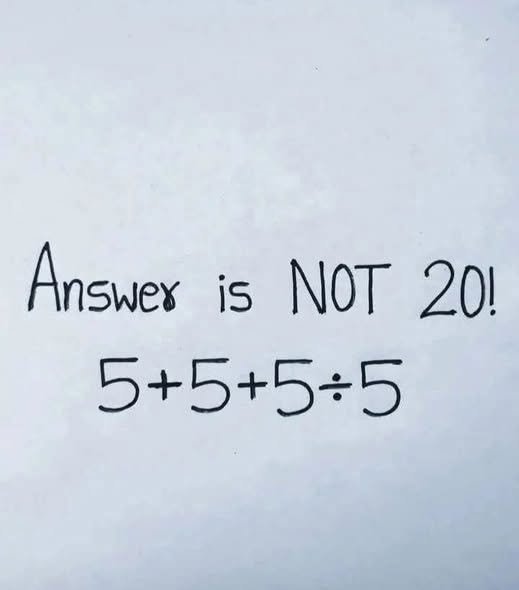
Math puzzles have a way of making us question everything we thought we knew about numbers. A simple equation written on a piece of paper has been circulating online, and it has sparked heated debates among friends, family members, and even math teachers. The puzzle reads: 5 + 5 + 5 ÷ 5. At first glance, it looks like a straightforward addition problem. But there is a trick hidden in plain sight, and most people get it wrong. Can you solve it without falling for the trap?
The Most Common Mistake
When most people look at this equation, they read it from left to right. They see 5 + 5, which equals 10. Then they add another 5, which equals 15. Finally, they add 5 ÷ 5, which they might mistakenly calculate as 5, giving them a total of 20. This is the answer that the puzzle warns against. The note at the top says, “Answer is NOT 20!” This is a clue that the solution requires a different approach.
The Correct Way to Solve It
The key to solving this puzzle is to remember the order of operations, often taught using the acronym PEMDAS or BODMAS. This rule tells us the sequence in which we should perform mathematical operations. The order is: Parentheses, Exponents, Multiplication and Division (from left to right), and Addition and Subtraction (from left to right).
In this equation, there are no parentheses or exponents. The operations are addition and division. According to the order of operations, division must be performed before addition. So, the first step is to solve 5 ÷ 5, which equals 1. Now the equation becomes 5 + 5 + 1. When you add these together, you get 11. The correct answer is 11, not 20.
Why This Puzzle Is So Tricky
This puzzle is a classic example of how our brains can be tricked by the way information is presented. When we see numbers arranged in a line, we naturally want to read them from left to right, just like we read words. This is called the “left-to-right bias.” It is a common cognitive shortcut that helps us process information quickly, but it can lead us to the wrong answer when mathematical rules are involved.
The puzzle also plays on the fact that many people forget the order of operations after they leave school. It is a rule that is easy to learn but even easier to forget, especially if you do not use it regularly. By presenting the equation in a simple, handwritten style, the puzzle lulls you into a false sense of confidence. You think you know the answer, but you are actually falling for the trick.
How to Avoid Falling for Math Tricks
If you want to get better at solving math puzzles, there are a few simple steps you can take. First, always write down the equation and identify the operations involved. This helps you see the problem clearly and avoid rushing to an answer. Second, always apply the order of operations. If you are unsure, use a pencil and paper to work through it step by step. Third, do not trust your first instinct. If an answer seems too easy, it probably is. Take a moment to double-check your work.
Other Common Math Puzzles
This type of puzzle is part of a long tradition of math brain teasers. Other popular examples include the “missing dollar” riddle, the “how many triangles do you see” puzzle, and the “what is the next number in the sequence” challenge. These puzzles are not just fun. They also help keep your brain active and improve your problem-solving skills. They remind us that math is not just about numbers. It is about logic, reasoning, and paying attention to details.
Final Thoughts
So, the next time you see a math puzzle that looks too simple, do not fall for the trick. Remember the order of operations, take your time, and think carefully. The answer to 5 + 5 + 5 ÷ 5 is 11, not 20. If you got it right, congratulations. Your math skills are sharp. If you got it wrong, do not worry. This puzzle tricks most people. Share it with your friends and family and see how many of them get it right. It is a fun and simple way to challenge your brain and learn something new.