Decoding the Car Sticker: The Fascinating Science Behind the Rubin Vase Optical Illusion
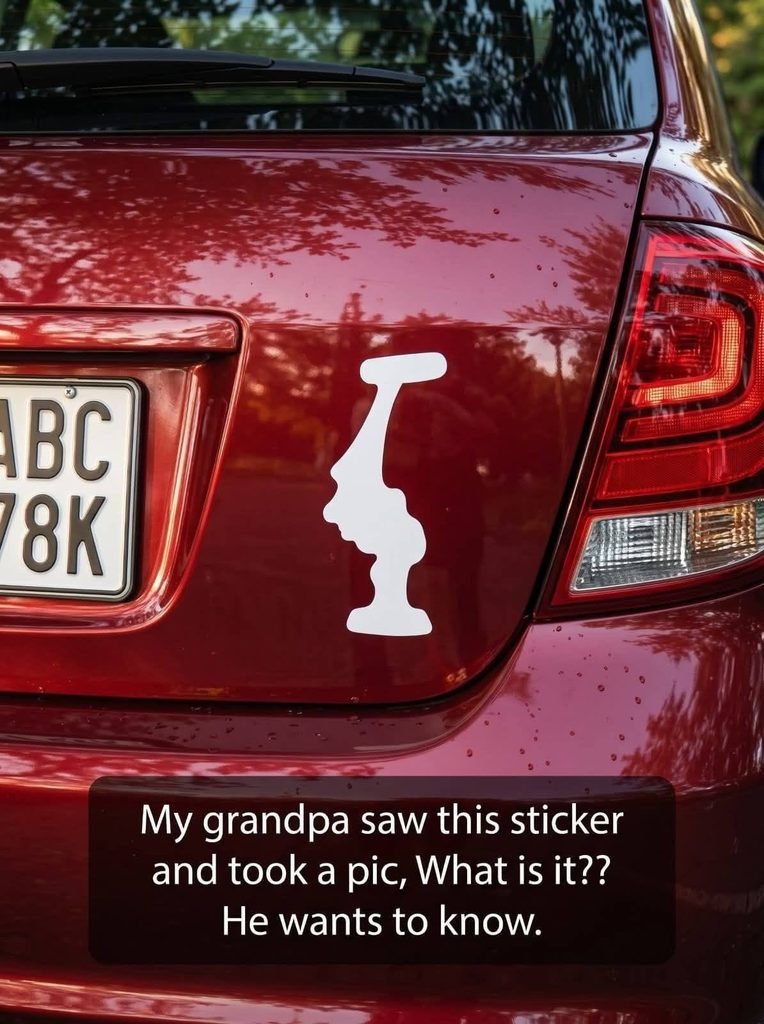
When a curious grandfather spotted a strange white silhouette on the back of a red car, he snapped a photo and asked a simple, honest question: “What is it?” The image features a peculiar white shape against the glossy red backdrop of a vehicle’s trunk, flanked by a l highly specific, obscure logo for a brand he had never encountered.
His confusion is entirely understandable, and he is far from alone. The image has sparked countless debates and queries across social media platforms. However, the answer is far more intriguing than any secret society symbol or hidden corporate logo. What the grandfather captured is a brilliant and famous psychological illustration known as the Rubin Vase, also referred to as the Rubin face-vase illusion.
This visual trick is not a modern internet creation; it is a classic of psychological literature, dating back over a century. It is designed to demonstrate the complexities of human visual perception, specifically how our brain
s organize the world into objects and backgrounds. This comprehensive guide will unpack the mystery behind the sticker. We will explore the history of the illusion, the neuroscience behind why our brains perceive it the way we do, its significance in psychology and design, and why this particular image continues to fascinate and confound people decades after its creation.
What Is the Rubin Vase Illusion?
At its core, the Rubin Vase is a two-dimensional drawing that is deliberately engineered to be ambiguous. It is an optical illusion that utilizes negative space to create a secondary, equally valid image. When you look at the sticker, your brain is presented with two distinct interpretations of the exact same visual data:
A White Vase: If you focus your attention on the white shape in the center of the sticker, treating the red car paint as the background, you will likely see a symmetrical vase, a chalice, or a candlestick.
Two Faces in Profile: Alternatively, if you shift your visual focus to the red spaces flanking the white shape, the red becomes the foreground, and the white shape becomes the background. Suddenly, you see two human faces looking directly at each other, their noses almost touching.
The brilliance of the illusion lies in its inability to be seen both ways simultaneously. While you can rapidly switch between seeing the vase and seeing the faces, your brain cannot hold both interpretations at the exact same moment. It forces you to choose one perspective at a time, creating a fascinating “flip-flop” effect in your visual perception.
The Grandfather’s Confusion Explained
It is entirely understandable why someone unfamiliar with psychological literature would be baffled by this image. Without the context of visual psychology, the brain initially struggles to categorize the shape. It lacks the typical visual cues—like shading, context, or recognizable three-dimensional features—that usually help us determine what is an object and what is its background.
When the grandfather looked at the sticker, his visual system had to resolve the ambiguity. Depending on whether he focused on the white shape or the red negative space first, he might have seen the vase or the faces. Because the brain naturally seeks a single, stable interpretation to make sense of the environment, the constant flipping back and forth can feel jarring, leading to the question: “What is it?”
The Psychology of Perception: Figure-Ground Organization
To fully understand the Rubin Vase, we must delve into the field of Gestalt psychology. Developed in the early twentieth century in Germany, Gestalt psychology is a school of thought that looks at human minds and behavior as a whole. The word “Gestalt” roughly translates to “form” or “shape.” The central tenet of Gestalt psychology is that people do not simply piece together individual elements of a scene; instead, we perceive entire structures or wholes.
One of the key principles of Gestalt psychology is figure-ground organization. This is the cognitive ability to separate an object (the figure) from its surroundings (the ground). It is an essential survival mechanism. Without the ability to distinguish a predator (the figure) from the bushes (the ground), an organism would not survive for long.
How the Brain Separates Figure from Ground
When you look at a typical photograph, your brain instantly categorizes the elements. A person standing in front of a brick wall is the figure; the brick wall is the ground. The figure usually has a distinct shape, appears closer, and stands out from the background.
In the Rubin Vase illusion, these visual cues are deliberately stripped away. There are no depth cues, no shading, and no distinct edges that belong exclusively to one image. The contour line—the boundary between the white and the red—is shared by both the vase and the faces. This shared edge is known as a “contour rivalry.” Because the edge belongs to both potential images, the brain must decide which area constitutes the figure and which area recedes into the background.
Bistable Perception
When the visual system is presented with an ambiguous image like the Rubin Vase, it enters a state known as bistable perception. This means the brain perceives the image as two stable states, but cannot integrate them into a single, unified picture.
Research using brain imaging techniques has shown that different parts of the visual cortex are activated depending on whether you are seeing the vase or the faces. When you perceive the faces, there is increased activity in the fusiform face area (FFA), a region of the brain specialized for recognizing faces. When you perceive the vase, other visual processing areas take over. The constant flipping between the two images is a result of the brain’s visual system trying to find the most coherent and stable interpretation of the available data.
The History and Origins of the Rubin Vase
The illusion is named after the Danish psychologist and phenomenologist Edgar Rubin. Rubin introduced the figure-ground illusion in 1915 in his two-volume book, Synsoplevede Figurer (Visually Experienced Figures). It was groundbreaking work that formed part of the foundation of Gestalt psychology.
Rubin used the image to illustrate his theories on visual perception. He argued that visual perception is not a passive process where the eye simply receives information and sends it to the brain. Instead, it is an active, constructive process where the brain actively organizes sensory input into meaningful patterns.
Interestingly, while Rubin is credited with bringing the illusion into the realm of psychology, variations of the image have appeared throughout history. The concept of an ambiguous image that can be seen as two different things was explored in art and design long before the twentieth century. However, Rubin’s specific black-and-white rendering became the standard textbook example of figure-ground organization, cementing its place in the annals of psychology.
Why It’s Called “Rubin’s Vase”
The image is most commonly referred to as “Rubin’s Vase.” This name stems from the fact that the central white shape resembles a classic, symmetrical vase or a chalice. However, it is also frequently called “Rubin’s Face” or the “Rubin Face-Vase” because the most common alternative interpretation is two faces in profile.
Other Famous Bistable Illusions
The Rubin Vase is not alone in the world of ambiguous images. It belongs to a broader category of optical illusions that demonstrate the fascinating ways our brains can be tricked. Exploring these related illusions helps contextualize the Rubin Vase and demonstrates the universality of bistable perception.
The Duck-Rabbit Illusion
Another classic example of bistable perception is the duck-rabbit illusion. This drawing can be interpreted as either a duck facing left or a rabbit facing right. It was originally published in a German humor magazine in 1892, before being featured in a famous essay by the philosopher Ludwig Wittgenstein in his Philosophical Investigations.
My Wife and My Mother-in-Law
This famous illusion, popularized in the early twentieth century, shows a young woman looking away over her right shoulder, or an old woman with a large nose looking down and to the left. The young woman’s ear is the old woman’s eye, and the young woman’s necklace is the old woman’s mouth. It is a masterclass in how the brain interprets facial features based on context.
The Necker Cube
The Necker Cube is a line drawing of a cube with no depth cues. Because it lacks shading and perspective lines, the brain can perceive it as either pointing downward and to the left, or upward and to the right. It was first published by the Swiss crystallographer Louis Albert Necker in 1832 and has been a staple of perceptual psychology ever since.
Why the Sticker Matters: Practical Applications of Figure-Ground
While the Rubin Vase is often treated as a psychological curiosity, the principles it demonstrates have real-world applications. Understanding figure-ground organization is crucial in several fields.
Graphic Design and Branding
Graphic designers regularly use figure-ground principles to create clever and memorable logos. A famous example is the FedEx logo, which features a hidden arrow in the negative space between the letters ‘E’ and ‘x’. This arrow subconsciously reinforces the company’s brand promise of speed and forward momentum.
Another classic example is the Spartan Golf Club logo, which depicts the side profile of a Spartan warrior’s helmet. However, the negative space of the helmet forms the silhouette of a golfer swinging a club. These designs work because they rely on the viewer’s brain to actively resolve the figure-ground relationship, making the logo more engaging.
User Interface (UI) and User Experience (UX) Design
In digital design, figure-ground organization is vital for usability. Designers must ensure that interactive elements, such as buttons and menus, clearly stand out from the background. If the figure-ground relationship is too ambiguous, users will struggle to navigate a website or application.
By using contrasting colors, shadows, and distinct shapes, designers can manipulate the visual hierarchy and guide the user’s attention to the most important elements on a page. The Rubin Vase serves as a cautionary tale for designers: if you make the background as visually interesting as the foreground, you might confuse your audience.
Art and Visual Storytelling
Artists like M.C. Escher were masters of figure-ground manipulation. Escher’s works, such as Sky and Water I and Day and Night, use shared contours and shifting perspectives to create intricate, mesmerizing patterns where the background seamlessly becomes the foreground, and vice versa.
The Curious Debate: Are There Secret Meanings Behind the Sticker?
When an image goes viral, as the photo of the bumper sticker has done, there is often a tendency for people to search for hidden meanings. Conspiracy theories, secret society symbols, or obscure pop culture references are frequently attached to ambiguous images.
The white sticker in the photograph is a literal representation of the Rubin Vase. It is highly unlikely to be a secret gang sign, a hidden political statement, or a coded message. It is simply an individual’s choice to display a piece of classic psychological art on their vehicle. People put stickers on their cars for a variety of reasons: to express their personality, to share a joke, or simply because they find a design visually appealing. The person who placed this sticker on their car likely has an interest in psychology, art, or clever visual illusions.
Tips for Seeing Both Images in the Rubin Vase
If you are struggling to see both the vase and the faces in the sticker, you are not alone. Many people naturally fixate on one interpretation and have difficulty shifting their perception. Here are a few tricks to help your brain flip between the two images:
Focus on the Negative Space: Instead of looking at the white shape, try to focus your eyes on the red areas on the left and right. Try to imagine the red car paint as being in front of the white sticker.
Blur Your Vision: Sometimes, squinting or blurring your focus can help your brain stop over-analyzing the details and grasp the broader shapes.
Look at the Edges: Trace the outline of the white shape with your eyes. As you trace, see if you can interpret the line as the profile of a face, starting from the forehead, down the nose, lips, and chin.
Shift Your Gaze: Look slightly away from the center of the sticker. Sometimes, peripheral vision can help the brain pick up on the alternative interpretation.
The Fascination with Ambiguity
The popularity of the Rubin Vase sticker highlights a fundamental aspect of human psychology: we are deeply fascinated by ambiguity. Our brains are wired to make sense of the world, to categorize and label everything we encounter. When we are presented with something that defies easy categorization, it creates a momentary cognitive dissonance that is both frustrating and intriguing.
When the grandfather took a picture of the sticker, he was engaging in a natural human instinct to seek understanding. By asking “What is it?”, he was trying to resolve the visual ambiguity. The answer—that it is a classic optical illusion—is satisfying because it provides context and explains why the image looks the way it does.
Conclusion
The white sticker that sparked a grandfather’s curiosity is far more than just a random car decal. It is a timeless piece of visual psychology. The Rubin Vase is a brilliant demonstration of how our brains construct our reality. It shows us that perception is not a passive recording of the world, but an active process where the brain constantly makes decisions about what to focus on and what to ignore.
Whether you see a serene white vase or two faces locked in an eternal stare, the Rubin Vase reminds us of the complexity of the human visual system. It is a delightful reminder that sometimes, the most interesting things are found not in what is explicitly drawn, but in the spaces in between. So, the next time you see an ambiguous image on a car bumper or a poster, take a moment to appreciate the incredible cognitive machinery that allows you to see the world in all its multifaceted wonder.
Frequently Asked Questions
What exactly is the sticker in the picture?
The sticker is a reproduction of the Rubin Vase (or Rubin Face-Vase), a classic optical illusion developed by Danish psychologist Edgar Rubin in 1915. It is designed to be visually ambiguous, allowing the viewer to see either a white vase in the center or two human faces in profile looking at each other.
Is the sticker a secret symbol or a gang sign?
No. The image is a well-known psychological illustration used in textbooks and classrooms to explain how the brain processes visual information (figure-ground organization). It has no connection to secret societies, gangs, or hidden codes.
Why can I only see one image at a time?
This is due to a psychological phenomenon called bistable perception. Your brain’s visual system naturally seeks to organize what it sees into a distinct “figure” (the object you are looking at) and “ground” (the background). Because the image provides equal visual weight to both the white shape and the red negative space, your brain must choose one interpretation at a time.
Who created the Rubin Vase?
The illusion was created by Edgar Rubin, a Danish psychologist, in 1915. He used it to illustrate his theories on figure-ground perception, which became a foundational concept in Gestalt psychology.
How can I train my eyes to see both images?
Try focusing on the negative space—look at the red areas flanking the white shape and imagine them as the foreground. You can also try tracing the outline of the white shape with your eyes, interpreting the curves as the profile of a human face. Squinting or looking slightly away from the center can also help shift your perception.
Are there other famous optical illusions like this?
Yes. Other famous bistable illusions include the Duck-Rabbit illusion (which can look like a duck or a rabbit), the Necker Cube (a wireframe cube that can be seen from two different angles), and the My Wife and My Mother-in-Law illusion (which depicts a young woman or an old woman depending on how you look at it).
Why do people put this specific sticker on their cars?
People choose car stickers for many reasons. This specific sticker is likely chosen because the owner finds optical illusions interesting, appreciates psychology, or simply enjoys having a visual puzzle that makes people stop and think. It serves as a fun conversation starter.
Does this illusion have any practical use in the real world?
Yes. Understanding figure-ground organization is crucial in graphic design, UI/UX design, and art. Designers use these principles to create legible logos (like the hidden arrow in the FedEx logo) and intuitive user interfaces by ensuring that interactive elements stand out clearly from the background.