Can You Spot the Hidden Mistake That 93% of People Miss?
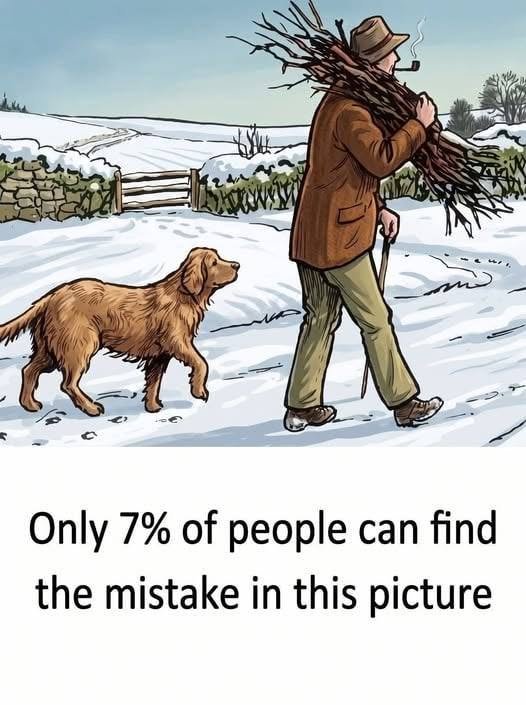
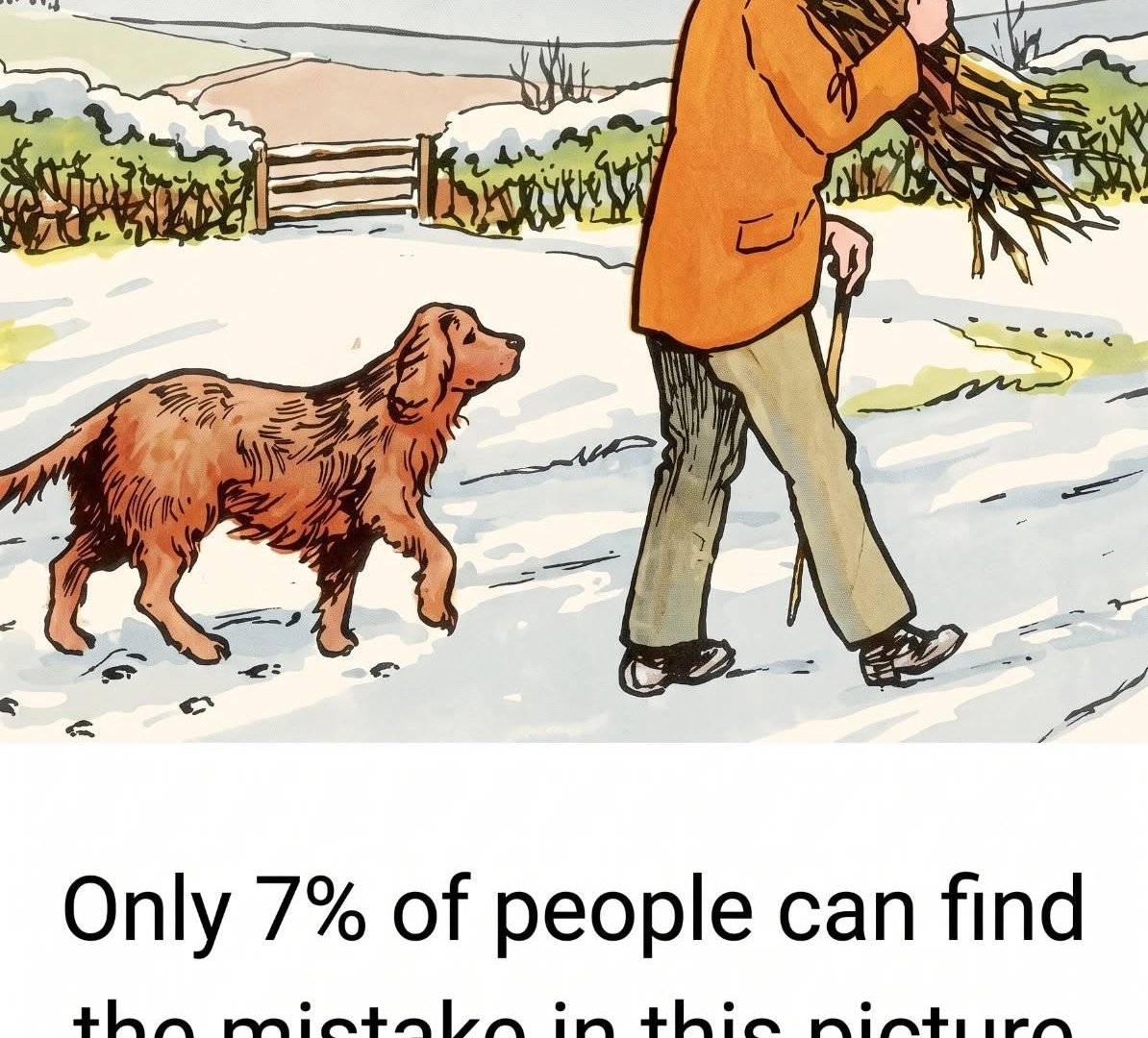
Visual puzzles and optical illusions have a unique way of captivating the internet. They tap into our innate human desire to solve mysteries, test our perception, and prove that we possess a sharp eye for detail. The image currently sweeping across social media platforms features a seemingly idyllic winter scene: a man walking his dog through a snowy landscape, carrying a bundle of wood, and smoking a pipe. The bold text at the bottom challenges the viewer: “Only 7% of people can find the mistake in this picture.”
At first glance, the illustration appears perfectly normal. It evokes a sense of rustic tranquility, reminiscent of a classic holiday card or a storybook illustration. However, as with all great visual puzzles, there is a glaring logical inconsistency hidden in plain sight. The human brain is an incredibly efficient processing machine, but its efficiency relies heavily on taking shortcuts. It fills in the blanks based on expectations and past experiences. This is why millions of people can look at this image and completely miss a detail that, once pointed out, becomes impossible to unsee.
This comprehensive guide will walk you through the process of solving this viral puzzle. We will break down the visual elements of the scene, reveal the primary mistake hidden in the snow, and explore several other subtle anomalies that make this image so fascinating. Furthermore, we will delve into the psychology of visual perception to understand exactly why our brains are so easily fooled. By the end of this article, you will not only know the answer, but you will also have a deeper appreciation for the complex, and sometimes flawed, way we see the world.
The Anatomy of a Visual Puzzle
To understand the puzzle, we must first look at the composition of the image. The artist has deliberately created a scene that is visually rich but logically flawed. The eye is immediately drawn to the main subjects: the man and the dog.
The Man
The man is walking from the left side of the image toward the right. He is dressed for cold weather, wearing a brown jacket, green trousers, a hat, and sturdy shoes. He is carrying a large, heavy bundle of branches or sticks over his right shoulder and is using a wooden walking stick in his left hand. He has a pipe in his mouth, with a thin trail of smoke drifting upward.
The Dog
Walking slightly ahead and to the left of the man is a golden-colored dog, likely a retriever. The dog’s posture is alert, and its tail is wagging or held up. It appears to be walking in the same direction as the man, toward the right side of the frame.
The Environment
The background features a quintessential winter landscape. The ground is covered in a thick layer of white snow. In the background, there is a low stone wall with a wooden gate. Bare trees and a pale blue sky complete the scene. Crucially, the snow is not pristine; it is marked by the footprints of both the man and the dog.
Revealing the Primary Mistake: The Impossible Footprints
The most glaring mistake in the image lies in the footprints left in the snow. Once you see it, the entire scene shifts from a realistic illustration to a surreal, impossible puzzle.
The Direction of Travel
Take a close look at the man’s stance. His body is angled toward the right. His left foot is planted firmly on the ground, and his right foot is lifted behind him in mid-stride. The toe of his left shoe is pointing toward the right edge of the image. Everything about his posture indicates he is moving forward, toward the right.
The Direction of the Tracks
Now, look at the footprints directly behind the man and under his feet. The tracks clearly show the heel and the toe of the shoe. The heel is on the right side, and the toe is pointing toward the left. This means the footprints are pointing in the exact opposite direction of where the man is walking.
If he were walking forward, the toe of his shoe would create a deeper impression at the front, and the tracks would point to the right. Instead, the tracks look as though he has been walking backward from the right side of the image toward the left. The same anomaly applies to the dog’s tracks. The dog is walking right, but the paw prints in the snow are oriented toward the left.
The Subconscious Expectation
Why do we miss this? When we look at the image, our brain immediately categorizes the scene: “Man walking dog in snow.” We see the footprints and assume they belong to the man and the dog. We do not automatically check the orientation of the footprints against the direction of travel. The brain accepts the footprints as a “background” element and focuses on the “foreground” action. The artist relies on this cognitive shortcut to hide the error.
Other Anomalies and Hidden Details
While the footprints are the most prominent mistake, a closer inspection reveals several other bizarre anomalies that suggest this image may be AI-generated or intentionally drawn with multiple errors to frustrate the viewer.
1. The Contradictory Wind
Look at the smoke coming from the man’s pipe. The smoke is drifting forward, toward the right side of the image, indicating a wind blowing from left to right. Now, look at the dog’s fur and tail. The fur on the dog’s back and its tail appear to be blowing backward, toward the left. This implies a wind blowing from right to left. You cannot have the wind blowing in two opposite directions simultaneously in the same open landscape.
2. The Three-Legged Dog
Examine the dog’s legs closely. In a natural walking stride, a dog should have four legs visible, or at least three distinctly placed legs. However, the dog in the image appears to have a front leg, a back leg, and another leg seemingly sprouting from the middle of its body. The anatomy of the legs is physically impossible, creating a bizarre, tripod-like structure.
3. The Man’s Left Hand
Look at the man’s left hand holding the walking stick. The way the fingers wrap around the stick is anatomically incorrect. The thumb appears to be on the wrong side of the hand. If he is holding the stick from the left, the thumb should wrap around the front of the stick, pointing toward his body. Instead, the thumb is on the outside, making the hand look backwards or unnatural.
4. The Walking Stick
The walking stick in the man’s hand extends down to the snow, but there is no footprint or indentation in the snow directly beneath it. It appears to be hovering just above the surface, leaving no mark.
The Psychology of Visual Illusions: Why We Miss the Obvious
To understand why 93% of people miss the mistake, we must look at the fascinating science of human perception. The eye does not function like a camera, capturing every detail with perfect accuracy. Instead, it sends signals to the brain, which then interprets those signals based on context, expectation, and memory.
Top-Down Processing
The brain uses a process called “top-down processing” to make sense of the world. This means it uses prior knowledge and context to fill in the gaps of what we are seeing. When we look at this image, we see a snowy scene, a man, and a dog. Our brain immediately activates a script for this scenario. We expect to see footprints behind them, so our brain registers the presence of footprints without closely analyzing their direction.
Inattentional Blindness
Inattentional blindness is a psychological phenomenon where we fail to see an unexpected object or detail because our attention is focused on something else. In this puzzle, our attention is drawn to the man carrying the heavy load of wood and the dog walking in the snow. We are so focused on the main subjects that we fail to notice the logical inconsistencies in the background.
The “Gestalt” Effect
Gestalt psychology states that we perceive things as a whole rather than as a sum of their parts. We see a “man walking a dog,” not a collection of shapes, colors, and lines. Our brain creates a coherent narrative that overrides the individual details. If a detail does not fit the narrative (like the footprints facing the wrong way), the brain often ignores it or rationalizes it away.
The Rise of AI-Generated Puzzles
The specific type of logical inconsistencies seen in this image—the bizarre anatomy, the contradictory shadows, the impossible physics—are hallmarks of AI-generated imagery. Artificial intelligence image generators (like Midjourney, DALL-E, or Stable Diffusion) do not understand the world in the way humans do. They do not know that footprints must point in the direction of travel or that wind must blow in one direction. They are simply predicting patterns of pixels based on their training data.
This often results in images that look highly realistic at a glance but fall apart upon closer inspection. The viral success of these images relies on the “uncanny valley” effect—they look almost right, but something feels subtly off. When the creator adds a caption like “Only 7% can find the mistake,” it creates a viral loop. People stare at the image, fail to see the mistake, read the comments, and then share it to test their friends.
How to Improve Your Visual Observation Skills
While this puzzle is just for fun, the skills it requires are highly valuable in everyday life. Here are a few ways to train your brain to be more observant.
1. Slow Down
The most common reason we miss details is that we are moving too fast. When presented with a puzzle or a new environment, take a moment to pause. Resist the urge to immediately jump to a conclusion.
2. Scan Systematically
Instead of letting your eyes wander randomly, scan the image methodically. Start at the top left, move across to the right, and then work your way down. Look at foregrounds, backgrounds, and the spaces between objects.
3. Question Everything
Do not take anything for granted. If a shadow looks odd, ask yourself why. If a footprint is facing the wrong way, investigate it. Cultivate a sense of curiosity and a healthy skepticism of what you are seeing.
4. Look Away and Look Back
Sometimes, staring at an image for too long causes eye strain and mental fatigue. Look away for 10 seconds, then look back. The sudden shift in perspective can sometimes help you spot the anomaly that your brain was previously ignoring.
Conclusion: The Beauty of Seeing the Impossible
The viral winter puzzle is a brilliant example of how easily the human mind can be tricked. The image of the man, the dog, and the snowy landscape is a masterclass in misdirection. By presenting us with a familiar, comforting scene, the artist (or AI) tricks our brains into ignoring the glaring logical errors hidden in the details.
The impossible footprints—pointing left while the man walks right—are the key to solving the puzzle. But the other anomalies, from the contradictory wind to the three-legged dog, make this image a fascinating study in visual chaos. Whether you saw the mistake immediately or had to read through this article to find it, the experience is a powerful reminder of the limits of human perception. Our eyes are remarkable organs, but it is our brains that truly do the seeing. And sometimes, our brains need a little help looking past the obvious to find the hidden truth.
Frequently Asked Questions
What is the mistake in the viral winter picture?
The primary mistake is that the footprints in the snow are pointing in the opposite direction of the man and the dog. The man is walking to the right, but his footprints and the dog’s paw prints are oriented toward the left.
Are there other mistakes in the picture?
Yes, several other anomalies exist. The smoke from the man’s pipe is blowing forward, while the dog’s fur is blowing backward, indicating contradictory wind directions. Additionally, the dog appears to have an impossible leg structure, and the man’s left hand holding the walking stick is anatomically incorrect.
Why do only 7% of people find the mistake?
The “7%” claim is a viral marketing tactic. In reality, many people miss the mistake due to a psychological phenomenon called “inattentional blindness.” Our brains focus on the main subjects (the man and the dog) and ignore background details, assuming that the footprints follow the direction of travel.
Is this image AI-generated?
It is highly likely. The bizarre anatomical errors, the contradictory physics of the wind, and the illogical footprints are all classic hallmarks of AI-generated imagery. AI models predict patterns but do not understand real-world logic.
What does the image show?
The image shows a man in winter clothing carrying a bundle of wood on his back and a walking stick in his hand, walking through a snowy landscape with a golden retriever dog.
How can I train myself to spot these mistakes?
To improve your observation skills, try to scan images systematically (e.g., top to bottom, left to right). Slow down your perception, question the details that seem unusual, and try looking away and back to reset your visual focus.
Why is the smoke blowing in a different direction than the dog’s fur?
It is a logical error in the drawing. In a real scene, the wind would blow the smoke and the fur in the same direction. This contradiction is one of the subtle clues that the image is not a real photograph.